Key Takeaways
Understanding the nuances of AI can be difficult, but not knowing the difference can put your business in tech debt.
The next step in AI development is hybrid neuro-symbolic models that simulate human-like common-sense interpretation of data.
AI is here to stay.
Which means the confusion about the differences between machine learning, deep learning and generative AI? It’s got to go.
AI tools have become commonplace. Over 92% of companies are planning to increase their investment in AI going forward. Whether you are hiring new staff with knowledge of the latest AI tools or just adding a new tool to your business, you need to know the basics.
But all this technical jargon makes things more puzzling. What even is deep learning, machine learning or generative AI? Are they all models? Techniques? Systems? Tools?
When you don’t know these differences, claims like how tech can automate up to 57% of the working hours of US employees can sound like a hoax. But it is achievable if you know what you are dealing with.
So, here’s an easy guide that simplifies the key differences between generative AI and deep learning.
Generative AI vs Deep Learning: Key Differences
Technical AI terms are confusing, but understanding the relationship between the different subsets of AI is a whole other maze.
For starters, both generative AI and deep learning are AI-related terms for a learning process, but generative AI is a specialized subset of deep learning.
Deep learning is a method, generative AI is a specific use case of deep learning.
So while all generative AI uses deep learning, not all deep learning needs or is used for generative AI purposes.
To identify what you are dealing with, here’s a list of things to look out for:
Classification
Deep learning frameworks aim to create AI tools. The primary function is to learn datasets through layers of artificial neural networks and aid in building tools.
Generative AI aims to create. It can generate new images, videos or text based on its data training.
Data Requirements
Deep learning tools and frameworks need high-quality labeled data to perform accurately. This means training deep learning models requires expert data annotators.
Generative AI, on the other hand, can work with both labeled and unlabeled data. The only requirement is that it is trained on structured, niche-specific and accurate data.
Read More: Data Labeling Outsourcing: Use Cases, Types & Benefits
Outputs
Deep learning is a stepping stone to creating all kinds of AI models, from computer vision to natural language processing tools. Deep learning models are used for predictive analysis. They can interpret new data and predict results based on the data they are trained on.
Generative AI is primarily used for content creation.
Read More: Craft High-Quality Content With a Content Writing Virtual Assistant
But First: Machine Learning vs Deep Learning vs Generative AI
Instead of jumping in midway, let’s start from the top.
To get the full picture of what deep learning and generative AI are, you first need to know what machine learning is.
Machine learning is a crucial branch of the field of artificial intelligence. It is what allows AI models to learn from data and make accurate predictions. Machine learning works on algorithms that are trained on specific data. Any new input that enters the algorithm helps recognize patterns and continue to learn.
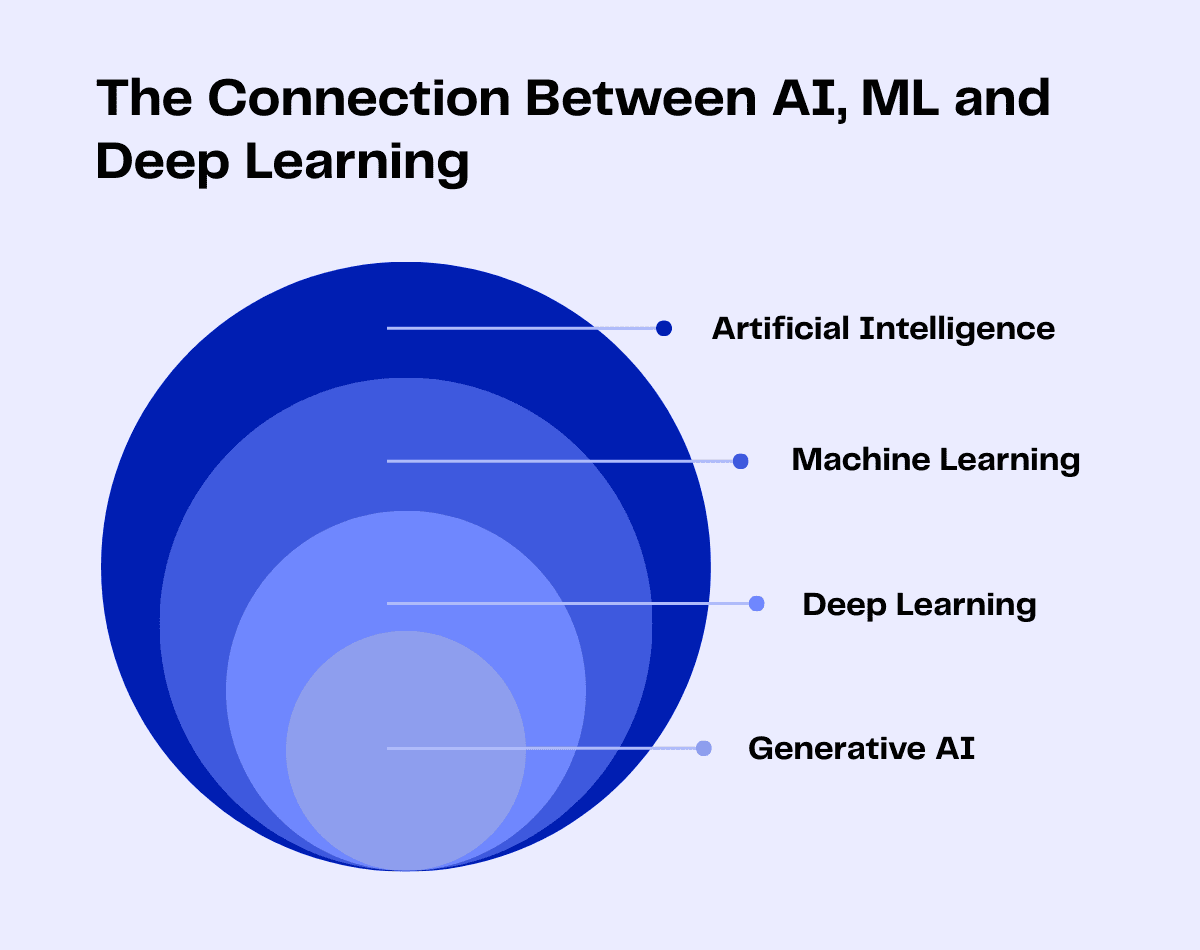
In this context, deep learning is a further specialized subdivision of machine learning. Deep learning also enables AI models to learn from data for predictive analysis, but instead of algorithms, it relies on something called neural networks.
An even more specific subsection of deep learning is generative AI. Instead of being a method to teach models, it’s the application of these methods for original content creation.
A Deeper Look Into Deep Learning
When everything is so deeply connected, it can be very easy to confuse which tool plays what part.
For example, on the surface, both deep learning and machine learning tools use data sets to identify and predict accurate outcomes. But how they achieve it is quite different.
Knowing the difference can ensure you are choosing the right tool to solve the problem you have.
How Deep Learning Works
Deep learning is actually a subset of machine learning and runs on layers—a minimum of four—of artificial neural networks. Every “neuron” is a mathematical operation and layering multiple networks allows complex data interpretation.
When you insert your data, it passes through layers of neural networks that identify patterns and weigh connections through rounds of internal validations. The model learns from previous mistakes and mitigates errors to boost output accuracy.
Essentially, deep learning allows AI models to learn patterns based on data that passes through the layers to produce accurate predictions and classifications.
What Deep Learning Is Used For
Deep learning’s primary goal is to process data.
But the end goal can differ from tool to tool. Here’s what you can create with deep learning frameworks:
Computer Vision tools: Using Convolutional Neural Networks (CNNs), AI models can be created for object recognition. This is essential for small apps and machines like self-driving cars, medical imaging, facial recognition systems and camera filters.
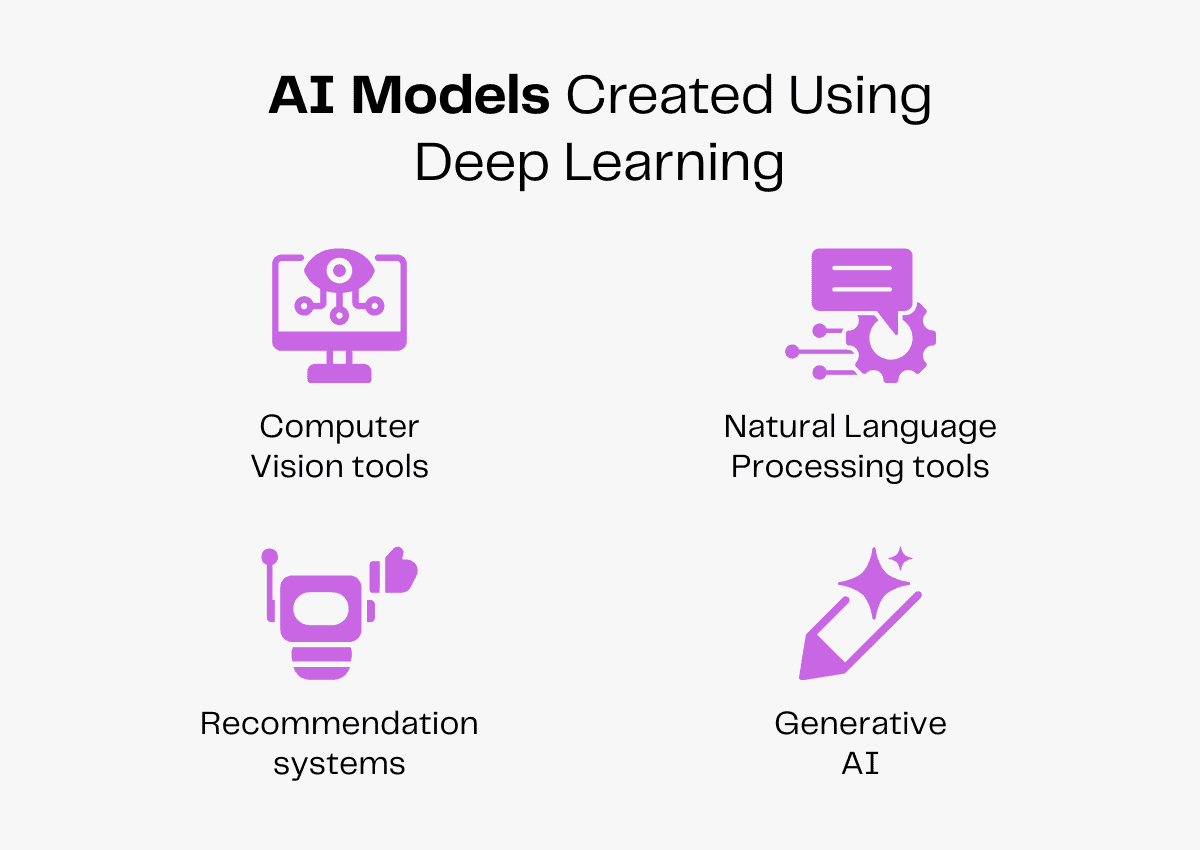
Natural Language Processing tools: Transformers and Recurrent Neural Networks (RNNs) can help create applications that can understand and create human language content. Think of applications like voice assistants, translation tools, chatbots and more.
Recommendation systems: Neural Collaborative Filtering (NCF) helps create high-functioning recommendation systems that go beyond suggesting similar content but content based on user interactions. This can be especially useful in fields such as entertainment, finance, marketing and e-commerce, which rely heavily on user behavior and purchase patterns.
Generative AI tools: Generative Adversarial Networks (GANs) can be used to create generative tools. These tools create original content based on existing data. Tools like ChatGPT, Midjourney and Veo 3 are all generative tools.
Read More: 30 Useful Virtual Assistant Tools and Software in 2026
Pros and Cons of Using Deep Learning
One of the biggest mistakes people make when learning about AI is focusing on all its possibilities and none of its limitations.
To choose a model wisely, you need to know where it falls short. This helps you stay on top of any loopholes and pitfalls involved. So here are some pros and cons to consider before you start working with deep learning models:
| Pros | Cons |
|---|---|
| More efficient than traditional algorithms. | Costly development since it needs a large dataset to train and sustain it. |
| Can be used to process multiple data formats, including image, text, audio and video. | Hard to follow its patterns, which creates opaqueness around decision-making. |
| Its ability to generalize makes deep learning a robust system. | Not a beginner-friendly model and needs expert support. |
Pros:
- Increased efficiency: The layered architecture of the artificial neural networks automatically identifies patterns in the data, which reduces bottlenecks of manual feature engineering.
- Varied data: Deep learning models can be trained to work with large datasets with a wide range of formats, unlike some traditional algorithms. From images and text to audio and speech, it can identify different formats to provide accurate results.
- Robustness and generalization: Layering neural networks allows the AI system to generalize and continue functioning even if a neuron fails or goes missing. Simply put, small disconnects don’t lead to complete model failure.
Cons:
- Expensive resources: Deep learning models can be expensive, needing large datasets for creating, training and sustaining the layered architectures. Plus, they need quality GPUs and a memory-intensive computer to run.
- Lacks human-like reasoning: The layered networks can give accurate but opaque results. Since they can’t stimulate human-like causal decision-making, it can make decision accountability dubious.
Without question, deep learning is an imperfect model of intelligence. It cannot reason abstractly, does not understand causation and struggles with out-of-distribution generalization – Forbes
- Complex implementation: Deep learning models aren’t exactly beginner-friendly. To utilize these for your operations, you need AI & automation professionals with a learning mindset.
| Deep Learning | Generative AI | |
|---|---|---|
| Definition | A method that uses layers of neural networks to interpret data and make accurate predictions. | Application of deep learning to create original content based on the data on which the tool is trained. |
| How it Works | The layers of the neural networks learn patterns, which they use to sift through new data. | The tool interprets the prompt and uses a deep learning model to generate original content. |
| Use Cases | Discriminative: Models can be dedicated to tasks like object detection, content generation and predictive analysis. | Generative: Used only to create content, like images, studies, tests or videos. |
| Techniques | Convolutional Neural Networks (CNNs), Recurrent Neural Networks (RNNs), Generative Adversarial Networks (GANs), etc. | Autoregressive models, Diffusion models, Variational Autocoders (VAEs), etc. |
| Industries | Retail, Automation, Finance, Healthcare, etc. | Media and entertainment, Marketing, Manufacturing, etc. |
| Examples | TensorFlow, PyTorch, Keras, etc. | ChatGPT, DALL-E 3, Cluade, etc. |
A Deeper Look Into Gen AI
Just like deep learning is a specific subset of machine learning, generative AI is a specialized subset of deep learning.
Think of deep learning as an architecture and generative AI as a specific application of it.
It is one of the easiest tools to integrate with your remote teams. So it’s no surprise that the market for generative tools is growing and is projected to reach $91.57 billion by 2026.
How Gen AI Works
Using generative AI tools doesn’t require in-depth knowledge of their inner workings. Think of ChatGPT or Google Veo 3. You don’t need to know how they function to use them and they can be highly beneficial.
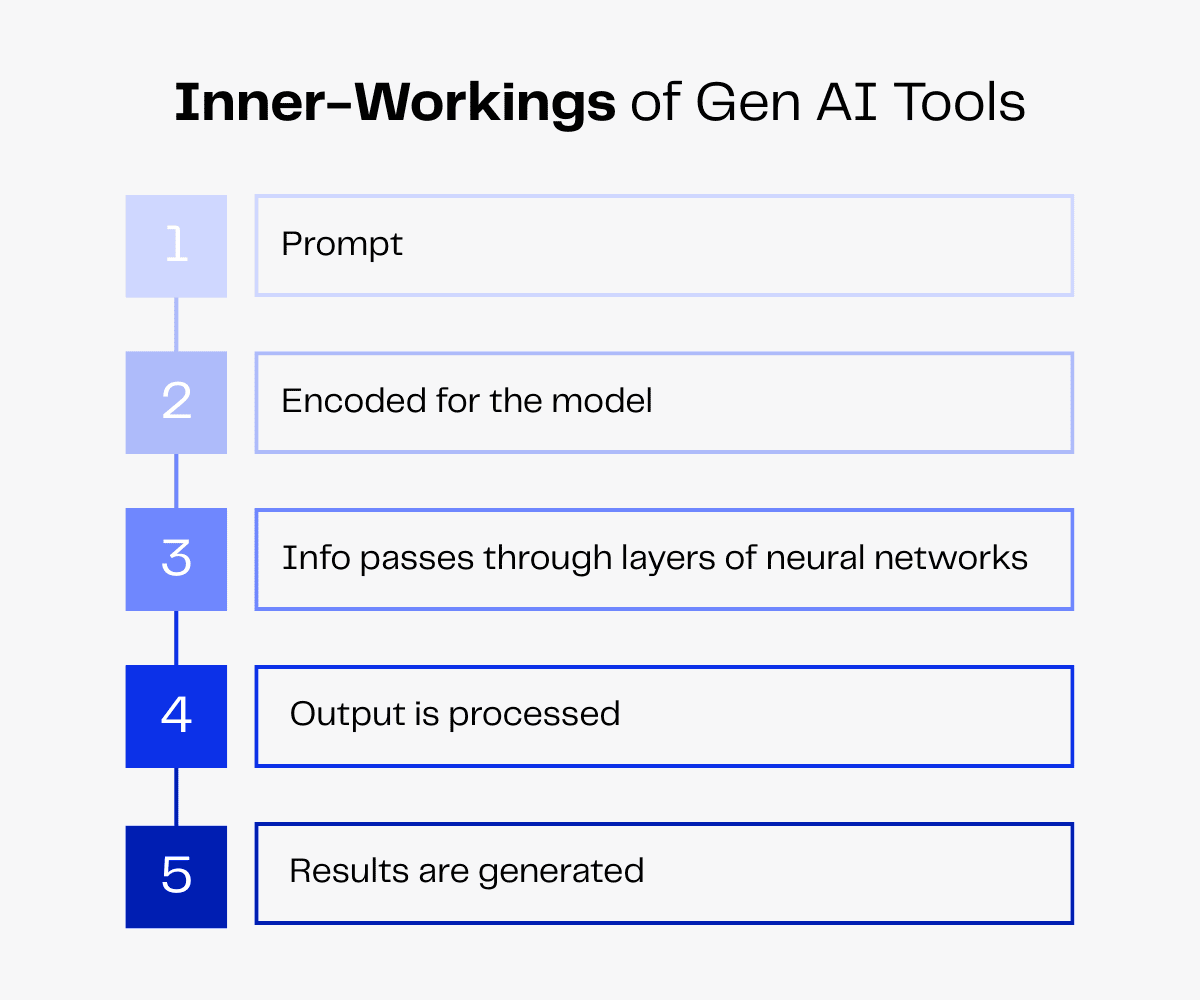
But to put it simply: generative AI uses neural networks to understand input/context and generate images, videos, texts or other types of content.
Your prompt is encoded into an input that the model can understand. The neural network then processes the information, allowing the tool to generate the output.
What Gen AI Is Used For
As the name suggests, generative AI generates content.
But it goes beyond just taking inputs. Generative AI can interpret inputs, leverage the data it is trained on and create original content. Based on the tool, it can create anything from text and images to audio and videos and even combine multiple formats.
In fact, with a combination of generative adversarial networks (GANs) and variational autoencoders (VAEs), Gen AI tools can generate realistic content.
Additionally, context-aware RAG is enhancing GenAI. It allows GenAI to refer to surrounding information like messages, user data and previous searches. This creates a larger context window, allowing the model to give smarter predictions and reduce silly errors like repeating answers.
Pros and Cons of Using Gen AI
Generative AI has slowly integrated itself into daily lives. By 2023, most people had already used some Gen AI tool at least once. The biggest reason for this is that, unlike deep learning, generative AI use is beginner-friendly.
Here are the pros of using Gen AI.
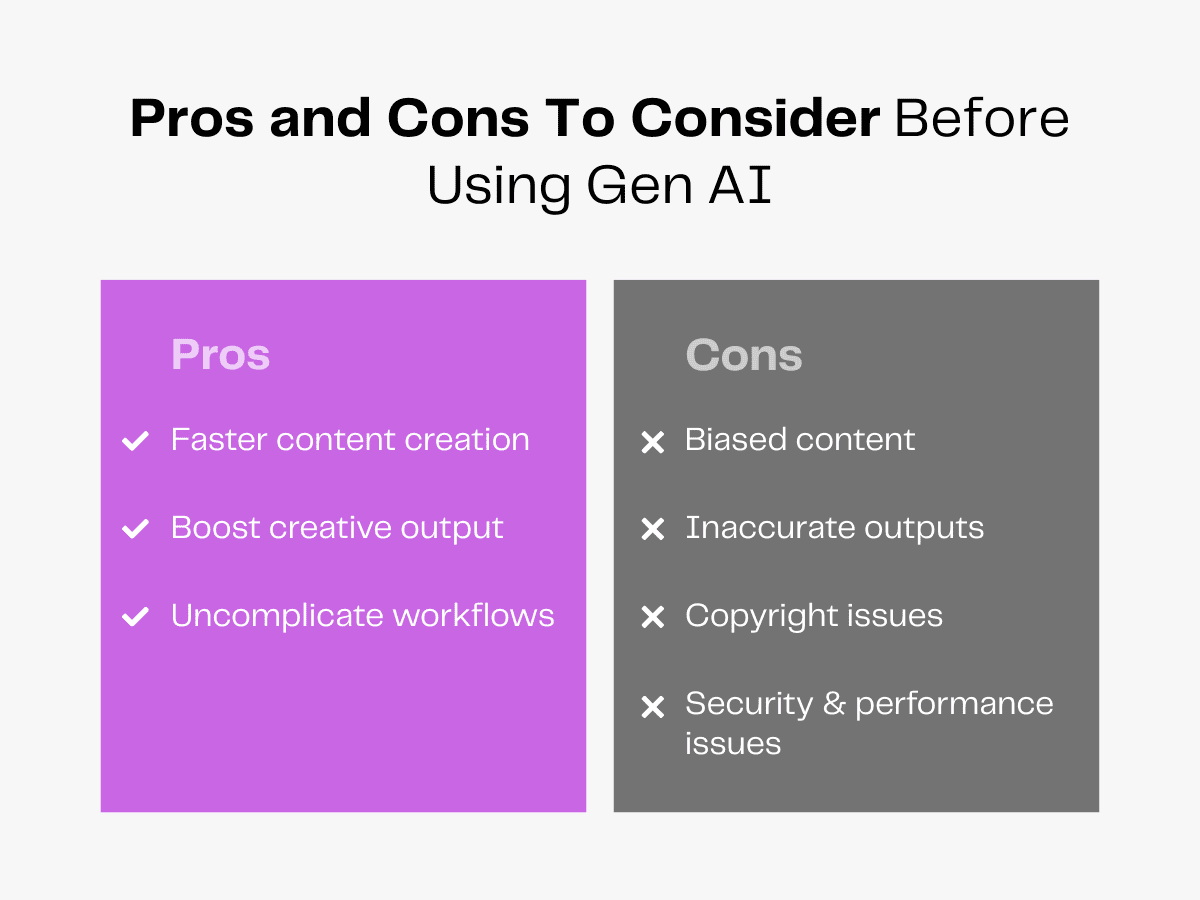
- Faster content generation: The biggest benefit of generative AI tools is how much time they save. With professional prompt engineers, businesses can generate anything from graphics to emails within seconds.
- Boosting creative output: Creative outputs still need a human in the loop, but the time-consuming ideating process can be made more productive with Gen AI applications. Users can use multi-shot prompting (giving examples of ideal output) as well as generate multiple test assets to get the best out of their brainstorming sessions.
- Context-driven responses: Generative AI isn’t just useful for creating generic assets. It can also create accurate content based on massive and personalized context libraries.
Read More: Top Virtual Assistant Skills to Boost Productivity
As Gen AI’s relevance grows rapidly—spreading to almost every sector—so is people’s reliance on it.
Andrej Karpathy, a Slovakian computer scientist, coined the term “Vibe coding” in 2025. This refers to a recent trend wherein the user only has to give specific prompts and get AI to generate the line-by-line code, without actually writing any code.
There’s a new kind of coding I call “vibe coding”, where you fully give in to the vibes, embrace exponentials, and forget that the code even exists, says Andrej Karpathy, Computer Scientist & AI Researcher
But too much of any good thing is bad. Let’s look at some other possible cons of this increasing reliance on Gen AI:
- Biased content: Generative AI tools are only as good as the data they are trained on and the GANs and neural networks they use. This means that if the data is poisoned and there are multiple missing neurons, the output can be highly biased.
- Inaccurate outputs: It is important to remember that generative AI can create believable outputs, but that doesn’t mean they are completely realistic. This can potentially create issues for businesses because simple mistakes can ruin brand reputation.
- Copyright issues: Generative AI creates original content, but not something out of thin air. This means the content might be original, but it will still have features of the data it uses. This makes it important for companies to know what data a model is trained on to avoid legal liabilities.
- Security issues: We’re still not at a stage where we can trust the decision-making of AI tools completely. Yes, speed and efficiency are important for an enterprise. But security and quality are still a priority. Security breaches, data poisoning and other risks are proof that while AI assistance is okay, a project cannot enter the market without human oversight.
What the Deep Learning and Generative AI Future Looks Like
What’s blocking AI’s move into core business processes today is that AI can make predictions but can’t mimic human decision-making. And that’s exactly where the latest developments in deep learning are taking place.
Modern AI tools are going beyond just systematic predictions and exploring reasoning. Developers are focusing on creating reliable hybrid neuro-symbolic models that combine deep learning and symbolic reasoning to simulate human-like common-sense interpretation of data.
This can significantly change the workplace hierarchies and reduce the routine decision-making load on management. These models will also be able to replace small LLMs to give domain-specific, in-depth support for a variety of industries.
Enterprise usage of Gen AI is also set to rise to 80% in 2026 and not just for novelty but for real outcomes.
Erik Brynjolfsson, Digital Economy Lab Director.
In 2026, arguments about AI’s economic impact will finally give way to careful measurement. We’ll see the emergence of high-frequency “AI economic dashboards” that track, at the task and occupation level, where AI is boosting productivity, displacing workers, or creating new roles…
Artificial intelligence courses, including generative AI and deep learning, will continue to be highly sought-after courses going forward. As the use of AI for core processes increases, businesses will face an IT & software department restructuring and place even more value on their tech stacks.
Read More: Remote Work 101: Everything You Need To Know
Final Thoughts
Deep learning and generative AI can seem like the same thing to an untrained eye. The difference between them is subtle but important.
One is a method and the other is its application.
As the state of technology continues to develop, business owners, recruiters and industry specialists will need to know a bit more about AI than just its hype. Knowing the slight specifics can be the difference between onboarding a powerful tool or falling into technical debt!
To make your business future-ready and prepare your teams for the massive shift, you need competitive talent from the global talent pool. With Zenius, you can find the perfect support. From generative AI engineers to computer vision engineers, we can help you find the right remote employee for your needs.