Key Takeaways
When employees feel they have a stake in what is expected of them, they feel in control of their performance and do better. This is why you should include them in goal-setting.
A good performance management plan can improve productivity by 31%.
In performance management, it’s important to address problems promptly and maintain tight feedback loops to save time and prevent double-work.
Ever struggled with an employee who always checked in on time, had the perfect attendance record, was the most active on the system, but still failed to meet quality standards?
Many managers confuse performance management with monitoring.
The truth is that metrics, work hours and mouse movements are only proof of activity. They’re not outcomes—the true measure of performance.
A team’s performance rises and falls with dynamic human factors like curiosity, motivation, adaptability, accountability and work ethic, along with their sense of belongingness and alignment with the company.
While these factors are not easy to track in a virtual team, managing them for best performance is not impossible.
By setting clear goals, defining key performance indicators (KPIs), equipping employees with the right tools and maintaining tight feedback loops, you can boost efficiency, improve communication and enhance collaboration.
This article explores various do’s and don’ts for managing performance virtually. Let’s break it down.
What Is Virtual Performance Management?
Even with the many advantages of virtual teams, employers often worry about the performance of their remote employees. This is mainly because of technical issues, time zone differences and a lack of face-to-face interaction.
Virtual performance management means tackling poor productivity by overcoming remote team challenges, improving workflows and enabling employees to perform better and in alignment with your organization’s goals.
What Are the Objectives of Performance Management in Virtual Teams?
Managing a virtual team can feel chaotic at times. You can’t communicate without an online tool or platform. You don’t see the job happening in front of you. Even organizing interactive activities like brainstorming, outlining and strategizing plans can be incredibly challenging.
One goal of virtual performance management is to minimize the impact of geographical distance on a team’s productivity in remote work.
Read more: Remote Work 101: Everything You Need To Know
Second is to set better, clearer goals and provide substantial, fast feedback to improve efficiency, keep everyone engaged and stay on track.
The ultimate goal is to improve the quantitative and qualitative performance of the team.
Let’s discuss the impact of performance management in achieving these objectives.
Goal-Setting
Goals give your employees direction, keep them focused and ensure alignment with company targets. Well-defined and measurable goals prevent confusion and clarify expectations.
In a performance management study, only 30% of employees agreed that their managers involve them in goal setting, even though employees involved in the goal-setting process are 3.6 times more likely to be engaged.
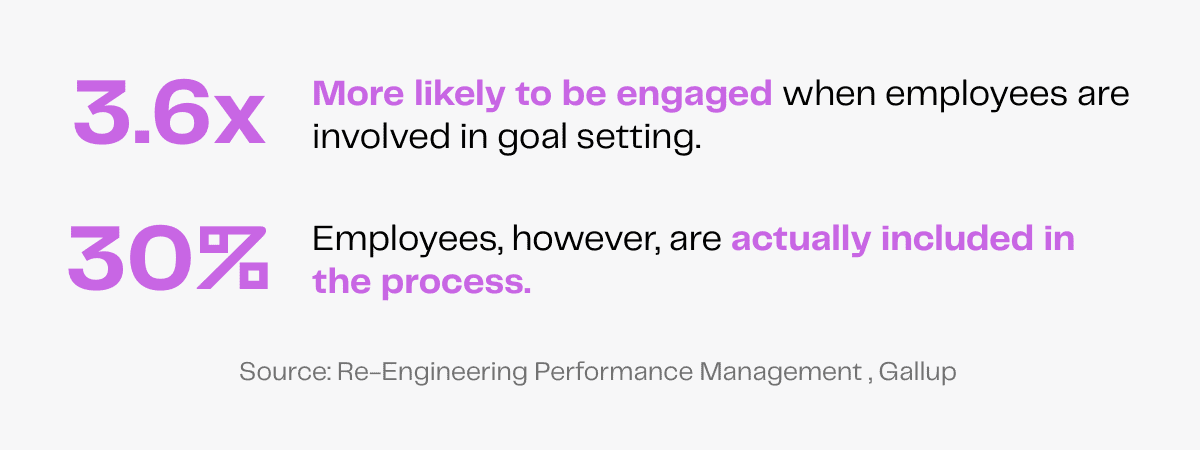
When employees feel they have a stake in what is expected of them, they feel in control of their performance and do better. Performance management achieves employee engagement along with efficient goal-setting.
Accountability
Holding your virtual team accountable allows them to take collective responsibility for their performance and results. But remember—a wrong approach towards accountability can enforce negativity.
The scorekeeping nature of accountability yields a built-in negativity bias, where leaders reflexively hunt for shortfalls and the tallying usually ends with a forced categorization—a rating system of numbers or labels, sometimes stack-ranking employees against their peers.
Ron Carucci
Good performance management avoids discouraging systems of rating and ranking. Instead, it uses positive reinforcement techniques to achieve accountability among employees.
For example, incentives for good performance are better than repercussions like pink slips or salary cuts for poor performance. With this, you’ll curate a scope for positive growth rather than a fear of consequences.
Improved Performance
The ultimate purpose of performance management is to improve your team’s performance. This improvement can be in terms of time management, skill development, project execution or better communication.
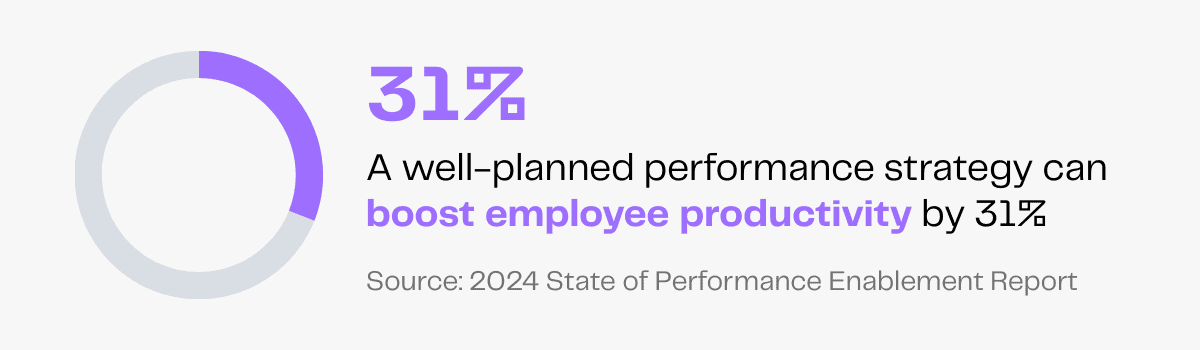
According to Betterworks’ 2024 State of Performance Enablement report, a good performance management plan can improve productivity by 31%.
Not only that, but employees feel 10x more positive about their career growth!
The Performance Management Cycle
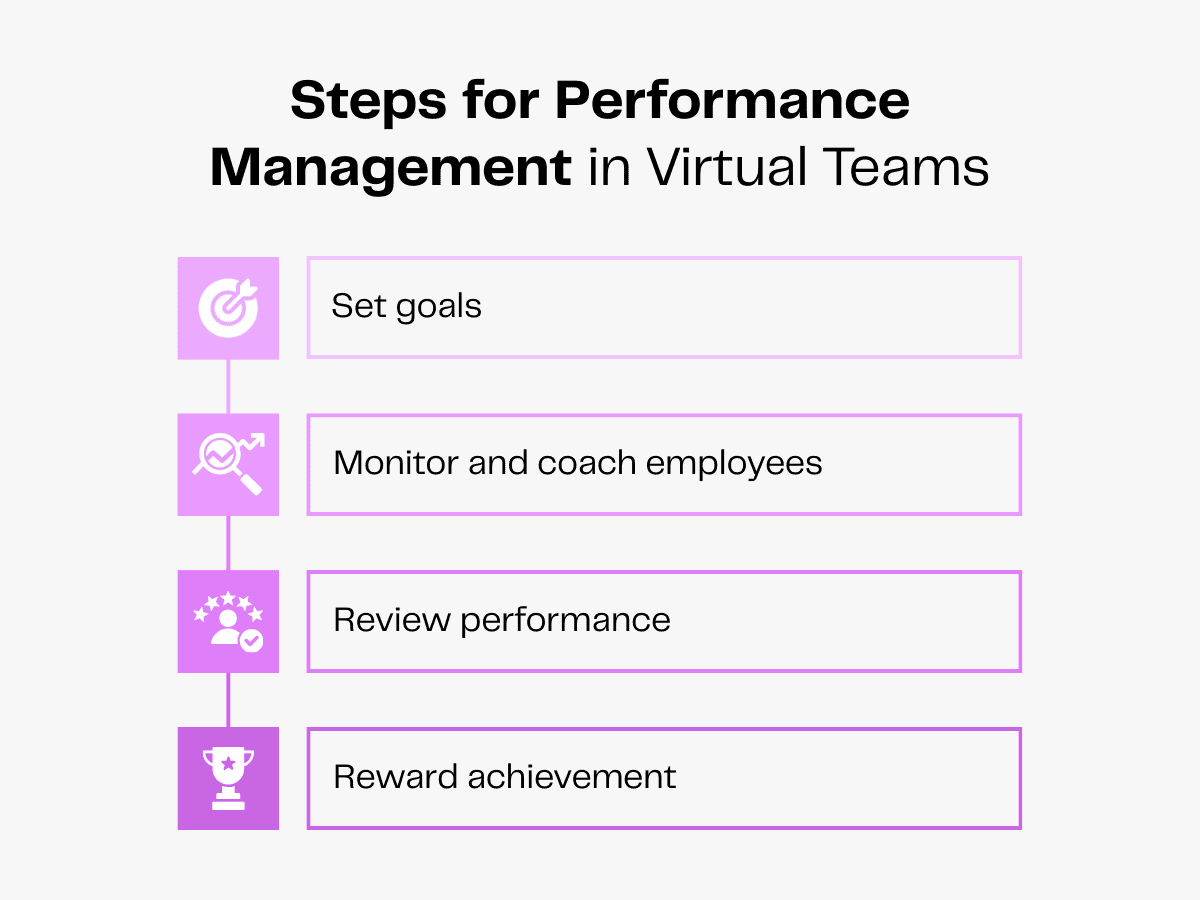
The 2009 book Armstrong’s Handbook of Performance Management defines the commonly used performance management cycle.
This four-step process sets performance standards and guides teams to live up to them.
Goal Setting and Planning
The first step is identifying the objectives and establishing exactly what the team has to accomplish.
As previously mentioned, involving your team in goal-setting can boost engagement and helps teams feel more aligned with the vision.
Once goals are set, planning comes into play. This includes setting up goals, workflows, tools and strategy.
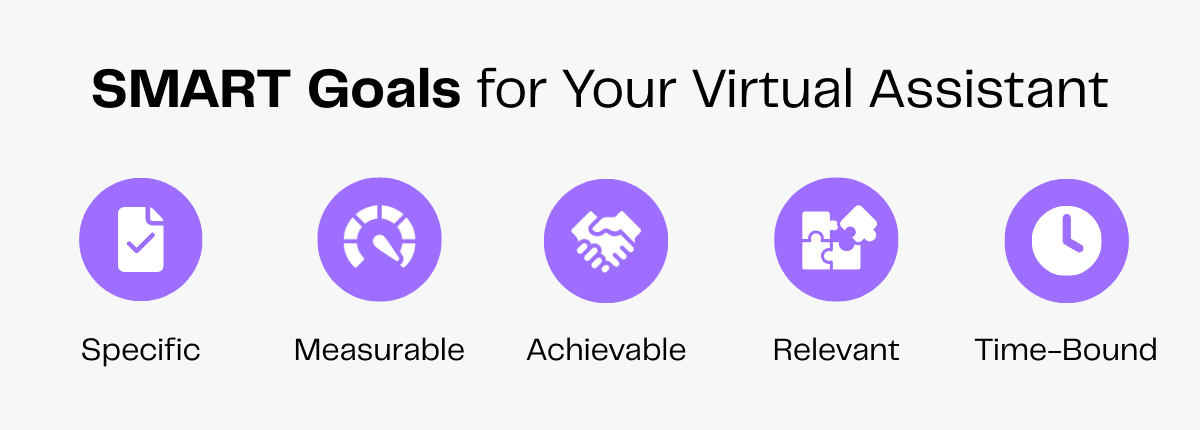
‘SMART’ is a popular goal-setting framework widely used in project management, performance management and personal development.
Here’s a breakdown of this acronym and how it matters in the performance management process.
Specific
Goals should have clear parameters. Your virtual team should discuss questions like:
- What is to be accomplished?
- Who will be responsible for it?
- How do we achieve it?
- In what amount of time can it be accomplished?
What your goal should not look like: Publish our monthly newsletter.
What it should look like: Divide your team into writers, editors and designers and publish the first issue of our monthly newsletter by the end of this month.
Measurable
Goals should be quantifiable. For this, establish performance metrics in advance to set benchmarks and map progress. However, be mindful and set metrics that are in your team’s control.
What your goal should not look like: Increase our website traffic.
What it should look like: Increase our website traffic by 15% by the end of this month.
Achievable
Goals should be realistic. Setting up unachievable or ambiguous goals can be discouraging for the team.
Such goal-setting often leads to overworking, affects work-life balance and may even cause employee burnout. And when a goal feels impossible, no matter how much employees push themselves, it is simply demotivating.
What your goal should not look like: Respond to all work emails and chat messages within 5 minutes.
What it should look like: Respond to all work emails and chat messages within 2 hours during your shift.
Relevant
Goals should be relevant to the ultimate objectives of the project the team is working towards. Team members should ask:
- What is this goal achieving?
- Is it contributing to the project goal?
What your goal should not look like: Use new tools every month without identifying any clear problem they solve.
What it should look like: Research and adopt tools that will resolve current pain points or substantially improve workflow.
Time-Bound
Goals should be time-bound. Both short-term and long-term goals need timelines. Everyone needs to be on the same page about the duration of tasks and cycles and the finalized timeline should be known to all.
What your goal should not look like: Complete the upcoming project.
What it should look like: Complete the upcoming project before next Thursday.
Monitoring and Coaching
Once the project is in action, team leaders and supervisors must monitor the progress of their virtual team.
You should track team and individual progress through regular virtual meetings, check-ins and updates. This will provide a window for spotting challenges early on and addressing them before they escalate.
Coaching your virtual team goes hand in hand with monitoring them. Instead of giving feedback once in a long period, providing appropriate support frequently is helpful. Regular and short feedback loops will encourage your team and guide members in the right direction.
Reviewing Performance
A performance review at the end of the project doesn’t do much good. Of course, the feedback will come in handy for the next project. But for the current project, there’s no longer a scope of improvement.
On the other hand, reviewing performance at regular intervals, like at the end of task cycles, will be highly effective. Your team will understand the current position, progress and errors. More than anything, they can strategize better plans to achieve upcoming goals.
In a performance review, you can address questions like:
- How much progress was achieved during this task cycle?
- Is the outcome aligned with project goals and objectives?
- Have individual team members fulfilled their roles?
- Were there any delays or errors during the process?
- What are the areas we can improve?
Rewarding Achievements
After your virtual team’s performance review, it is important to affirm progress and appreciate all employees. Rewarding the team for their effort will make them feel valued and motivated.
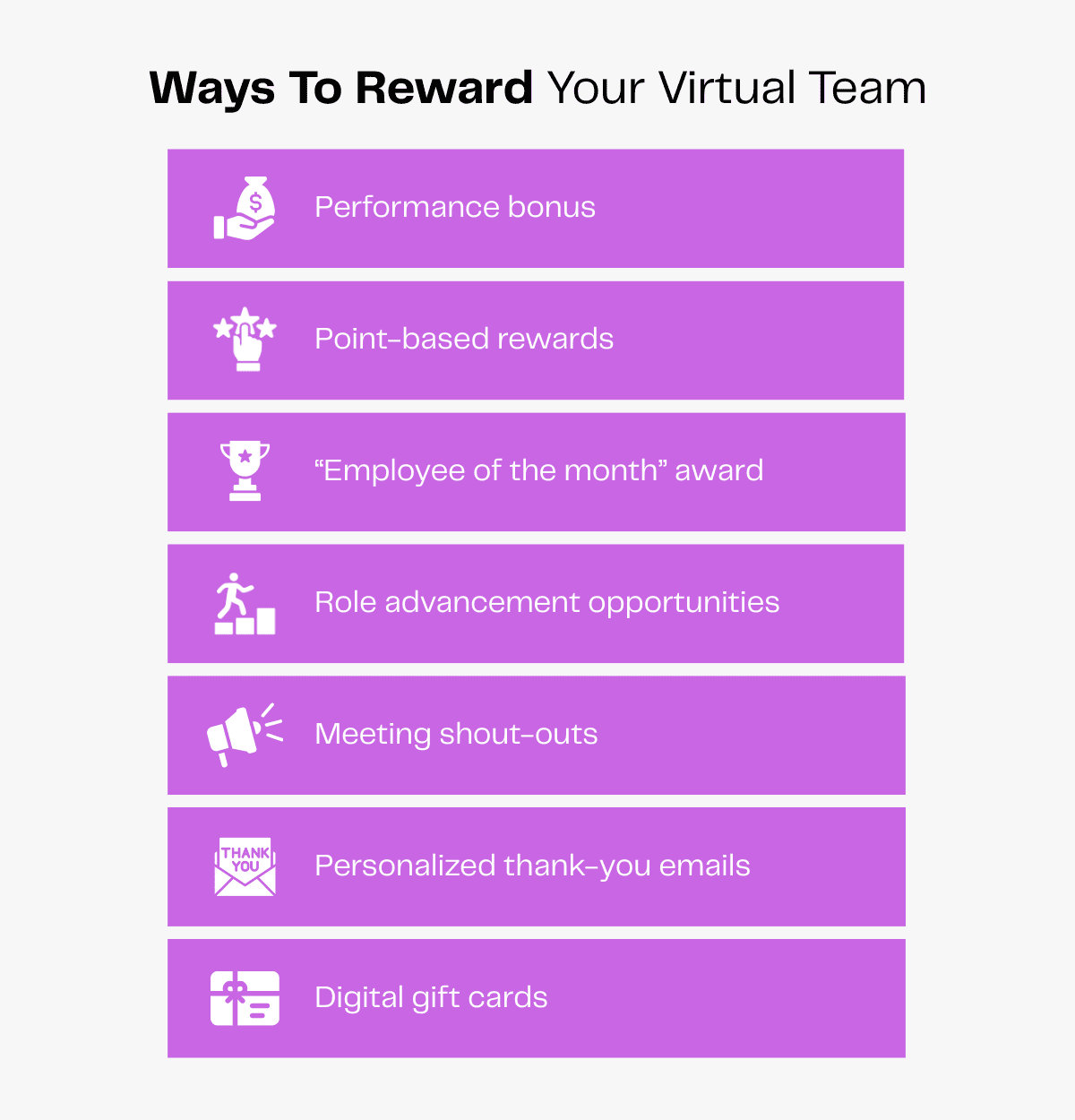
Both financial and non-financial rewards can be incentives for the team. Such recognition and appreciation will drive your employees to produce even better results in the future.
These could look like:
- Performance bonus
- Point-based rewards
- “Employee of the month” award
- Role advancement opportunities
- Meeting shout-outs
- Personalized thank-you emails
- Digital gift cards
Read more: How To Motivate Virtual Team Members: A Complete Guide
What are Key Performance Indicators (KPIs)?
Key performance indicators (KPIs) are quantifiable measures of performance. They measure progress and determine to what extent your business goals are being met.
KPIs are often mistaken for metrics. There’s a difference between the two. All KPIs are metrics but not all metrics are KPIs.
| KPIs | Metrics |
|---|---|
| KPIs show progress towards team/company goals. | Metrics are used to measure the performance of business activities. |
| It gives a high-level perspective. | It gives a low-level perspective. |
| KPIs are used for long-term goals. | Metrics are used for short-term goals. |
| These goals are relevant across all the departments, roles and tasks. | These goals are specific to certain departments, roles and tasks. |
| Example: Inventory turnover, sales growth, customer satisfaction. | Example: Website traffic, social media reach, return rate. |
Why Are KPIs Used?
Established benchmarks, prior performance and the competitive market assist organizations in setting key performance indicators. KPIs provide a high-level overview of the business and help analyze different aspects of the performance.
In business, what’s measured improves, says Mark Cuban.
These insights are used to spot performance trends and areas of improvement. They also allow you to make informed decisions and build strategic plans.
Types of KPIs
KPIs can be broadly categorized into three categories. Each type has its unique attributes. You need to determine the kind of KPIs that will be useful for you, according to the nature of your business and the function of your team.
Strategic
Strategic KPIs give a big picture of the company’s business. They measure progress against established long-term goals. Strategic KPIs include:
- Profit margin
- Overall equipment effectiveness (OEE)
- Generated revenue
Operational
Operational KPIs are time-bound. They track day-to-day performance by focusing on routine operations and processes. These include:
- Tasks completed per day
- Website traffic
- Average Resolution Time
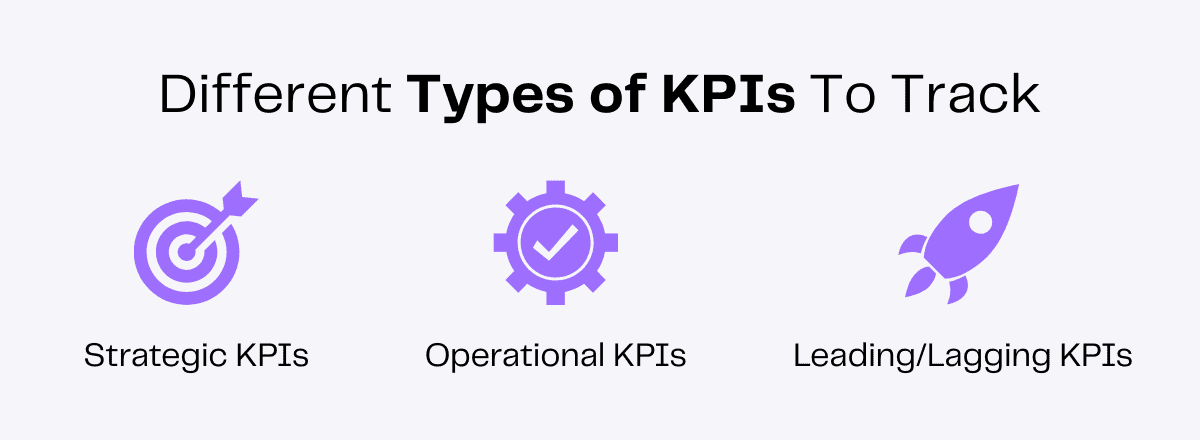
Leading/Lagging
Leading KPIs like website clicks and sales can indicate or predict future performance. In contrast, lagging KPIs like production rate and profit of the month show past performance.
Leading and lagging KPIs allow businesses to establish patterns or trends based on which predictions can be made.
How To Set KPIs
To set valuable KPIs that encourage growth, it is important to revisit business objectives. Metrics can measure performance but you need KPIs to see if goals are being met. These vary across departments according to respective team objectives.
For instance, the content team’s goal is to improve content engagement. Organic SEO traffic, website clicks, time on page and bounce rates are good KPIs for judging content performance. Thus, the team’s strategy plans can focus on SEO ranking, finding relevant topics and developing engaging content.
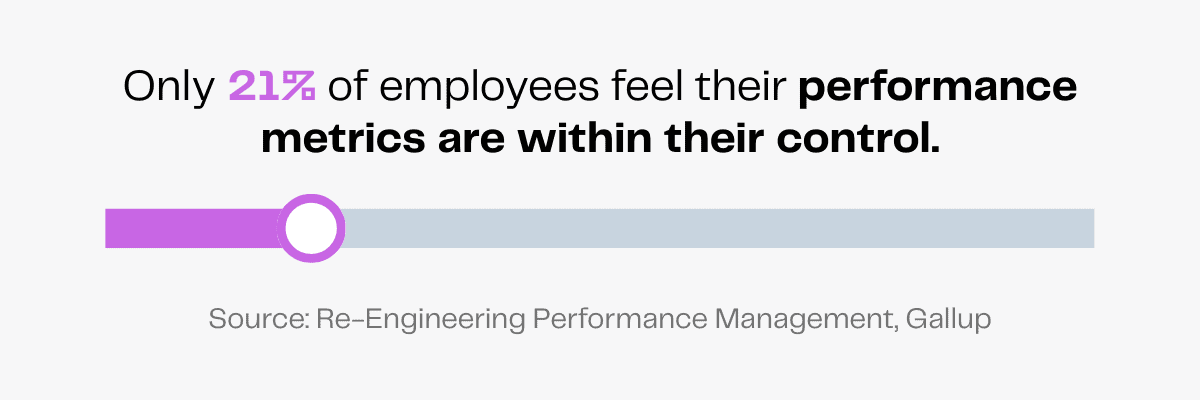
Establishing the team’s collective goals is relatively easy. Setting individual KPIs, however, can be tricky. According to Gallup, only 21% of employees think they have control over their performance metrics.
Let’s go back to our example—a content writer can include keywords, follow SEO guidelines and make content engaging and resourceful. But metrics like page clicks are still not within their complete control. Other processes and external factors also contribute to the metrics.
This is why there’s a need for goals that feel more attainable and within reach. The number of words written, the number of articles published and the quality of content are probably better KPIs for content writers.
To put it concisely, while setting KPIs:
- Set KPIs for the team and roles within the team separately.
- Keep the goals clear and structured.
- Involve your team in discussions while setting KPIs to avoid confusion or disagreements.
- Review KPIs from time to time to ensure they’re relevant and useful.
What Happens When You Set a Bad KPI—Case Study
One customer support rep working in a bank shared, “Recently, they introduced a new metric … to reduce the number of inter-department transfers …”
Explaining the metric further, they said, “If we can assist a client, we obviously do. But if the issue/question/request is for another department, instead of transferring them we’re now expected to contact the department ourselves, get the information and give it to the client… All to avoid a transfer.”
One quality of a reliable employee is knowing the limits of their knowledge. This was also a concern for the customer service rep: “If I don’t have expertise in X department, I’m just going to transfer the client, it’s the right thing to do.”
Poorly thought-out metrics like this can be discouraging, unproductive and in some cases, even damage the manager-employee relationship beyond repair. It’s also not uncommon for such metrics to be gamed by employees.
Here’s a creative workaround another employee devised in the same bank: “… to keep this metric low, he sometimes tells clients to hang up and call back thru the bank app bc it’s faster to reach the correct department that way …”
Re-routing clients like this could impact the reputation and image of the bank in question, having counterproductive outcomes.
So the great point of it all is this—your metrics should be set keeping in mind other, more important KPIs.
The metric in the above case study does not align with important KPIs like query resolution and client retention.
How can you identify such metrics in your dashboard? Take some time and look for a metric that’s performing well, but accompanying metrics are not.
Performance Management Techniques for Remote Teams
Now that we know how to set KPIs, we can move on to techniques for measuring and assessing performance.
Performance appraisal techniques are structured methods that are practiced over time. These techniques do not just monitor performance—they allow you to analyze patterns, strengths and areas for improvement.
Here are some of these techniques for building a high-performance virtual team.
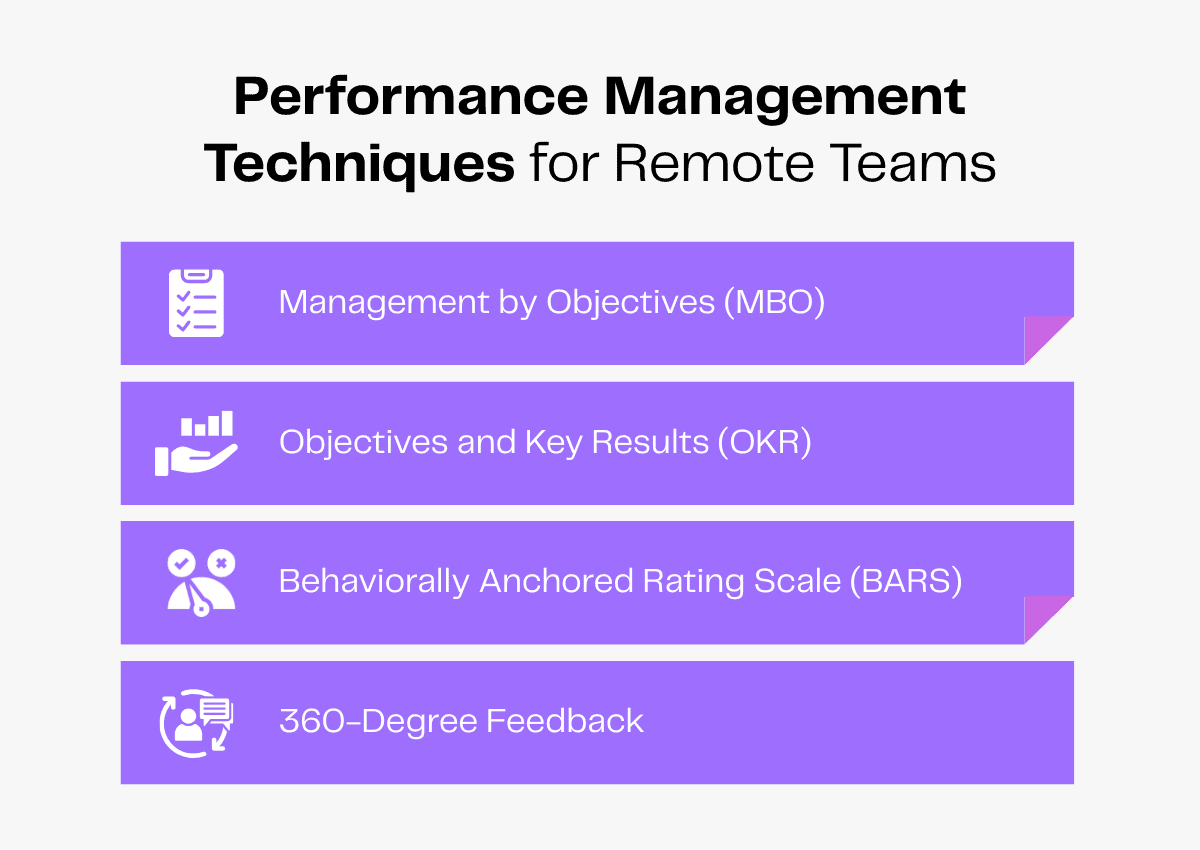
Management by Objectives (MBO)
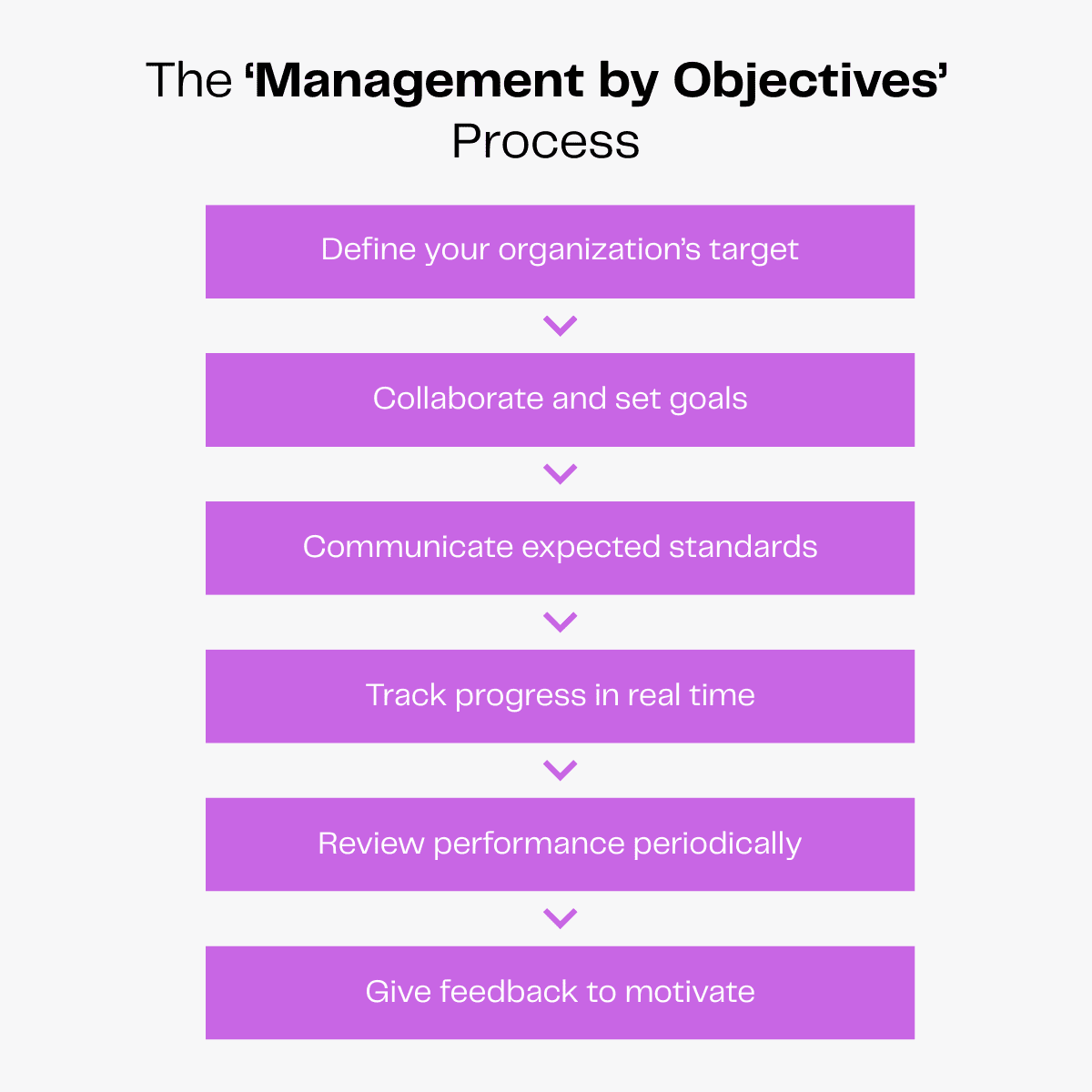
Peter Drucker’s 1954 book The Practice of Management popularized the term ‘management by objectives’ (MBO), which is a goal-oriented performance appraisal approach.
First, define a clear target that aligns with your organization’s needs. Then, collaborate with your virtual team to set clear, attainable goals and communicate standards with all employees.
The agreed-upon objective standards are used to determine employee performance, which is periodically reviewed.
This approach focuses on accountability and objectivity. With agile software and digital tools, you can track and monitor your remote team’s real-time progress easily. Also, communicating measurable expectations allows employees to stay motivated and in control.
Objectives and Key Results (OKR)
‘Objectives and key results’ (OKR) is another goal-oriented strategy. In this simple method, objective goals are set and then key results are established. The results you want to achieve give direction and help you understand if goals are met.
For example, a sales team’s objective is to increase monthly sales. Increased 10% social media engagement or 20% growth in average order value are good key results to establish for this goal.
Key results are quantifiable, so they can be used to track progress and create a road map for the process.
Behaviorally Anchored Rating Scale (BARS)
The ‘behaviorally anchored rating scale’ (BARS) is a technique that combines qualitative and quantitative aspects of performance assessment.
The method establishes a scale. At every level in the scale, a detailed description of what an outstanding, good, average or poor performance looks like is established.
This way, a performance rating can be determined through specificity instead of subjectivity.
For example, the three-scale rating for a content writing team’s performance can look like this:
Excellent: At the highest level, a writer consistently delivers clear and engaging content on time, uses correct grammar, adheres to guidelines and their work needs little editing.
Good: At the middle level, a writer’s content has a few grammatical errors and issues related to structure, flow or clarity; it needs some editing and there might be occasional delays in meeting deadlines.
Needs Improvement: At the lowest level, a writer’s content has frequent grammatical errors, it does not adhere to guidelines, it requires a lot of editing and the writer often misses deadlines.
360-Degree Feedback
‘360-degree feedback’ is an extensive technique that is result-oriented and feedback-oriented.
Organizations apply this feedback model by collecting and sharing feedback about performance from various stakeholders—managers, leaders, supervisors and employees.
This method of peer reviews is useful because it:
- Allows your virtual team to exchange feedback and create a bond with one another.
- Reduces bias from hierarchy and structure at work.
- Provides room for self-assessment and self-improvement.
- Incorporates diverse perspectives across various levels and roles of the teams.
In a virtual environment, anonymous surveys and questionnaires can be used to get an overall performance review.
You can agree upon the frequency of feedback collectively. It can be quarterly or at the end of a project or task cycle.
Best Practices for Managing Performance Virtually
Building virtual teams and onboarding team members are just the beginning of the process. The real challenge is managing and monitoring their performance. Communicating with your team, tracking progress, resolving errors and developing strategies are all difficult tasks.
But mindful leadership styles can simplify things. By checking in regularly to provide guidance, you can prevent double work and frustration preemptively.
However, you should be careful not to micromanage your team while doing so.
Here are some more such tips to get the most out of your remote teams.
Read more: The Art of Leading Virtual Teams
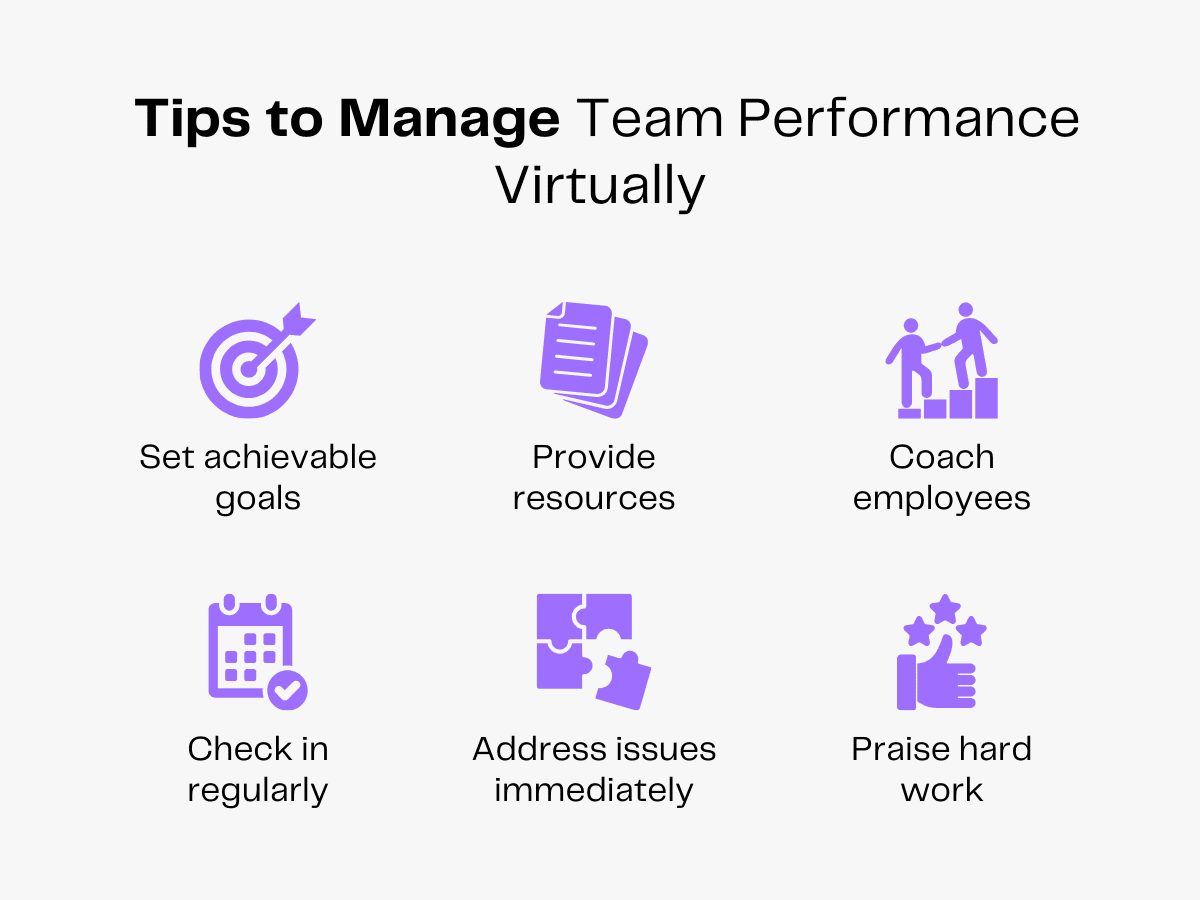
Set Attainable Expectations
Once goals have been established, the next step is to establish and communicate expectations.
Naturally, you’ll have different expectations for different team roles. You should discuss each separately. Ensure that the expectations are clear, measurable and realistic.
For example, you may expect your design team to create 5–8 social media graphics per day. It is a clear and quantifiable expectation. But whether it is realistic is subjective.
Ask your team if they believe the goals can be achieved. Ensure that the discussion is not one-sided. This will make the team feel valued and heard. Your team will also be encouraged to meet the goals when they have a stake in decision-making.
Provide Resources
Providing your team access to communication channels, collaboration tools, project management software, training modules and manuals for tasks will support them immensely.
Let’s say your remote employees are using a project management software to collaborate. Not all members know how to use the software. A tutorial or user guide can help them understand it quickly. Plus, they can always get back to the docs whenever needed, reducing back-and-forth for you.
When the team is well-equipped with resources, they will gradually become more independent and confident in their work. This means less time is wasted waiting on solutions from seniors, communicating queries or understanding functionality.
Consider Coaching
Mentoring your virtual team can be useful for virtual performance management. You can hold one-to-one or team sessions where employees can develop new skills, discuss challenges and find ways to improve efficiency.
Personal growth and interaction are limited with remote employees. Coaching can provide a medium for employees to interact and feel involved. You can boost collaboration and performance by developing a supportive working relationship with your employees.
Check-In Regularly
Regular check-ins curate a culture of transparency, communication and collaboration. Frequent one-on-one video calls, planned periodically, allow your team and individuals to discuss progress, address potential issues and devise solutions.
Goal setting is an essential part of performance reviews and management. Regular check-ins ensure goals are being met. If they aren’t, you must discuss with your team. Adjusting short-term goals and addressing minor issues during the process can prevent drawbacks in the long term.
Regular discussion also provides an opportunity to resolve conflicts within your virtual team. Overlapping or conflicting ideas, goals and responsibilities can be addressed head-on during check-ins.
Read more: 8 Unique Ways of Connecting With Employees Virtually
Address Issues Immediately
Remote work can sometimes be disruptive due to technical issues or unforeseen delays. In a virtual environment, you must solve these glitches as they arise.
Read more: What Are Virtual Teams and How Do They Benefit Your Business?
You can prevent major issues in the future by addressing the root cause of the problem. A practical solution will help your team maintain the established workflow and meet deadlines.
Let’s say an employee in a remote work set-up is facing a technical issue. They should immediately inform you about the issue after troubleshooting on their end. Then, a team member with technical expertise or a technical support person can help them.
Appreciate Progress
Employees feel motivated when their work is recognized and celebrated. It’s not just about the outcome—it’s about appreciating your virtual team for accomplishing short-term goals, meeting deadlines and putting in continuous effort.
Showing your appreciation reinforces a positive workplace attitude and motivates employees. Moreover, you curate a supportive virtual team culture, build loyalty and teamwork.
Such recognition programs drive team performance but also individual engagement and growth within the team.
Wrapping Up
Virtual performance management is key to keeping remote employees productive and engaged. You can initiate quantitative and qualitative growth by setting SMART goals and KPIs, adopting performance management techniques and establishing a performance management cycle.
Fostering accountability, maintaining regular check-ins, addressing problems promptly and recognizing and appreciating progress are a few more things to keep in mind.
However, it all starts with hiring a team with the right people in the right roles.
At Zenius, we find skilled and motivated individuals for your virtual teams. We’ll take care of everything from hiring to monitoring, so that you can focus your energy on your core business activities!