

Key Takeaways
Around 68% of global organisations surveyed by Kendryl are investing heavily in some form of AI, whether that’s agentic, generative or machine learning.
Studies show that AI investments deliver an average return of 3.5x!
Over 80% of developers say increased productivity is the top benefit of using AI in their workflows, underscoring its significance in the workplace.
In a world overflowing with information, it’s a battle for attention, impact and relevance.
To keep up with the current pace of change, businesses can’t rely on instinct alone. Speed, precision and adaptability are non-negotiable!
So you must actively invest in today’s top business trend—artificial intelligence.
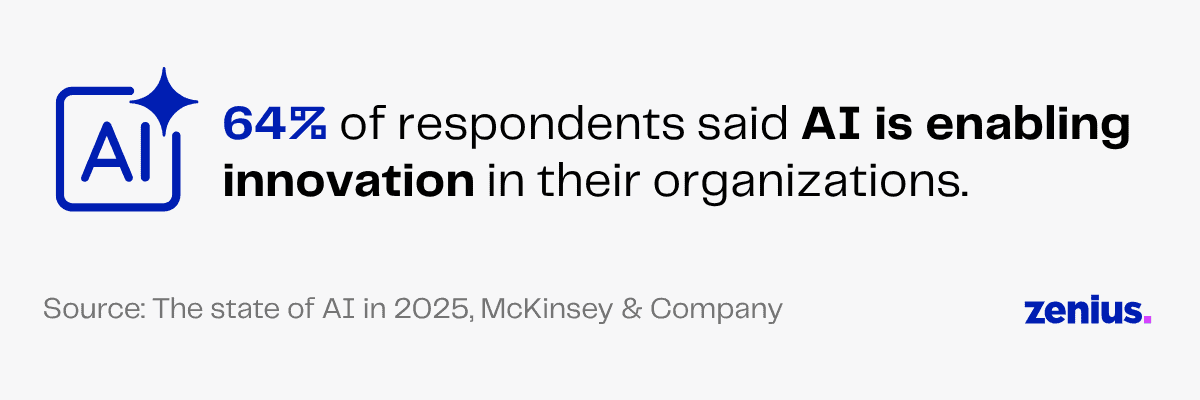
In a survey conducted by McKinsey & Company, 64% of respondents said that AI is enabling innovation in their organizations.
Leveraging AI/ML platforms helps businesses automate workflows, analyze data faster, predict trends accurately and deliver more personalized solutions at scale.
And who doesn’t want optimized operations, real-time insights, smarter growth strategies and scalable success with AI?
What Are AI/ML Platforms?
AI/ML platforms are software environments that enable data scientists, AI engineers and developers to build, train and deploy artificial intelligence and machine learning models customized to your specific needs.
Platforms like Microsoft Azure AI, PyTorch and TensorFlow provide developers with ready-made tools to build intelligent models quickly.
Whether you want to automate complex processes, enhance decision-making, gain predictive insights or offer 24/7 customer support, AI platforms accelerate all such operations.
Read more: Best Artificial Intelligence Tools for Businesses
What Are the Main AI Platforms in 2026?
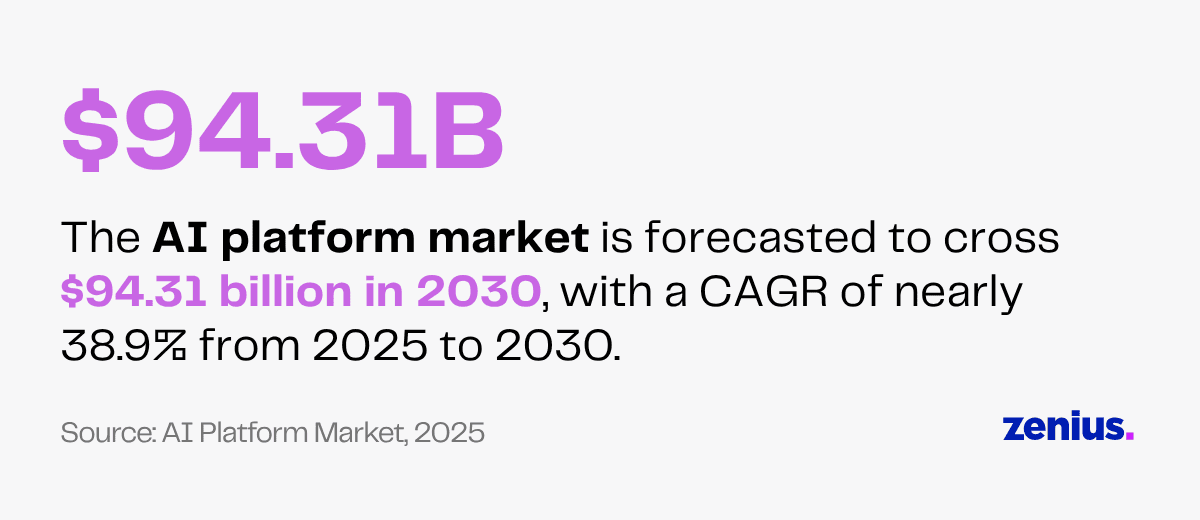
The AI platform market is forecasted to cross $94.31 billion in 2030, with a CAGR of nearly 38.9% from 2025 to 2030.
This growing dependence on AI/ML models highlights why you should invest in industry-leading AI platforms to power your business workflows and stay competitive.
Here are the top AI/ML platforms transforming how businesses build, deploy and scale intelligent solutions with speed and precision.
Google Vertex AI
Vertex AI is Google Cloud’s unified, fully-managed AI platform, designed to build, deploy and scale machine learning models and generative AI applications.
With Vertex AI, you can access the latest Google Gemini models, over 200 first-party, third-party and open AI models, purpose-built MLOps tools and enterprise-grade agents.
Key Features
- All-in-one AI ecosystem: Your developers can access generative AI foundational models to build, train, deploy and monitor models without constant tool switching.
- AutoML: Vertex AI allows developers to build high-quality models for images, text, video and tabular data with minimal code.
- Custom training: If you don’t want off-the-shelf solutions, this tool helps developers tailor AI model development to meet your unique organizational goals.
- Built-in MLOps: Enjoy features such as Vertex AI Pipelines, Model Registry, Model Monitoring and Vertex Explainable AI to automate ML lifecycle workflows.
- Multimodal AI capabilities: You can handle text, images, audio and video in a single workflow.
Businesses can use Google Vertex AI for generative AI applications, conversational AI agents, search and recommendation engines, video analytics and image classification apps, predictive analytics tools and more.
Amazon SageMaker AI
From data preparation to deployment, Amazon SageMaker AI helps you simplify the entire ML lifecycle while giving you the flexibility to customize models at scale.
It’s built for speed, automation and deep integration with the AWS ecosystem, helping you handle massive datasets, train models efficiently and deploy with minimal effort.
Key Features
- End-to-end ML workflow: Amazon SageMaker covers data prep, training, tuning, deployment and monitoring—all in one place.
- Managed Jupyter Notebooks: Your developers don’t have to worry about infrastructure setup—they can start building models instantly, minimizing operational burden.
- Built-in algorithms and pre-trained models: Your developers won’t have to code from scratch, allowing them to train models faster, reducing deployment time.
- AutoML: Using SageMaker Autopilot, you can build, train and tune models automatically, making it a great choice for beginners.
- Deep AWS integration: Amazon SageMaker AI integrates seamlessly with Amazon S3, Lambda, EC2, Amazon Redshift, Amazon Athena, Amazon EMR, AWS Glue and other AWS services.
With Amazon SageMaker AI, you can build fraud detection models, inventory management tools, personalized recommendation systems, content generation models and chatbots.
Microsoft Azure AI
Microsoft Azure AI is a powerful enterprise-grade, cloud-based platform that helps you deploy AI models with strong security, compliance and seamless integration into your business systems.
From beginners to advanced professionals, any individual and business can leverage its comprehensive, all-in-one platform capabilities to access scalable AI solutions.
Key Features
- Azure AI Foundry: This unified platform supports model cataloguing and features Prompt Flow, streamlining the development cycle, from prototyping and testing to deploying and monitoring LLMs.
- Exclusive OpenAI integration: Azure is one of the cloud providers for OpenAI, offering managed services for GPT-4o, GPT-4, GPT-3.5, DALL-E and Whisper.
- Drag-and-drop flexibility: This feature helps data scientists who are more familiar with visual tools than coding.
- Seamless Microsoft ecosystem integration: Microsoft Azure AI works smoothly with tools like Power BI, Azure Storage and Microsoft 365 products.
- Enterprise-grade security & compliance: RBAC (Role-Based Access Control) and responsible AI frameworks ensure data privacy and adherence to safety standards.
From computer vision and document intelligence to speech-enabled apps and data analytics, you can build customized, scalable solutions that fit your business needs seamlessly.
Databricks Data Intelligence
The Databricks platform is like a data plus AI powerhouse hub that combines data engineering, analytics and machine learning in one place.
It’s perfect for organizations that want to process massive datasets, build high-performance ETL pipelines and deploy intelligent models built on Apache Spark for high-speed, large-scale processing.
Key Features
- Lakehouse architecture: Databricks combines data lakes and data warehouses for a single, unified data platform.
- Apache Spark powered: It enables lightning-fast processing for big data, real-time analytics and ML workloads.
- Collaborative workspace: It has shared notebooks for teams so your data scientists, data engineers and data analysts can work together.
- Cloud integration: Databricks works across AWS, Azure and Google cloud seamlessly.
- Scalable infrastructure: You can easily scale compute resources for large datasets and complex models.
With this platform, you can build RAG (Retrieval-Augmented Generation) chat apps, predictive analytics models, interactive data apps and dashboards, customer segmentation models, supply chain optimization solutions and more.
TensorFlow
TensorFlow is an end-to-end open-source machine learning platform developed by Google that processes data through neural networks.
It also easily scales across CPUs, GPUs and TPUs, making it perfect for both beginners and large organizations.
Key Features
- Powerful deep learning capabilities: TensorFlow supports advanced neural networks like CNNs, RNNs and transformers, making it ideal for tasks like image recognition, NLP and speech processing.
- Cross-platform deployment: TensorFlow offers specific libraries tailored for different platforms—TensorFlow Lite for mobile devices, TensorFlow.js for web development and TensorFlow Serving for servers.
- High-level APIs (Keras integration): With built-in Keras APIs, your developers can build models quickly with minimal code, enabling rapid development cycles and faster innovation.
- TensorBoard visualization: You can visualize graphs, plot performance metrics (like accuracy and loss) and monitor the training process in real-time.
- Strong ecosystem and community: Backed by Google, TensorFlow has a massive community support, comes with extensive documentation and offers pre-trained models and libraries, accelerating learning and productivity.
From simple prediction models to complex deep learning systems, TensorFlow supports everything without sacrificing speed or performance.
PyTorch
PyTorch is an open-source machine learning framework developed by Meta’s AI Research, used to train AI models, build deep learning systems and experiment with complex algorithms.
It’s especially loved for its flexibility and ease of use. Features such as Python-first design, real-time execution and experiment-friendly architecture make it a research and development favorite.
Key Features
- Tensors: These multi-dimensional arrays enable fast, GPU-accelerated computations.
- Dynamic computational graphs: PyTorch uses a “define-by-run” approach, allowing greater flexibility in model development, easier debugging and control flow during runtime.
- Strong deep learning capabilities: It supports advanced neural networks for computer vision, natural language processing and reinforcement learning.
- Automatic Differentiation: Developers can handle gradient calculations automatically, simplifying backpropagation.
- Multi-dimensional flexibility: You can handle complex data like images (3D tensors), videos (4D tensors) and text embeddings easily.
You can build NLP models, research and enterprise applications, image recognition systems, self-driving tech and recommendation engines with PyTorch.
Key Benefits of Using AI Development Platforms
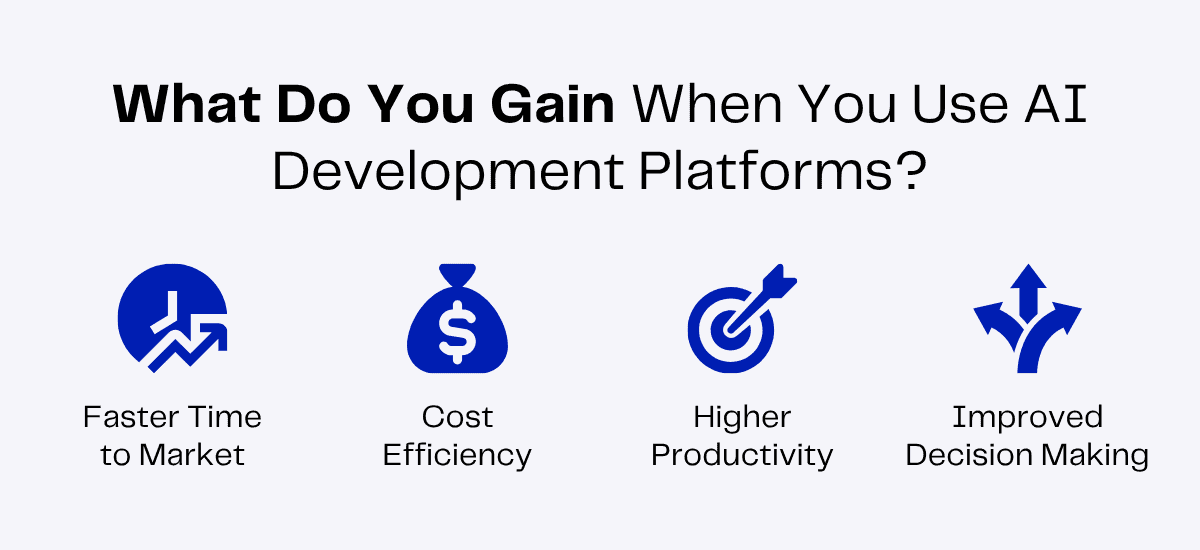
From reducing costs and development time to enhancing decision-making and productivity, AI development platforms empower businesses to innovate at scale.
Here’s an in-depth overview of how they benefit your business.
Faster Time to Market
Late-stage software design changes often create a ripple effect requiring extensive re-engineering and re-budgeting, causing project delays.
For such situations, you need flexible and agile technology to accelerate processes.
AI development platforms come with pre-built models, APIs and automation tools that significantly reduce development time. In fact, a study on the business opportunity of AI found that 90% of AI deployments take 12 months or less.
Instead of building everything from scratch, businesses and developers can quickly prototype, test and deploy custom solutions based on their needs.
This speed helps you launch products faster, respond to market changes quickly and stay ahead of competition in this AI-driven landscape.
Cost Efficiency
Cloud-based AI platforms eliminate the need for expensive tech investments, reducing upfront infrastructure costs. Businesses can also opt for pay-as-you-use models and scale according to needs, improving budget control.
Additionally, AI automates repetitive tasks, helping you cut operational and labor costs. Using pre-trained models and managed services, you further save on heavy engineering expenses.
Studies show that AI investments deliver an average return of 3.5x! This highlights that businesses leveraging AI aren’t just saving costs, but unlocking exponential value and competitive advantage!
Higher Productivity
In a survey of developers worldwide, over 80% reported that increased productivity is the number one benefit of using AI in their workflows, highlighting its significance in the workplace.
AI development platforms help automate repetitive tasks such as data processing, testing and reporting, freeing teams to focus on high-value tasks.
Automation also minimizes human errors, improving output quality and reducing unnecessary rework, accelerating development cycles and significantly enhancing your team’s productivity.
Improved Decision Making
AI development platforms replace guesswork with data-backed precision, helping businesses make faster, better decisions.
By processing live data streams, forecasting trends, user behavior and risks and handling massive datasets, AI’s predictive analytics function turns raw data into actionable intelligence without wasting manual effort.
Businesses can also leverage AI to analyze historical data and accurately estimate project cost and timeline, reducing uncertainty and improving planning.
Top AI-Powered Applications and Their Use Cases
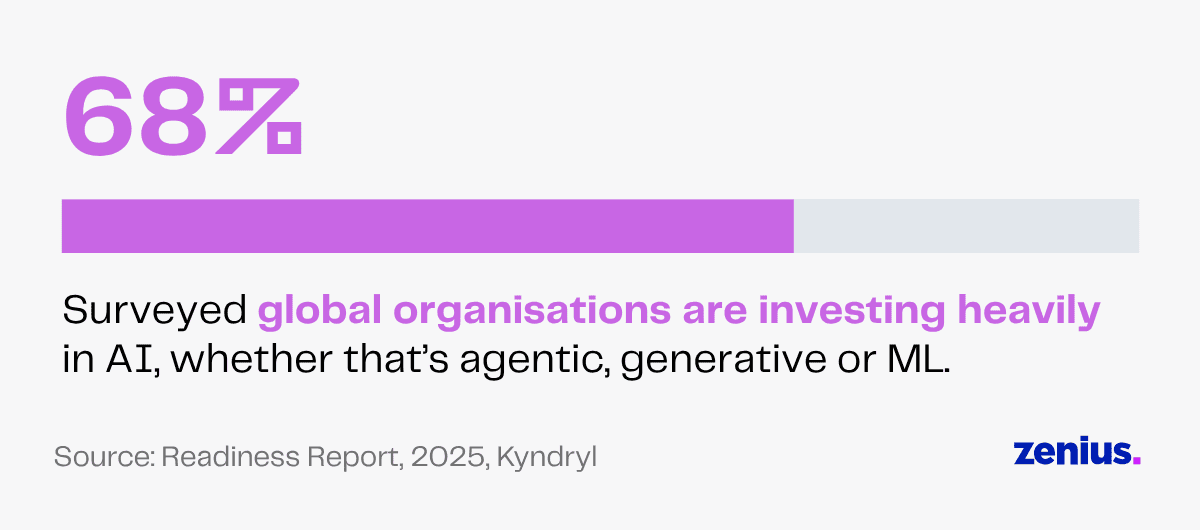
According to Kendryl’s 2025 AI Readiness report, around 68% of surveyed global organisations are investing heavily in some form of AI, whether that’s agentic, generative or machine learning.
And this isn’t just a passing trend. It’s a full-scale shift in how businesses compete today and stay future-ready!
The gap is widening between businesses that adopt AI and those that delay. Waiting is riskier than experimenting—which is exactly why you must adopt AI tools, accelerate your operations and stay competitive!
Here are our top picks for the ruling AI-powered applications that can help you drive innovation, productivity and higher ROI in your business.
Generative AI Tools
As per Menlo’s 2025 State of Generative AI in the Enterprise report, the surveyed U.S. companies spent $37 billion on generative AI in 2025, marking a 3.2x surge compared to the previous year.
Generative AI adoption is rapidly increasing, with most businesses using it primarily for product engineering, marketing and content creation.
Read more: Generative AI vs Deep Learning: A Simple Guide to Key Differences
ChatGPT
ChatGPT is a prompt-based, conversational AI tool by OpenAI that understands and generates human-like text, helping businesses automate, create, analyze and engage at scale.
With nearly 180 million downloads, ChatGPT was the most downloaded generative AI mobile app worldwide as of March 2026. This highlights massive global adoption across industries and everyday users for content support, research, coding and more.
Your business can also leverage its features for:
- Content creation, including blogs, emails, ads and product descriptions.
- Marketing campaigns that need catchy copy, captions and scripts.
- Caption, image and video generation for social media.
- Quick summaries, documents and reports to streamline internal workflows.
- Product engineering with coding based on user prompts.
- Content translation and localization for global audiences.
Google Gemini
Google Gemini is a gen AI model developed by Google with multimodal capabilities that seamlessly integrate with Google Workspace.
It comes in multiple versions such as Gemini Ultra, Gemini Pro, Gemini Flash and Gemini Nano, each tailored for specific tasks.
You can use Google Gemini for tasks like:
- Long email thread summarization.
- Calendar conflict summarization and meeting agenda creation.
- Real-time, deep research for information like competitor moves or pricing changes.
- Video analysis.
- Complex document analysis.
AI Assistants and Chatbots
The global chatbot market size is projected to reach USD 41,244.2 million by 2033, growing at a CAGR of 19.6% from 2026 to 2033.

AI chatbots are being increasingly adopted across sectors such as customer service, banking and healthcare, with retail and e-commerce dominating the chatbot market to enhance customer interactions and streamline operations.
The biggest benefit of using AI assistants and chatbots is their 24/7 availability, helping businesses reduce response time for basic issues and enhance user satisfaction.
Microsoft Copilot
Microsoft Copilot is an AI-powered conversational assistant integrated into the Microsoft 365 apps that turns everyday tasks into faster, smarter and more intuitive workflows.
Using natural language prompts, it simulates human interactions, understands context and automates actions, helping you save time and boost productivity.
Microsoft Copilot can help you with:
- 24/7 intelligent customer support to answer queries instantly, resolve common issues and reduce wait times.
- Handle FAQs, order tracking and personalised recommendations for your products.
- Engage website visitors and assist sales teams in filtering high-intent leads.
- Help employees summarize emails, retrieve files from the knowledge base and get quick answers, simplifying internal operations.
- Provide multilingual support by interacting with global customers without needing separate support teams.
Zendesk
Zendesk is a customer service platform that offers ticketing services, omnichannel assistance (email, chat and social media) and analytics support powered by artificial intelligence.
Zendesk AI assistants can:
- Handle customer queries across channels with back-and-forth interaction.
- Create human-like, context-aware responses automatically.
- Understand queries and send them to the right flow or agent instantly.
- Handle conversations in 80+ languages for global support.
- Track conversations and continuously improve responses using data.
Email Assistants
Dianna Booher, the CEO of Booher Research Institute and a communication expert, says,
Unfortunately, whether at work or on vacation, most of us are still tapping away … chances are, your email habits drain you, both mentally and emotionally.
That spells lost productivity for your organization and stress for you … while email has many benefits, it has also engulfed us and created other productivity drains.
To make inbox management faster and smarter, businesses can leverage email AI assistants to automate and optimize how they manage emails.
From drafting and rewriting to summarizing and prioritizing, these intelligent tools turn cluttered inboxes into organized hubs, making day-to-day communication easier for busy professionals.
Superhuman
Superhuman is a premium AI-driven inbox assistant designed to make email management faster, smarter and less overwhelming.
It claims that it saves teams over 15 million hours every single year!
Its features include speed-first design, deep keyboard shortcuts, split inboxes, AI-powered drafting and smooth integration with Gmail and Outlook.
Superhuman helps you with:
- Writing quick, context-aware replies.
- Sorting emails into custom tabs (“team”, “personal” or “VIP”) using the “Split Inbox” feature to reduce clutter.
- Tracking when emails are opened and engaged with.
- Scheduling meetings and sharing availability over email.
Scheduling Platforms
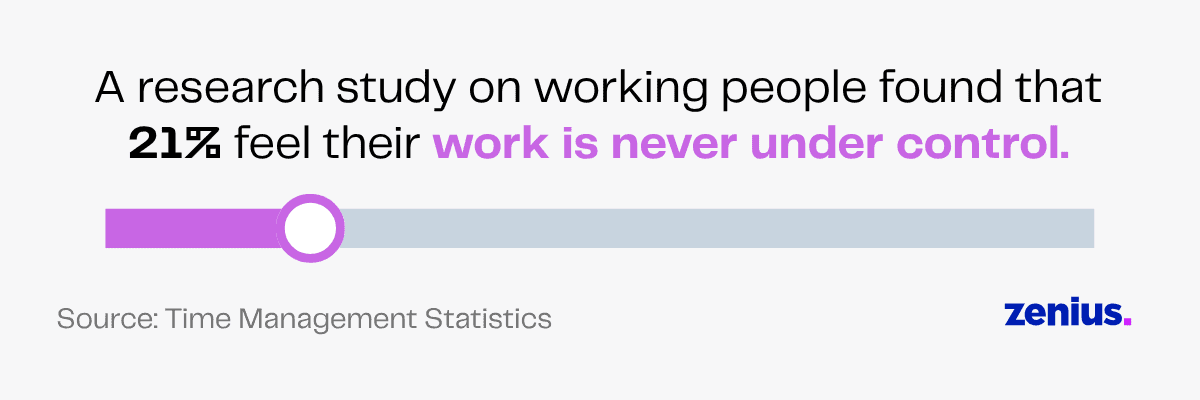
A research study on working people found that 21% feel their work is never under control.
Poor planning habits, distractions, procrastination or multitasking can affect how you manage your schedule and impair your productivity. You need a better strategy for seamless calendar management and workday scheduling.
Smart scheduling tools can simplify your work life. They’ll help you automate meeting coordination, sync calendars, manage availability, eliminate email back-and-forth and make workday planning hassle-free!
Reclaim AI
With Reclaim AI, you can put your calendar on autopilot. This AI-powered scheduling assistant helps you automatically organize your calendar around tasks, meetings and routines.
One of its key features includes its ability to continuously reprioritize and reshuffle your schedule in real-time.
Use Reclaim AI for:
- Automatically scheduling tasks and meetings in the best time slots based on priorities.
- Adjusting your calendar dynamically in case of spontaneous changes.
- Blocking uninterrupted time for deep work.
- Merging multiple calendars (work and personal) to eliminate chaos and prevent double booking.
- Getting solid analytics on how you spend time to adapt better strategies for work-life balance.
Wrapping Up
Investing in artificial intelligence and machine learning tools is no longer optional—it’s essential for businesses aiming to stay competitive and future-ready.
As your business operations and market grow, you’ll need to assess your business goals and choose the right AI/ML tools that align perfectly.
And to leverage them effectively, you must find the right talent to build, train and optimize solutions.
From AI & automation developers to machine learning engineers, Zenius can help you find the right professionals.