Key Takeaways
The rules for hiring are changing fast and this means there is a growing margin for new errors.
Hiring isn’t limited to job descriptions and pay scales anymore. Company reputation and employee experience are increasingly taking center stage.
Recruitment is incredibly competitive; if you aren’t quick to show interest and keep candidates engaged, you can end up getting ghosted.
Still paying dues from the last time you hired someone because of their perfect resume?
They looked like the ideal candidate, but ended up disappointing you. They couldn’t even handle routine operations. Now you spend hours training them and holding their hand every step of the way in hopes they will live up to the expectations.
Bad hiring can waste resources, halt workflows abruptly and prevent scaling.
Hiring is essential for scaling operations and it is a great opportunity to level up the skills and competencies present in your workforce.
So why is it that only 28% of businesses get it right? One reason is that there is an overwhelming number of things to look out for.
To make sure you make the best hiring decisions every time, here’s some expert advice on common mistakes to avoid while hiring.
Hiring Trends To Look Out For
The fear of ending up with wasted resources and a mediocre team that caps your ability to reopen hiring is real, especially with how quickly hiring trends are changing.
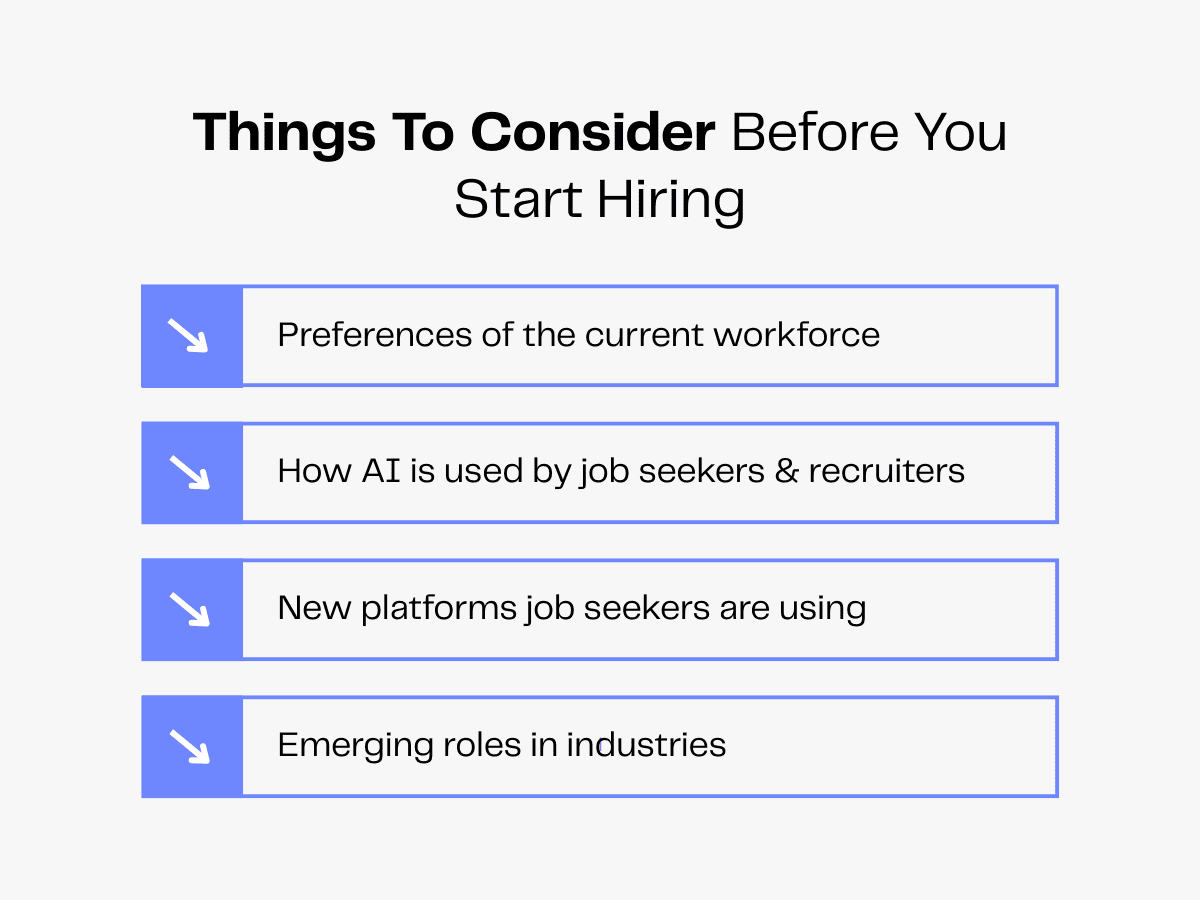
Imagine spending all your finances on hiring a team, only to find out all the best candidates weren’t even on the platform you used. Such things happen when you’re not aware of the recent trends in the job market.
Changing Workforce
The 2026 workforce is not like previous generations. From Lily Padding to Micro-retirement, they are redefining career ladders.
Instead of aiming for a higher position at a single company, Gen Z employees jump from one similar role to another, like frogs on lily pads, to gain a range of unique experiences and skills. They also prioritize mental health, taking “short retirements” that last weeks or months in their careers to reduce burnout.
While the older generations and teams had prioritized the hustle mindset and long-term relationships at jobs, Gen Z also wants a workplace that aligns with their values. There is also a greater need for job security and the new workforce is constantly struggling to balance security and independence.
This makes things trickier for recruiters.
Hiring today isn’t limited to the job descriptions but is closely intertwined with company reputation and employee experience. Candidates don’t just care about the role and the salary, but also about other benefits like growth opportunities.
AI in Hiring and Resumes
Another trend shifting the hiring process is the role of AI.
…2026 is the year of more widespread adoption of AI tools, particularly in hiring, said Janine Chamberlin, LinkedIn’s U.K. country manager
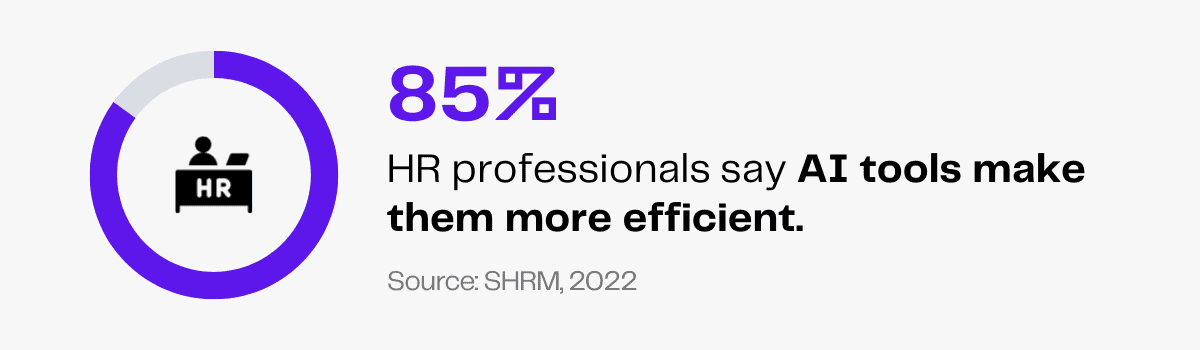
AI tools for candidate tracking, resume parsing and interviewing are cutting down the administrative hassles of hiring. As many as 85% of professionals using AI tools claim the tools have helped them boost efficiency.
So it’s no surprise that 1 in 4 organizations say they aim to increase AI use for recruitment.
This not only makes hiring faster but also changes how candidates need to be evaluated. You might have already noticed that resumes are getting keyword-heavy and formatted to make it easy for AI tools to parse and not necessarily for humans.
On the one hand, it’s helping recruiters automate large volumes of applications. On the other hand, it’s making the human touch more scarce.
When everything from resume writing to screening is handled by AI tools, the actual candidate-recruiter interaction doesn’t begin until the interview stage or sometimes even later!
This can create a major disconnect between the company and the candidates who want to join it. That’s what’s making cover letters even more important in the hiring process.
New Rules for Hiring
The old strategy of creating a checklist of skills and experience isn’t enough anymore to hire the best candidates.
To adapt to the changing landscape, recruiters now have to think about finding culture fits, resourceful hires and candidates committed to a learning mindset.
While AI tools can help sift out irrelevant applicants by identifying hard skills, recruiters need to find new ways to test if candidates’ personal goals and work ethic align with the company’s values.
The rules for hiring are changing fast and this means there is a growing margin for new errors. So, how do you safeguard your operations from these mistakes?
More importantly, what mistakes do you even need to look out for?
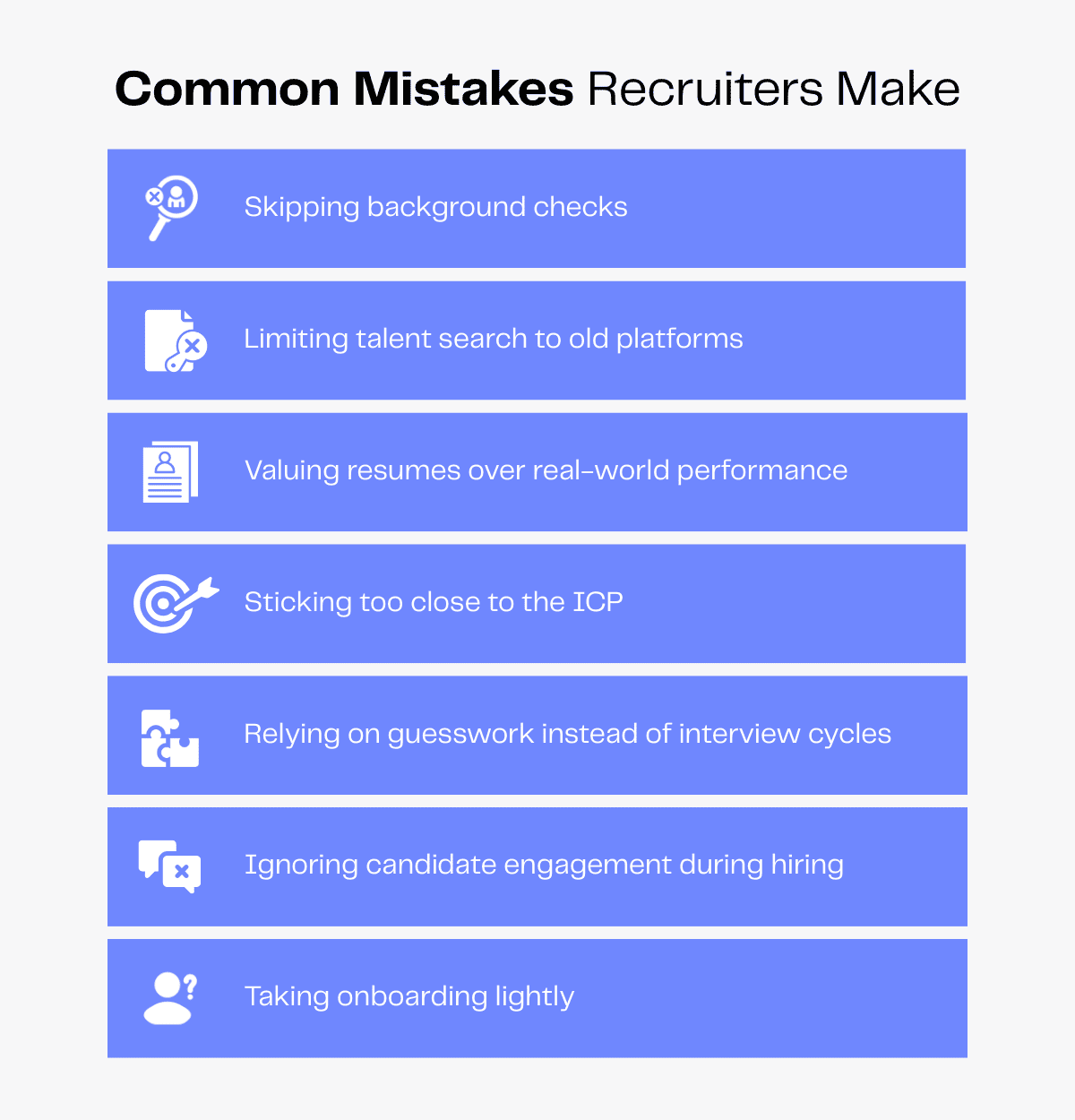
Top 7 Common Hiring Mistakes Businesses Make
Ever made a hiring mistake that was so obvious you can’t believe it happened? You are not alone.
Every workflow has weak points that can turn into hurdles.
The key is to identify the most common mistakes that sneak into the hiring process so you have a plan in case something goes wrong.
Here are 7 of them you can start avoiding today.
Skipping the Background Checks
Whether you’re hiring by posting a job description online or through referrals, a background check is an essential step.
Otherwise, you can fall for perfect-looking resumes of people who simply don’t exist.
“The thing I regret the most was not doing more background checks. I skipped them not because they were expensive, but because I wanted to hire fast,” said Daniel Kroytor, the CEO of Tailored Pay.
“That ended up being a mistake because we hired a candidate with a completely fabricated background. They made up their entire resume and they somehow went through three interviews with solid performance. When they actually started working, it was clear after one week that they didn’t know the basics of the job. We lost thousands of dollars and a month we’ll never be able to get back.”
The issue is that fake resumes can sound incredibly real and it is an escalating concern. So recruiters need to double down on candidate checks if they want to prevent problems down the line.
Limiting Talent Search to Old Platforms
The new workforce isn’t just changing how you create job descriptions. It’s also changing where you need to post them!
Just like handing out flyers is outdated, just posting applications on job sites is not enough, either.
Recruiters often make the mistake of sticking to old and trusted platforms. But when you keep searching for candidates on the same old platforms, you’re only getting job seekers with the same old skills.
To maximize job posting visibility, your recruiters need to cast a wider net and explore a range of platforms depending on what niche you’re hiring for. You can get creative here and explore social media platforms like Instagram and X (Twitter), where your target candidates are.
This means going beyond the usual job sites like LinkedIn, ZipRecruiter or Glassdoor and creating communities on Facebook, Reddit, GitHub and even Discord for some roles.
Valuing Resumes Over Real-World Performance
One mistake that recruiters often end up making is trusting resumes a little too much.
Glenn Orloff, CEO of Metropolitan Shuttle, said, “Having operated two decades performing high-volume, time-sensitive tasks, the most regrettable hiring error was placing too much weight on resumes and placing too little weight on real-world execution.”
According to him, “Companies are obtaining candidates who interview well, but they have no evidence of being able to perform under pressure … The fact that hiring workflows focus on structure, pedigree, and keyword-matched resumes gives the impression that hiring is objective and can be based on something other than situational performance. As a result, in roles where interviews are not connected to the real job experience, early turnover has exceeded 30%.”
The major issue here is that there is a huge gap between reading candidates’ skills on paper and judging their actual potential. This makes custom role-based assessments a cornerstone for successful hiring.
Read more: 5 Major Virtual Assistant Assessments To Find the Best Candidate
Sticking Too Close to the ICP
If you’ve recruited before, you know several factors decide the quality of the talent pool. It can be an off-season, a lack of job seekers or missing skills that can hold you back from finding someone who remotely fits your ideal candidate profile (ICP).
This can drag on your recruitment cycle, costing you money and resources, leaving your recruiters burned out.
The mistake here isn’t creating an ICP and knowing what you want, but sticking too close to it. In response to rapid tech growth and an insatiable market, Gen Z job seekers are focusing on acquiring a range of adjacent skills. This means that traditional ICPs with a clear career ladder are insufficient for successful recruitment.
Recruiters now need to have a deeper understanding of the role they are hiring for. While ICPs are still a good starting point, understanding which interdisciplinary skills or adjacent roles would add agility to the role can give businesses a competitive advantage when hiring.
Relying on Guesswork Instead of Interview Cycles
Hiring is a human-first process, but over-reliance on instincts is a big no!
Recruiters often turn to quick gut checks based on a single interview to speed up hiring, but this can open your processes to more mistakes. While instincts can be useful sometimes, data-driven decisions are always better.
Recruiters are under pressure to move roles quickly, and managers assume resumes and first screens reveal ability.
Nik Witowski, co-founder of NextRound
For example, a candidate might ace a 30-minute call but fail to run a full sales demo or build a real campaign. Managers often miss this because the traditional process only tests surface skills.
The solution would be to have interviews that solely focus on challenges or mock scenarios; however, this has now seen a major shift as tools like Cluely emerge, so continuous iterations are required.
The problem is simple. Relying on instincts can lead to biased decisions, but having a single interview or assessment isn’t enough either. It’s also easy to get AI’s help for interviews without getting detected, as highlighted by Nik.
What your hiring process needs is a step-by-step interview strategy with humans in the loop to ask the right questions and gather key information like candidate abilities, mindset and attitude.
Ignoring Candidate Engagement During Hiring
Another common hiring mistake recruiters make is not planning for candidate engagement during the hiring process.
Hiring is incredibly competitive. If an applicant is highly qualified, chances are they have applied to a few different job postings. This means if you aren’t quick to show interest and keep them engaged, you can end up getting ghosted.
So recruiters need to keep an open line of communication with selected candidates, whether in the form of consistent emails, calls or chats.
Another thing to look out for is avoiding being spammy. Sending constant emails can quickly turn into noise and leave a bad impression. The key is to strike a comfortable balance so that the candidate is updated about their application status without feeling overwhelmed.
Taking Onboarding Lightly
A common misunderstanding in hiring is that people often think that once a candidate is selected, the hiring process has ended.
But candidates who have a negative onboarding experience are over 50% more likely to leave the job, resulting in high turnover rates.
Himanshu Agarwal, co-founder of Zenius, said, “… in my opinion, a chaotic onboarding can dismantle months of sourcing, interviewing and closing efforts. Fragmented or rushed onboarding processes fail to communicate KPIs or ramp plans for new hires. Underperformance in such cases actually results from a lack of foundational training but ends up looking like a bad hire.”
“I recommend structuring the onboarding program into a gradient, where responsibilities and cross-functional teams are introduced gradually. A 30-60-90 day ramp plan has helped us pace recruits in our in-house teams.”
Recruiters need to work with HR professionals to ensure that hiring has a proper and positive closure. This means having a solid onboarding plan to assimilate the new hire into teams quickly and efficiently.
After all, performance management begins right from onboarding.
Final Thoughts
Hiring is inevitable, but hiring mistakes are not.
Just knowing and establishing guardrails for common mistakes isn’t going to cut it in 2026. You need to handle job postings, post on multiple job and social platforms, take rounds of interviews, conduct assessments, handle candidate engagement and a hundred other tasks.
Luckily, if you aren’t ready for the task, you can always reach out to staffing agencies like Zenius to help you avoid mistakes businesses end up regretting. We handle remote talent recruitment so your routine operations stay uninterrupted and you stay on top of hiring trends.