Key Takeaways:
The data labeling solution and services market is expanding at a CAGR of 22%.
The quality of labeled data influences the accuracy of predictions. Doing it right requires skilled professionals, time and consistent effort. That’s why many businesses choose to outsource data labeling!
When choosing between outsourcing and internal teams, evaluate investment against the volume of data and return on investment in both cases.
Generative AI has taken the world by storm! Big or small, all businesses now want to attract customers with AI solutions.
As a result, investment in the machine learning market has increased and the need for preprocessing activities like data labeling is booming!
But here’s the catch: This one-time data labeling task defines how well machine learning models perform. The quality of labeled data influences the accuracy of predictions.
Doing it right requires skilled professionals, time and consistent effort.
That’s why many businesses choose to outsource data labeling! It’s a faster, cost-effective way to access reliable candidates and get accurate results.
Let’s discuss all the ways outsourcing can help you.
What Is Data Labeling?
Data is processed before it’s fed into large language models (LLMs) for training. This pre-processing step prepares data by cleaning, structuring and transforming it.
Data labeling is an essential part of machine learning pre-processing.
It involves identifying properties in unstructured data and providing context. For example, recognizing sentiment in a tweet and describing it accordingly.
The purpose of data labeling is to provide meaningful information that helps machine learning models understand what the data means.
Machine learning works somewhat like teaching a child. When a machine is fed pictures of different animals labeled with their names, it begins to recognize the animals.
The more accurate your data labeling, the better the results. If you accidentally label an image of a jaguar as “cheetah,” it will mislead the machine.
Thus, accurate data labeling is a must for precise predictions.
How Does Data Labeling Work?
The data labeling process follows the following steps:
- Collecting data: The first step is collecting a large dataset. Depending on the machine learning model, this data can be images, audio, video or text.
- Defining labels: Next, categories and guidelines for labeling data are established. These cover topics like how to identify data, how to match it to the right categories, what context data labelers must provide and what to do for edge cases.
- Labeling data: Human labelers or AI tools label raw data according to guidelines.
- Reviewing: After labeling, the data is checked for accuracy. In case of errors or discrepancies, the labels are corrected.
Uses of Data Labeling
Data labeling is fundamental in various fields of artificial intelligence (AI). Machine or deep learning models that use supervised learning rely on labeled data to recognize patterns and make accurate predictions.
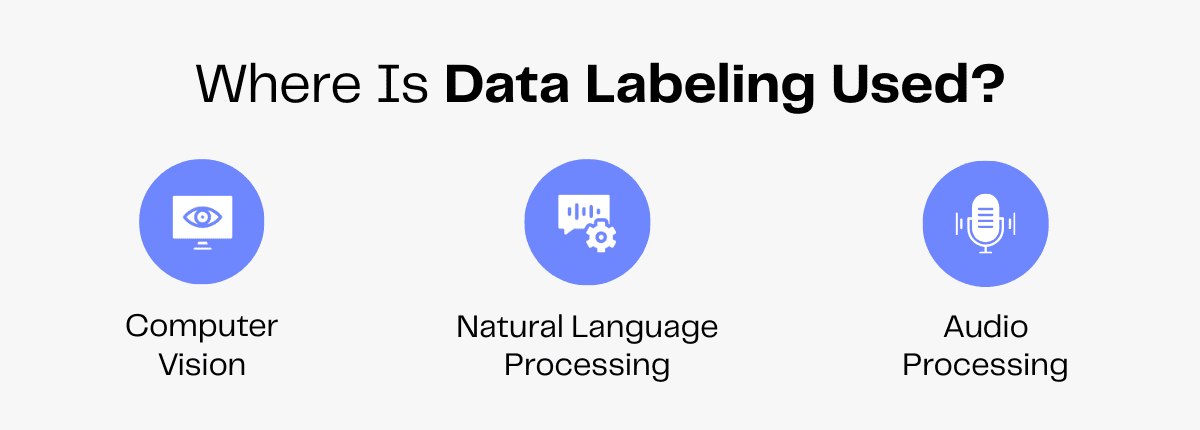
In this section, we’ll discuss AI fields that work with labeled data.
Natural Language Processing (NLP)
Natural language processing (NLP) combines machine learning with linguistics.
It trains machines to identify, understand and replicate elements of human language. NLP powers solutions like chatbots, machine translation, grammar checkers, email classification and auto-complete.
Computer Vision
Computer vision is a field of AI that trains machines to interpret images and videos as humans do. Using convolutional neural network (CNN) models, machines learn and gain information from visuals.
Computer vision has diverse applications like automatic object detection, self-driving cars, facial recognition and crop monitoring.
Audio Processing
Audio processing involves converting sounds such as speech, music or background noise into structured, machine-readable formats.
This processed data is then used for classification, speech recognition, sound detection and audio synthesis.
Types of Data Labeling You Can Outsource
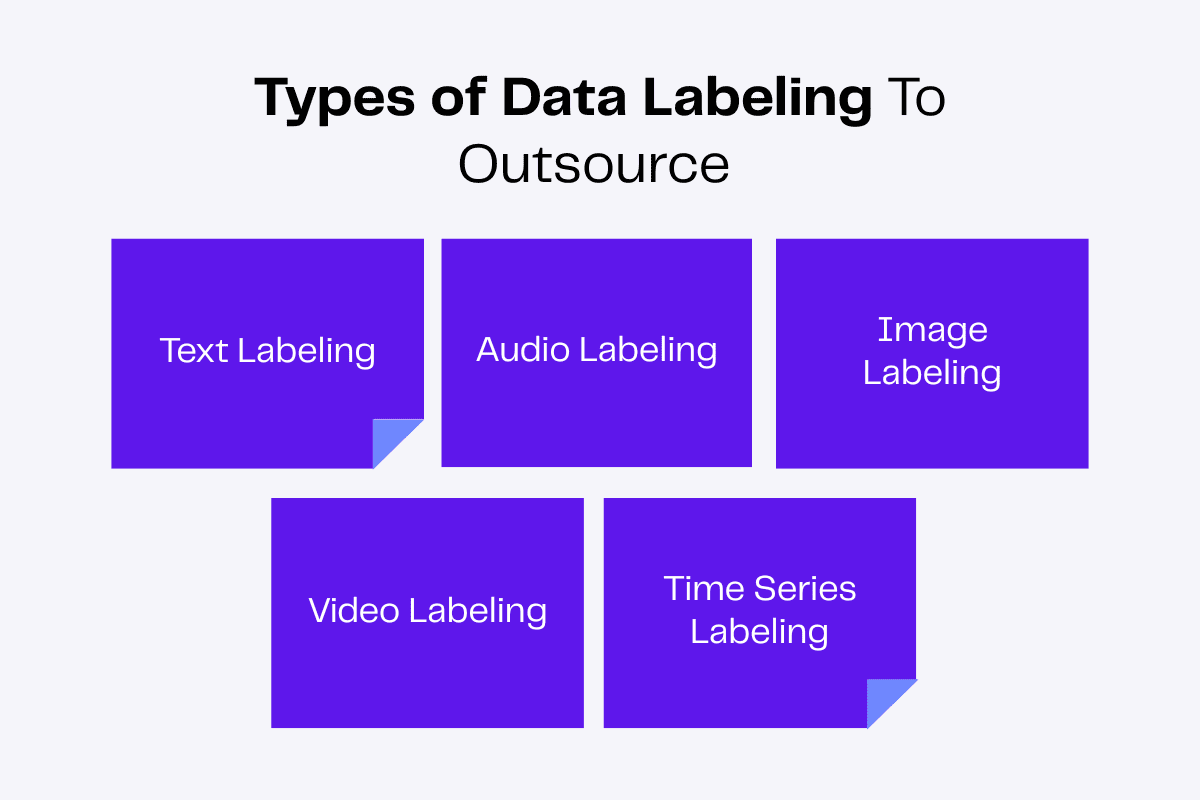
Different types of data are labeled to train machine learning models. The four main categories include text, audio, video and time series. Each data type supports a specific field of AI.
To outsource data labeling, you can hire skilled virtual assistants (VAs) to tag and annotate raw data.
Here’s a list of services virtual assistants can provide.
Text Labeling
Text-based labeling is mostly concerned with NLP. It helps NLP models understand written language.
Virtual assistants can label data, provide context and add metadata according to the model’s needs.
Here are the common types of text labeling:
- Sentiment analysis: Sentiment analysis involves identifying and labeling the emotion and tone in a text. For instance, virtual assistants can label a tweet about disliking a movie as “negative.” They can also add metadata about what words connote negative emotions.
- Named entity recognition (NER): NER identifies particular entities in the text, such as people, locations, dates and organizations. In the sentence “Stephen Hawking was born in 1942,” virtual assistants can label “Stephen Hawking” as a person and “1942” as a date.
- Part-of-speech (POS) tagging: Virtual assistants can tag parts of speech in sentences. For example, in the sentence “This is an informative article,” “this” is a demonstrative pronoun, “is” is the main verb, “an” is an article, “informative” is an adjective and “article” is a noun. VAs can label this with an explanation to help LLMs recognize grammar rules and lexical context.
- Intent detection: Data labelers can help recognize the intent behind a text. For example, they can label a search for “Apple MacBook price” as an intent to find pricing information. Virtual assistants can also add context to online conversations.
Audio Labeling
Audio labeling, unlike text labeling, requires switching between two media. Virtual assistants work with both audio and text formats.
It’s used for tasks such as:
- Speech recognition: Data labeling virtual assistants can transcribe audio into text form.
- Sound classification: Audio labelers can identify and tag specific sounds in audio clips, such as a waterfall, birds chirping or a cat meowing.
- Speaker diarization: Virtual assistants can recognize multiple speakers in an audio file and tag the audio to specify who’s speaking at what time.
Image Labeling
Virtual assistants can label images to identify and classify objects and people.
Image labeling includes:
- Image classification: This involves labeling the whole image as a single category. This is usually possible when dealing with specific data and limited categories.
- Object detection: Virtual assistants can find objects in an image, draw boxes around them and label them.
- Segmentation: Segmentation involves outlining the object pixel by pixel and labeling it. This way, virtual assistants help improve the accuracy of predictions.
Video Labeling
Video labeling involves annotating video clips to train computer vision models.
It includes tasks such as:
- Object tracking: Virtual assistants can detect objects in videos and track their movement across frames.
- Action recognition: Data labeling VAs recognize actions or postures in videos and label them within a time frame. This is commonly used for auto-detection in surveillance footage.
- Scene segmentation: Based on background, people and objects, VAs can segment videos into scenes. They can also label different components of a scene.
Time Series Labeling
Time series data includes a collection of data points logged over time, such as stock prices, website traffic, temperature records and sales figures.
Data labeling virtual assistants add context to such data by tagging important events and dates and adding metadata to data points.
In-House vs Outsourced Data Labeling
Confused between setting up an internal team and outsourcing data labeling? We can help you!
Here’s a breakdown of the pros and cons of hiring virtual assistants versus in-house employees.
This will help you understand their key differences and how each approach affects your business.
Pros and Cons of In-House Data Labeling
| Pros | Cons |
|---|---|
| Easier to communicate and collaborate with team members. | Time-consuming and costly to hire and train internal teams. |
| Full control over data security and privacy without the intervention of a third party. | Higher operational and overhead costs. |
| Physical supervision ensures continuous improvement and consistent accuracy. | Full-time employees are a long-term commitment with little room for scalability. |
Pros and Cons of Outsourced Data Labeling
| Pros | Cons |
|---|---|
| Cost savings by leveraging offshore labor markets. | Potential risk to security and privacy due to data being shared externally. |
| Flexibility to scale teams based on the volume of data. | The quality of work differs from one outsourcing company to another. |
| Access to global expertise and candidates skilled in the latest technology. | Communication and management require extra effort and collaboration tools. |
| Faster turnaround times with a streamlined workflow. | Difficulty in creating organizational culture and building cohesive teams. |
Factors To Consider Before Choosing
What factors should you consider while choosing between outsourcing and internal teams?
- Investment and ROI: Evaluate investment against the volume of data and return on investment in both cases.
- Time: Estimate the time required for data annotation in both cases.
- Communication and management: Assess if you have the necessary resources for remote communication and whether you’ll be able to supervise virtual assistants effectively.
- Expenditures: Compare the expenses of salaries, equipment and utilities for in-house employees versus the cost of hiring virtual assistants.
- HR and training: Consider the time and resources needed for hiring and training on-site employees against onboarding vetted candidates who need minimal training.
- Expertise: Determine the availability and expertise of local talent. If there’s a lack of local expertise, outsourcing lets you hire candidates from across the world.
- Scalability: Understand your business’s needs. Does the volume of data fluctuate over time? What factors affect the volume of data? Is there a possibility that the internal team will be underutilized?
Remember that both internal and external teams have their own pros and cons. You need to choose what works best for you in terms of profit and long-term goals.
Benefits of Data Labeling Outsourcing
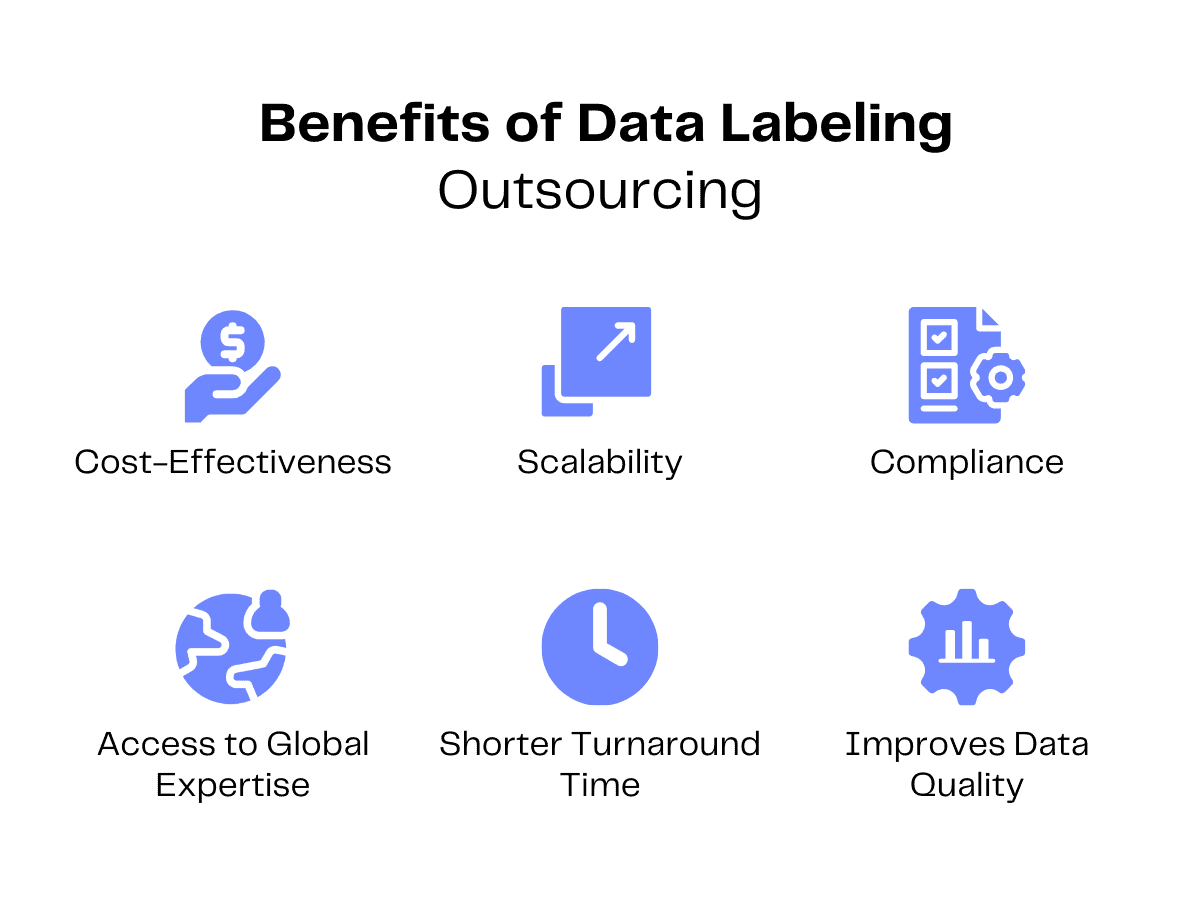
Let’s discuss the benefits of outsourcing data labeling for your business.
Cost-Effectiveness
Outsourcing virtual assistants helps you cut down on recruitment and training costs. Instead of blowing your budget on job postings, applicant tracking systems and signing bonuses, you only pay to hire candidates.
Virtual assistants also help you reduce overhead charges. Unlike traditional employees, VAs don’t need office space, utilities and equipment.
Outsourcing companies like Zenius even take care of your day-to-day HR management, covering payroll, taxes and legal compliance—saving you further time and money.
Scalability
Outsourcing data labeling services brings flexibility to the table.
Outsourcing companies offer different packages to cater to your specific business needs. You can hire a single VA, a dedicated virtual assistant or a data labeling team according to your budget.
Plus, outsourcing allows you to adjust your workforce according to the workload. You can expand or downsize your team as per your needs and even adjust the number of hours virtual assistants work for.
Improved Data Quality
Data quality depends heavily on metadata. It adds context and structure, making data more accurate, usable and easier to filter or organize.
Metadata is often described as “data about data.” For example, an image’s metadata is its file type, resolution and color depth.
Jonathan Sunderland, an information architect and analyst with over 20 years of experience with data, says,
Data without metadata is like a supermarket full of tins with no labels
A data labeling virtual team can manually add metadata to complex and unstructured data. Moreover, VAs ensure that accuracy and data integrity are maintained throughout the process.
Access to Global Expertise
Through virtual assistant companies, you can hire candidates from across the world. Instead of being restricted to local talent, you’re free to choose from a skilled global talent pool.
With tech-savvy talent on board, your team remains up-to-date with current technologies and best practices.
Global virtual teams are also diverse. Every member can bring forward fresh ideas, fostering innovation and creativity.
Shorter Turnaround Time
The size of a training dataset depends on factors like complexity, number of features and data availability. Neural networks typically require large datasets to learn from a diverse set of information.
When models are trained on small, simple datasets, they replicate rather than learn, resulting in poor performance. This problem is called underfitting.
To avoid this, machine learning models are trained on large and varied datasets.
Of course, labeling such huge volumes of data takes immense time and effort.
Dedicated virtual assistants are a great way to accelerate projects and reduce turnaround time. They bring undivided attention, helping you cut delays and boost productivity.
Compliance
Outsourcing companies take essential security measures to keep your data safe. They ensure compliance with local rules and statutory regulations, so you don’t have to worry about legal issues.
Virtual assistants also practice confidentiality to maintain privacy, giving you the peace of mind needed to focus on core business activities.
How Is Data Labeling Changing in 2026?
Emergence of Generative AI
OpenAI’s ChatGPT launched on November 30, 2022. It took ChatGPT only five days to gain one million users! The generative AI bot was capable of more than what people had seen before.
This development accelerated investment in AI solutions.
According to Bloomberg, in October 2023, AI funding was more than any other technology. The investment reached $17.9 billion in the third quarter of 2023. This was a 27% increase from the previous year.
The following years saw AI models from tech giants like Google’s Gemini, Twitter’s Grok and Microsoft’s Copilot.
The increased investment in generative AI also indicates a rise in the development of machine learning models. As a result, there’s a growing demand for data preprocessing services such as data labeling.
Growth in Demand for Data Labeling Services
According to FactMR, the data labeling solution and services market is expanding at a CAGR of 22%.
It was estimated at $12.7 billion in 2024 and is expected to be valued at $92.4 billion by 2034.
North America led the data labeling market in 2024 with a 33.9% share. This can be attributed to the large number of technology companies and AI research centers in the region.
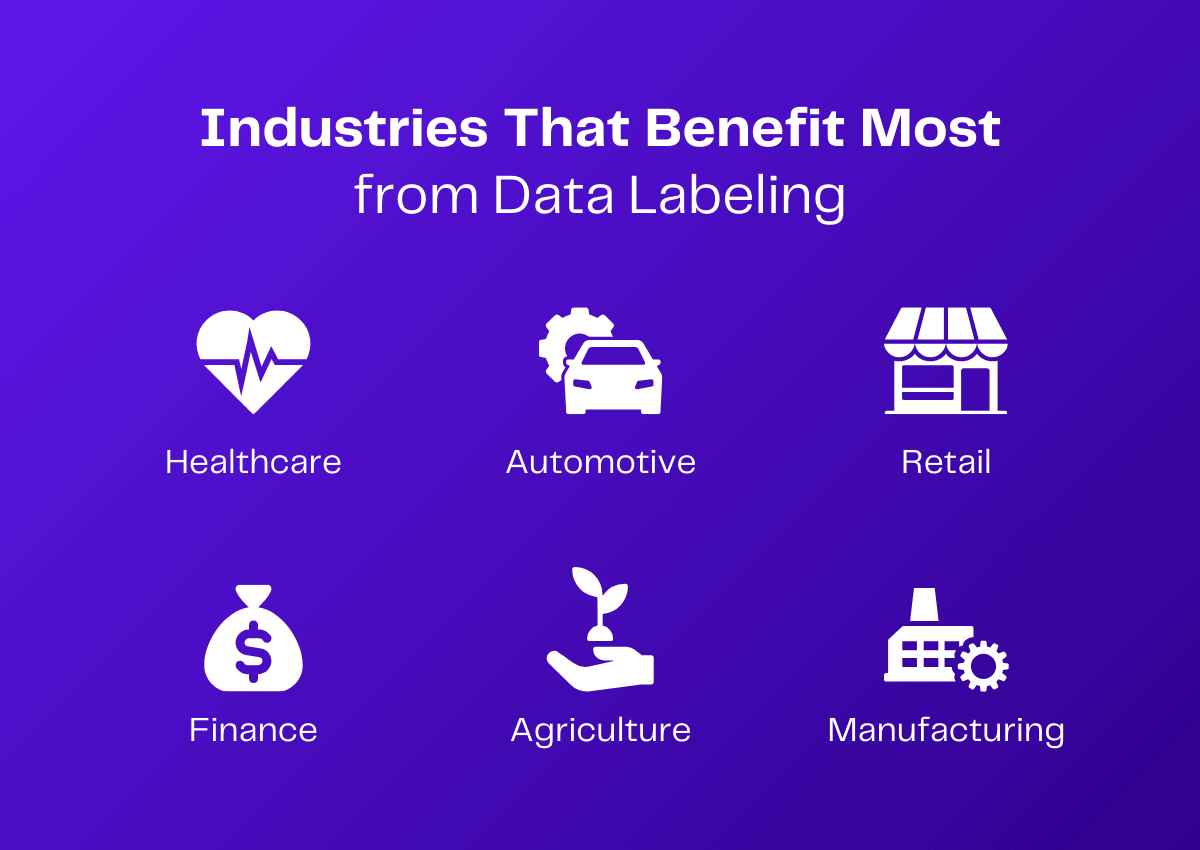
The demand for data labeling also spans several industries, with healthcare, automotive, finance, retail, agriculture and manufacturing sectors topping the charts.
Predictions for the Future
Current trends suggest continued growth in the data labeling industry.
Demand for niche data types like geospatial, semantic and sensor data annotation is also expected.
Moreover, in a future market saturated with AI solutions, people will look for the best. The most accurate models will sell. Thus, quality assurance during data labeling becomes essential. The more accurate and helpful the labels are, the better the models will predict.
Based on current trends, knowledge processing outsourcing (KPO) is also growing. As businesses increasingly seek data-driven insights and analytics, tasks like data labeling become more relevant.
Wrapping Up
Data labeling is essential in many fields of AI, such as computer vision, NLP and audio processing. Machine learning models rely on annotated data to learn patterns and make predictions.
Data labeling VAs can manually annotate all kinds of data—text, videos, images and audio! They work diligently to meet deadlines while prioritizing data quality and security.
Zenius can help you build the right team for your business.
Through our rigorous screening process, we vet each candidate’s skills, qualifications and expertise to find you top global talents.
We also handle day-to-day HR tasks like payroll and leave management, so you can stay focused on your core business activities.