Key Takeaways:
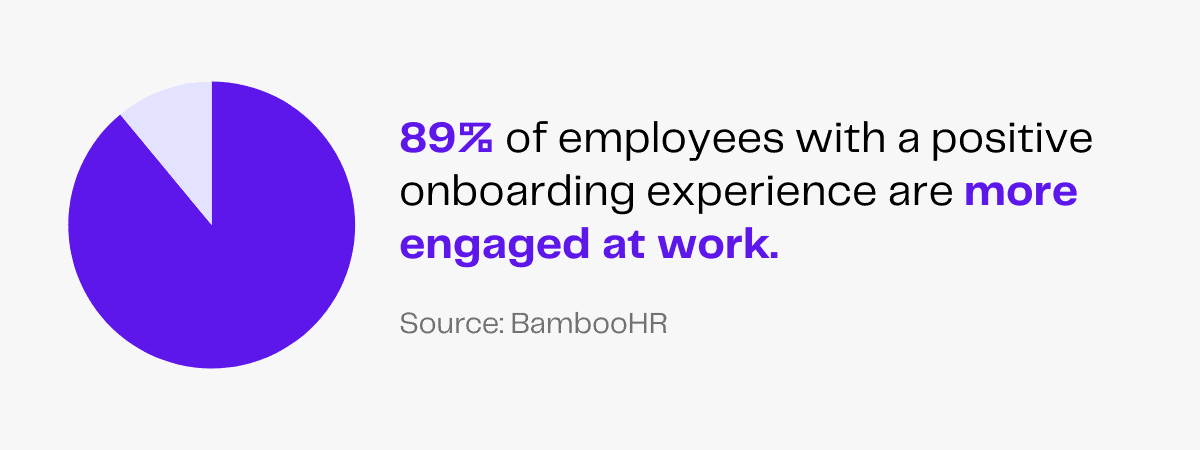
89% of employees with a positive onboarding experience are more engaged at work.
A strong onboarding process can improve new employee retention by 82% and elevate job performance by 56%.
59% of employees say training improves their overall job performance and 51% believe it gives them more self-confidence. This is why you must provide your team members with comprehensive training modules.
Onboarding is crucial for both employees and employers. After all, the first impression is often the last.
For a good team leader, it’s the first opportunity to introduce the company’s values and goals to their new hire. On the other hand, it offers employees a look into how their new workplace operates.
When done right, onboarding boosts employee productivity and helps them integrate smoothly into the company.
So how do you do it right?
Before we get there, let’s explore the importance, benefits and challenges of onboarding virtual team members.
What Is Virtual Employee Onboarding?
Virtual onboarding is the process of welcoming and integrating a new remote employee into your organization.
Just like in-person onboarding, it includes an introduction to the job, orientation and compliance training. The only difference is that it happens online.
Onboarding employees virtually can be extensive, since you have to familiarize them with the company’s culture and workflow.
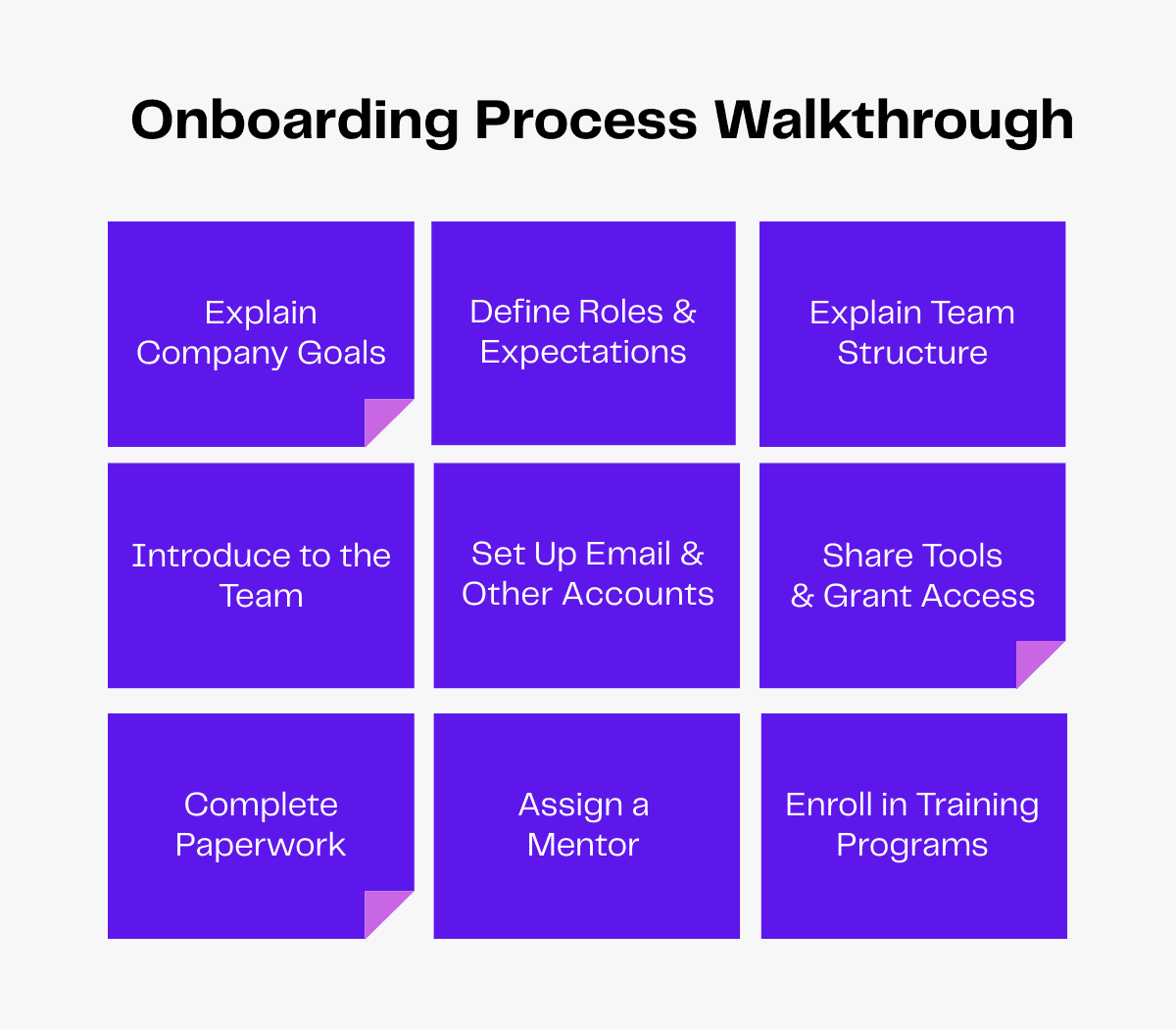
Here’s a list of things covered while onboarding virtual team members:
- Explaining your company’s goals, principles and policies.
- Defining the employee’s job expectations and responsibilities.
- Familiarizing them with the organization’s structure.
- Introducing the new employee to their team members.
- Setting up their work email and essential accounts.
- Acquainting the employee with the tools used for work.
- Completing the required paperwork and documentation.
- Assigning a mentor or point of contact, if needed.
- Enrolling them in the relevant training programs.
Read more: Managing Virtual Teams for Ultimate Success
How Long Does Onboarding Virtual Employees Take?
Onboarding isn’t a one-time event that happens on the first day. It’s an ongoing process that can span from weeks to months, depending on the role and company.
While onboarding a new employee can take anywhere from 3 months to a full year on average, you shouldn’t restrict it to a specific time period.
Onboarding employees doesn’t stop at a virtual welcome to the team. It includes giving clear directions, checking in regularly and ensuring new hires aren’t lost while they learn their way around.
A new hire can’t be overloaded with information and expected to deliver results immediately. That’s why it’s better to take time and help them ease into the role confidently.
Why Is Virtual Employee Onboarding Important?
New hires, especially recent graduates, have little knowledge of how organizations operate.
Even experienced employees are still unfamiliar with your company’s unique workflows.
Onboarding brings both the employee and employer onto the same page. It establishes expectations on both sides and sets the tone for the future.
It’s natural for new hires to feel confused in an unfamiliar workspace.
By hosting a virtual employee orientation, you provide them with crucial information, offer reassurance and create a safe space to clear doubts.
When new employees feel welcomed, it positively impacts their performance and relationship with coworkers.
The Benefits of Virtual Employee Orientation
As discussed in the previous section, orientation lays the foundation for future performance.
A comprehensive orientation helps employees feel informed, welcomed and ready to bring their A-game. In virtual teams, this is especially important.
While they seem small, these early efforts improve the employee experience in the long run.
Let’s explore the key benefits of virtual employee orientation.
Long-Term Employee Retention
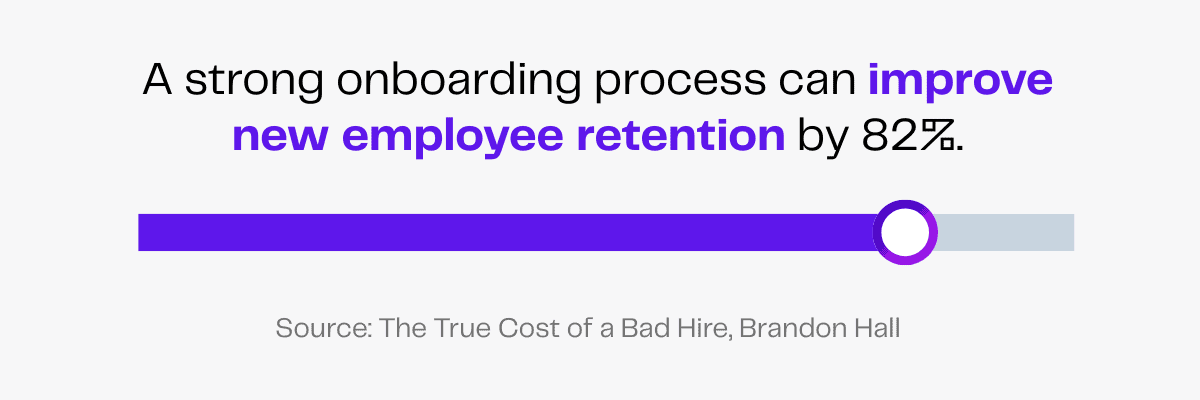
According to research, a strong onboarding process can improve new employee retention by 82%. These initial months are a crucial period where new hires adapt to the workload and culture.
On average, employees decide whether to stay or leave a company within the first 44 days.
If the onboarding process feels overwhelming, they might question if the job is right for them.
In contrast, an engaging and supportive orientation reinforces their decision to take the job. It assures them that the company values their well-being and professional growth, compelling them to stay longer.
Collaborative Work Environment
Introducing new hires to their coworkers is an essential part of virtual employee onboarding.
An introductory video call helps ease employees into the workspace and sets the stage for collaboration.
When virtual teammates connect and engage with each other, they build stronger bonds and work more effectively together. Good teamwork and communication, in turn, boost productivity, creativity and efficiency.
Enhanced Productivity
It takes some time before new hires become fully productive, but effective virtual employee onboarding can reduce this learning curve.
According to BambooHR, 89% of employees with a positive onboarding experience are more engaged at work.
Clarifying responsibilities, expectations and Key Performance Indicators (KPIs) helps employees deliver better results.
Proper guidance on the software and tools used for daily tasks also helps them settle faster.
A supportive onboarding also fosters a deep sense of belonging, which in turn can elevate job performance by 56%.

Reduced Employee Turnover
According to Gallup’s 2024 report, 42% of employees who decided to leave never faced any intervention from managers.
This highlights how a lack of communication and support can lead to turnover.
Most employees leave within a few months if they don’t adjust well. Onboarding helps prevent this by offering support from the start.
If both parties are honest about their expectations and plans early on, it reduces the chances of conflict of interest later.
Orientation also provides insights into the workload and the company’s leave, attendance and code of conduct policies.
Regularly checking in with new hires about job satisfaction and career plans can help avoid unexpected exits.
Better Time Management
Onboarding virtual employees reduces uncertainty and clarifies key job expectations. However, it’s best not to go into too much detail right away.
Sharing well-organized resources is the best way to familiarize new hires with their role without overwhelming them. This allows them to learn at their own pace and absorb all the information over time.
It also prevents back-and-forth queries. A new employee can rely on the resources instead of having to ask coworkers, helping them stay focused and work without unnecessary interruptions.
A clear understanding of workflows and tools will also reduce errors and delays in the future.
For example, a new content writer who knows which applications to use, when to submit work and how the feedback process works will be able to perform more efficiently and meet deadlines on time.
Cost Effectiveness
With virtual employee onboarding, you can avoid in-person costs on computers, internet connections and designated training rooms.
Digital training materials, such as video guides or online tutorials, are a one-time investment and can be reused for multiple hires.
They also allow employees to learn on their own. Senior members don’t have to halt their work to train new hires, boosting efficiency all around.
What’s more, a positive onboarding experience improves employee retention, reducing future rehiring costs.
According to SHRM’s 2022 Talent Access Benchmarking Report, the average cost per hire is $4,683.
Expenditures on resume screening software, background checks and job postings can also hike up your recruitment costs.
However, hiring through outsourcing companies is a great way to slash these expenses.
Companies like Zenius screen and recruit global candidates for you, allowing you to save your budget for growth and expansion.
Challenges in Onboarding Employees Virtually
Since virtual employee onboarding is entirely digital, it comes with a unique set of challenges.
Lack of physical presence can hinder communication, coordination and team building. Virtual workspaces are also susceptible to technical problems.
This section will help you understand issues that can get in the way of a smooth onboarding and how to tackle them.
Lack of Face-to-Face Communication
A remote environment makes communication difficult. You can’t emote or use your body language unless you are on a video call.
However, an unstable connection, poor video quality and sound delays can disrupt video calls too.
In most cases, communication is limited to chat, creating a communication barrier that leads to misunderstandings.
To overcome this, effective communication is necessary. Take extra care while writing messages, offering feedback and updating team members.
Using clear language and expressive emojis, avoiding jargon and maintaining a polite, friendly tone are some basic rules to remember.
Difficulty in Understanding Work Culture
Work culture is the set of values, attitudes and principles followed at a workplace. It builds trust and fosters strong interpersonal relationships between employees.
In virtual teams, the lack of physical interactions makes it harder for new hires to grasp norms and understand how things are done.
Employees working in global virtual teams may also face challenges due to cultural differences.
Some simple ways to create a positive organizational culture in virtual teams are by sharing constructive feedback, checking in regularly, conducting virtual team building activities and using collaboration tools.
Problems in Team Building
In virtual teams, ineffective communication and fewer engagement opportunities make working with coworkers difficult.
However, team spirit is necessary for productivity, engagement and employee retention. When employees have a community at work, they feel more motivated and fulfilled.
According to a Gusto report, 54% of employees stayed in a job longer due to a strong sense of belonging.

Moreover, team bonding reduces the possibility of miscommunication and conflicts. A supportive virtual team can also help overcome feelings of social isolation common in remote workers.
You can encourage more team interaction through small things like casual discussions and icebreakers.
Technical Challenges
Technical issues like poor internet connectivity, hardware problems and software glitches are unpredictable. They disrupt work and affect productivity.
While such issues are inevitable in virtual teams, training your employees to troubleshoot can help reduce downtime. Regular backups can also protect work from being lost, ensuring time and effort aren’t wasted.
If possible, organizations should have an IT support team to help employees in case of technical difficulties.
Necessities for Onboarding Virtual Team Members
How do you successfully onboard employees virtually? That’s the next question you must ask.
Remember that orientation is the first step and the first impression. A disorganized orientation will leave new employees feeling confused and unsure.
Their start at work has to be helpful, thoughtful and comfortable.
Here are a few things to put on your checklist for a smooth virtual employee onboarding.
Streamlined Online Tools and Platforms
Before your new hire joins, create a list of all the online tools and platforms they’ll need for work.
Generate credentials and share access to the platforms during the onboarding.
A comprehensive manual on how to download, install and set up tools is highly recommended. It gives employees clear guidelines and also helps you streamline onboarding for future hires.
Video Conferencing Software
A video conferencing platform is ideal for virtual employee orientations. Face-to-face meetings make it easy to gauge employees’ attitudes and understanding.
For effective onboarding, ensure that the video conferencing platform is common and user-friendly. If there’s a specific platform your company uses, you can introduce them to the tool later.
To make the meeting interactive, turn on your camera and request the new hire to do so as well. You can start with small talk and then move on to questions.
Encourage two-way conversation and adopt a conversational approach to create a sense of ease.
Comprehensive Training Modules
Training is an important aspect of onboarding that helps employees adapt to your workflows and deliver better results.
As a survey highlights, for 59% of employees, training improves their overall job performance and 51% believe it gives them more self-confidence.
Every organization has a distinct set of guidelines, tools and standards. Training is all about familiarizing new employees with these.
In traditional offices, training is done by demonstrating the process, involving new joiners in team projects and pointing out errors as they work.
However, in a remote setting, this is impossible. You cannot be present with employees or use practical means.
For remote employees, training modules are the easiest way to streamline knowledge transfer.
A training module can be a series of videos or comprehensive documents that teach employees about the whats and hows of your organization.
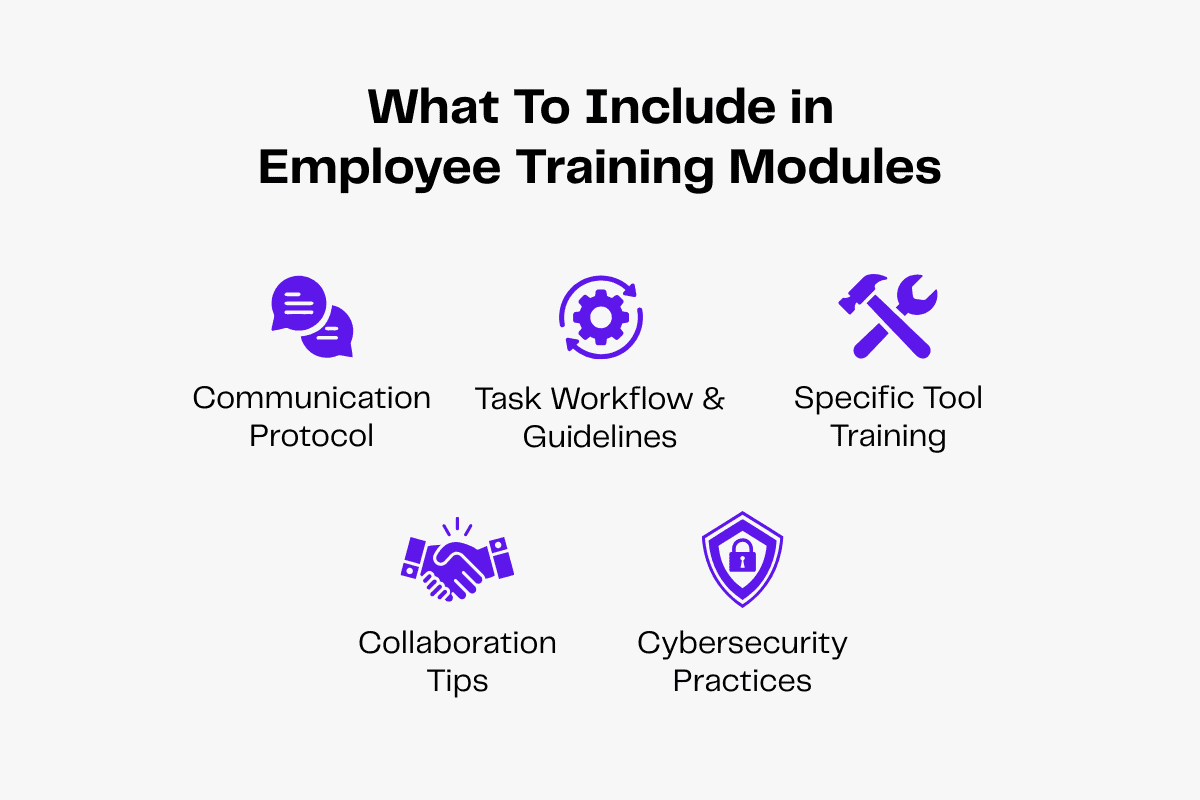
Ensure that the modules are arranged in a logical order so that they make sense. They should also be concise and easy to follow. Nobody would like to see a 10-minute video about installing an app!
Organized Resources
As a newbie, employees have a lot to learn about your organization. Compiling all important information in one place can save time and avoid confusion.
Having to go through multiple pages to find a document can be stressful and time-consuming.
The solution can be as simple as organizing links to important resources in a single, comprehensive document.
Remember to have manuals for troubleshooting common technical glitches. In cases of emergency, these manuals are extremely helpful.
6 Virtual Employee Onboarding Ideas
Dr. Tayla Bauer, author of Onboarding New Employees, says,
The faster new hires feel welcome and prepared for their jobs, the faster they will be able to successfully contribute to the firm’s mission.
In her book, she introduces the 5 Cs of onboarding: Compliance, Clarification, Confidence, Culture and Connection.
Here are a few tips to achieve Bauer’s vision of an ideal virtual employee onboarding!
1. Preboarding
Preboarding is the process of preparing new hires for their first day on the job.
Your responsibility isn’t just to share information, but to make a strong first impression, reduce their anxiety and help them onboard smoothly.
Start with a virtual welcome to the team and strike up a conversation.
Ask questions like: How do you feel about starting? Are you nervous? What are your expectations for the first day?
These questions will ease employees into the conversation and help you understand their perspective better.
You may even share your own experiences to ease their worries. Assure them they’ll be well-supported and familiarize them with the company’s policies, departments and hierarchy.
After that, move on to simple tasks like signing necessary paperwork and setting up work emails. Encourage them to ask questions and resolve their queries at every step.
2. Taking It Slow but Steady
Beginning a job remotely is overwhelming as is. Try not to pile too much on the new employee’s plate for the first few days.
Let them accomplish two to three tasks at first. Once they start easing into their role, set daily goals. This way, employees will get time to adjust to the workload.
Later, when the new employee has settled down, you can establish long-term goals and set KPIs.
3. Breaking the Ice
Organize a virtual welcome meeting to introduce the new hire to their coworkers.
Conduct team bonding activities or ice-breaking games to develop connections in a fun, interactive way. Keep the pressure low and chat about casual topics like hobbies, interests or personal fun facts.
If possible, work in teams to increase engagement and prevent isolation.
4. Assigning a Mentor
An experienced employee working in the same department can be a perfect mentor to guide new employees.
Employees will open up and ask for help readily if they know where to seek guidance.
Plus, one-on-one interactions will be easier to handle than group ones.
Read more: Discover the Best Leadership Style for Your Virtual Team
5. Giving and Asking for Feedback
Feedback allows new employees to recognize their errors and improve them.
Remember to criticize with responsibility. Don’t be harsh, but constructive. Avoid pointing out problems without offering solutions.
Ask for feedback from them, too! Let the new employees tell you where you can improve by creating a comfortable environment where they can convey their honest opinions.
Read more: 5 Virtual Employee Appreciation Ideas That Show You Care
6. Checking In Regularly
Onboarding doesn’t end after the first meeting.
You need to keep in touch with new employees, initiate conversations, check progress and ensure a comfortable transition into the job.
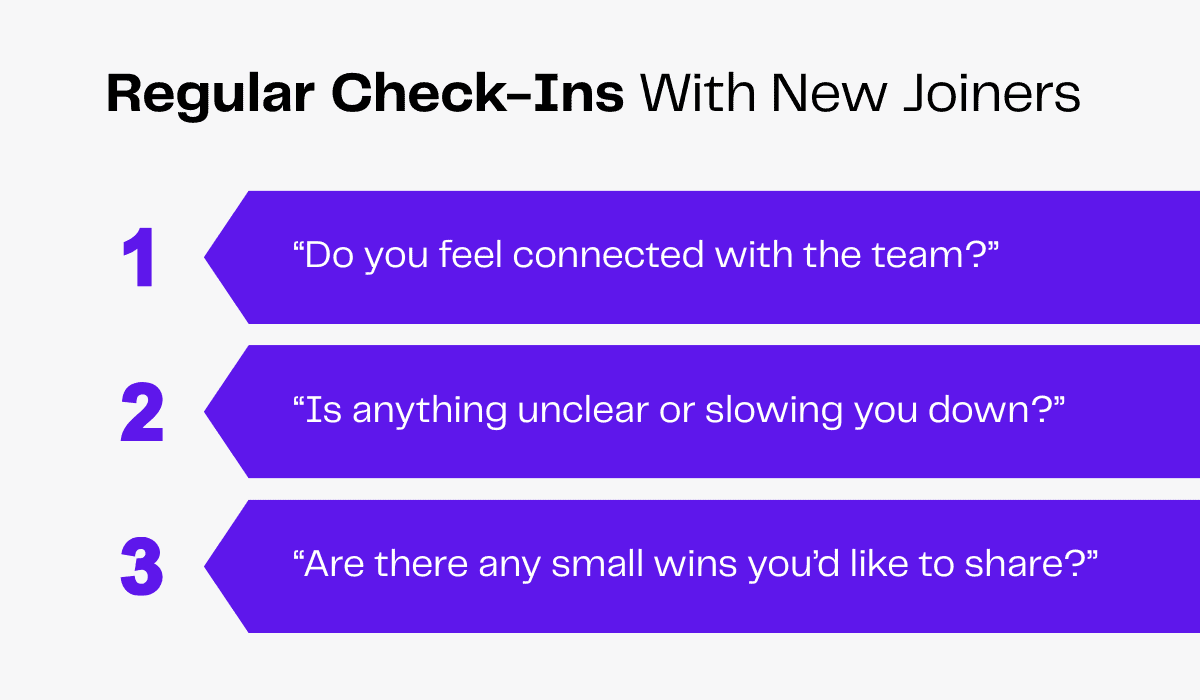
Ask them how they feel about work. Be open, honest and non-imposing to create a transparent space.
If they express negative feelings, listen attentively. Don’t dismiss their concerns, but walk them through solutions instead.
What Does Effective Onboarding Look Like in 2026?
In a recent survey, HR leaders across the U.S., U.K. and Australia were asked to choose their definition of employee onboarding and:
- 55.6% chose “a structured program to help new hires understand their roles & responsibilities and ramp to productivity quickly.”
- 14.1% chose “a continuous journey that supports employee growth and retention.”
- 13% chose “a culture-driven experience that fosters connection, engagement and belonging.”
Such reports show that, in 2026, your virtual team onboarding process shouldn’t just be a formality or a rushed first-week task.
Rather, it should be a guided process that commits to dividing clear roles, supporting your virtual team’s growth and encouraging a culture of collective partnership and inclusivity.
A recent trend to offer a better onboarding experience includes adopting AI.
61.3% of HR professionals say AI will play a role in providing personalized onboarding experiences and 60.6% say it will enhance training and learning modules in the next 3–5 years.
It’s high time that you, too, redefine onboarding to not only speed up the process but also provide a more engaging experience to your new hires.
You must invest in employee onboarding software like Enboarder to create a more personalized onboarding experience for your team members.
Another thing worth noting is that employees who have a clear plan for their professional development are 3.5 times more likely to strongly agree that their onboarding process was exceptional.
So, don’t just stop at your team members’ current roles. You must remember to also clarify their future roles and growth scope to keep them motivated.
Final Thoughts
Onboarding virtual employees can be challenging, but it’s worth the effort.
It helps new hires settle in confidently and work effectively from the start. This leads to better productivity, stronger collaboration and higher employee retention.
By following the guidelines in this article, you can ensure a smooth onboarding experience for your virtual team members.
This, in turn, will help your team members feel welcome, trust you and become true partners to fuel your business’s vision.