Key Takeaways:
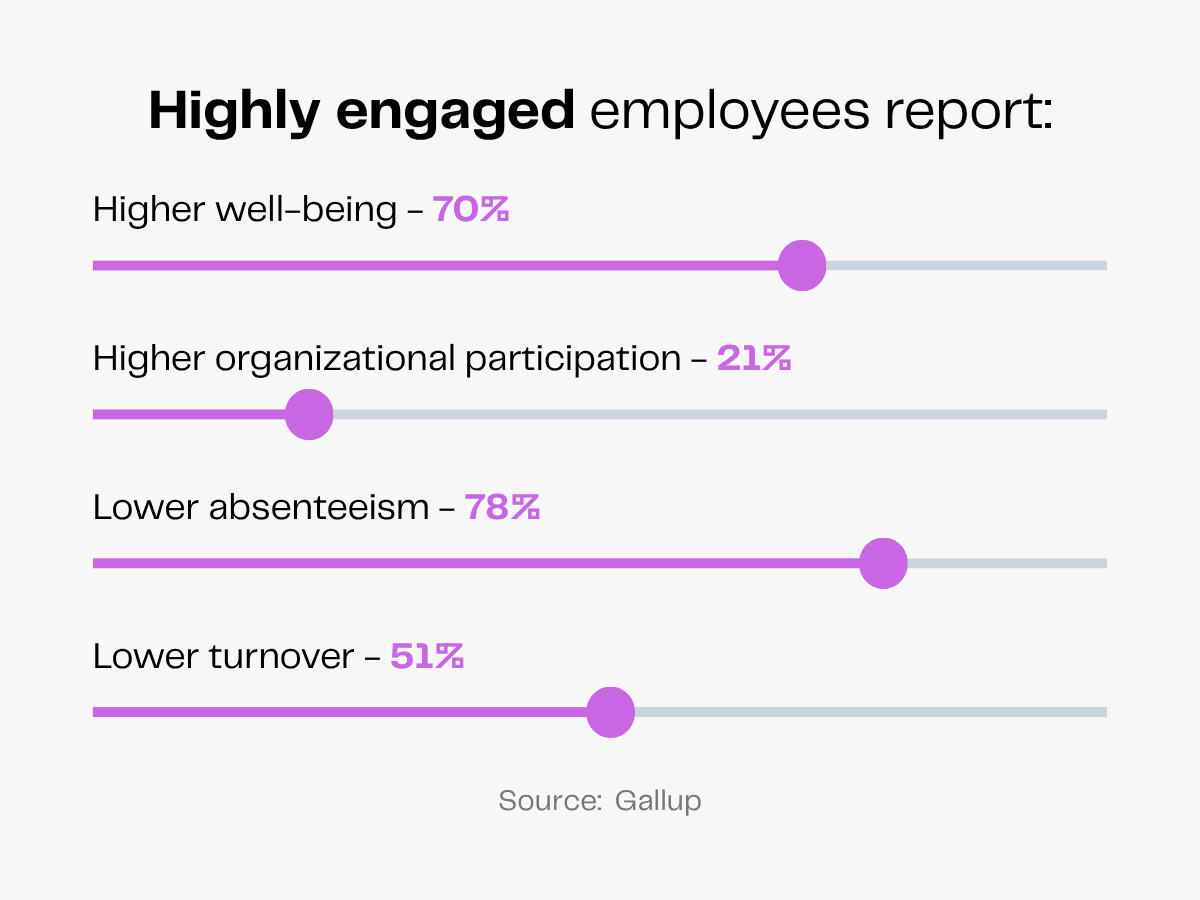
Highly engaged employees report 70% higher well-being & 21% higher organizational participation.
82% of employed Americans said they are happier when they’re recognized at work.
Employees who experienced higher psychological safety at work were far more likely to report “excellent” or “good” mental health—84% compared to 67%.
As remote work continues to rise, reshaping how teams connect and collaborate, building psychological safety has become more critical than ever.
In virtual teams, where casual interactions and non-verbal cues are limited, creating a safe space where employees don’t feel isolated, speak up, share ideas confidently and have room for mistakes requires intentional effort.
While managing virtual teams may seem challenging at first, leaders who prioritize openness, trust and inclusive communication are still far ahead in the game.
Practising kindness, promoting engagement, encouraging risk-taking, recognizing your team’s efforts, fostering inclusivity and leading by example will help create a fear-free and secure work environment.
The result? A workplace where ideas flow and teams thrive!
What Is Psychological Safety?
Amy Edmondson, an American scholar of leadership, teaming and organizational learning, says,
[Psychological safety is] the belief that one will not be punished or humiliated for speaking up with ideas, questions, concerns or mistakes and that the team is safe for interpersonal risk taking.
This means that any member, irrespective of their tasks or position, can voice their opinions, propose new ideas or be transparent about failures without the constant fear of embarrassment or punishment.
This safe environment is crucial for any team’s success, as it leads to higher performance, better innovation, greater inclusion and higher employee retention.
To create this environment in your virtual team, you must encourage team members to ask questions, express concerns and take risks to innovate.
Challenges To Psychological Safety in Virtual Teams
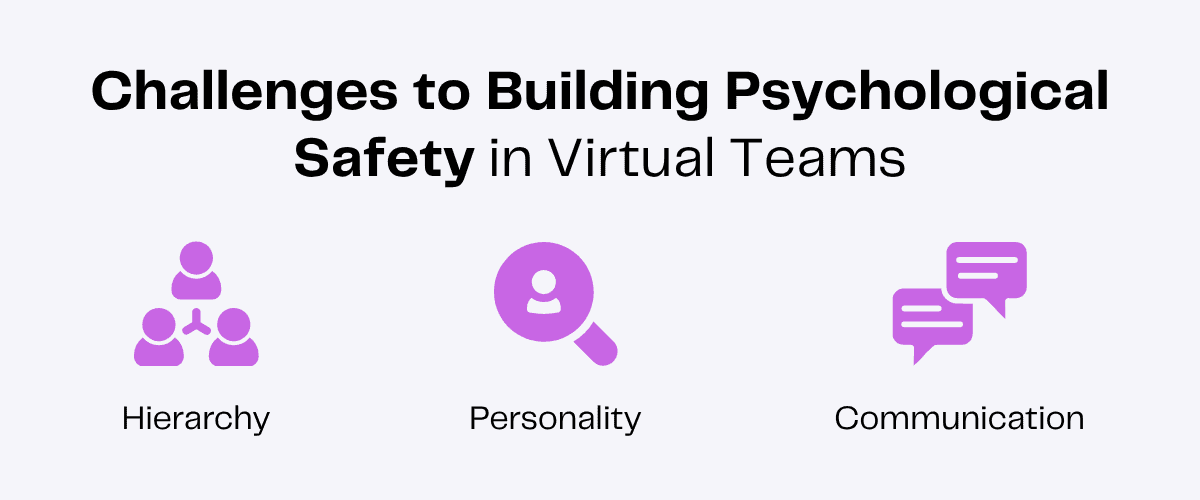
Building psychological safety in remote teams comes with its own set of challenges. Limited face-to-face interactions, communication gaps, workplace hierarchies and so on can easily lead to misunderstandings and strained relationships.
To reduce isolation, foster trust and encourage open dialogue within your team, you must address such challenges head-on.
Here’s a look at each challenge and how they influence psychological safety in virtual teams.
Hierarchy
Hierarchy refers to the order of people within an organization.
The senior members (presidents or directors) guide the company’s vision and mission. They task their juniors (vice presidents or managers) with handling daily operations and producing results. Then managers supervise employees and try to meet the shareholders’ vision
Whether you own a small business or a large enterprise, hierarchy can create a useful structure for communicating information and coordinating employees to achieve company objectives. It can also ensure accountability during crises.
But it can also discourage and frustrate employees if you fail to foster inclusivity and equality within the company’s workforce.
A strict hierarchy imposes decisions instead of encouraging discussions. If you force your decisions on employees, they’ll fear you. They may even develop inferiority complexes if you continue devaluing their opinions.
And you can’t build a psychologically safe workplace if your employees are afraid.
Work pressure and fear may hurt employees’ enthusiasm, confidence and interpersonal connections. And poor employee morale can damage productivity and performance!
So an unsupportive hierarchy can cause employees to feel powerless, creating a toxic atmosphere unfit for learning, building and innovating.
Personality
A leader’s personality plays a crucial role in shaping psychological safety, especially in remote teams where tone and intent can be harder to read.
If you come across as overly critical, dismissive, hostile or unapproachable, team members will hold back ideas, questions or concerns to avoid negative reactions.
Lack of empathy in digital communication can make interactions feel transactional, making team members less receptive to taking risks.
Disrespectful criticism, deserved or not, is demeaning. It will cause lower morale and job dissatisfaction, leading to lower employee retention.
Even unconscious biases can hurt your team members’ sentiments and cause anxiety.
Communication
Communication is essential for virtual collaboration. Remote employees use online tools to exchange information and complete tasks.
But virtual communication can reduce the quantity and quality of informal interactions. When you rarely face your colleagues, it’s natural to misunderstand their tone and intentions.
Lack of non-verbal cues in online communication can cause misinterpretations. Unclear and unprofessional communication can damage team confidence and collaboration, affecting interpersonal relationships.
Also, irregular interactions in asynchronous communication setups can lead to assumptions and suspicions, creating unnecessary stress. And a stressful environment is unsuitable for building trust.
Poor communication can isolate your employees, affecting their performance. Which is why you must ensure open and honest communication within your virtual team to build psychological safety.
Read More: How To Manage Conflict in Virtual Teams for Seamless Collaboration
How To Create Psychological Safety in Virtual Teams
In virtual teams, where quick chats and body language cues are replaced by screens, maintaining team cohesion and building psychological safety is all the more important.
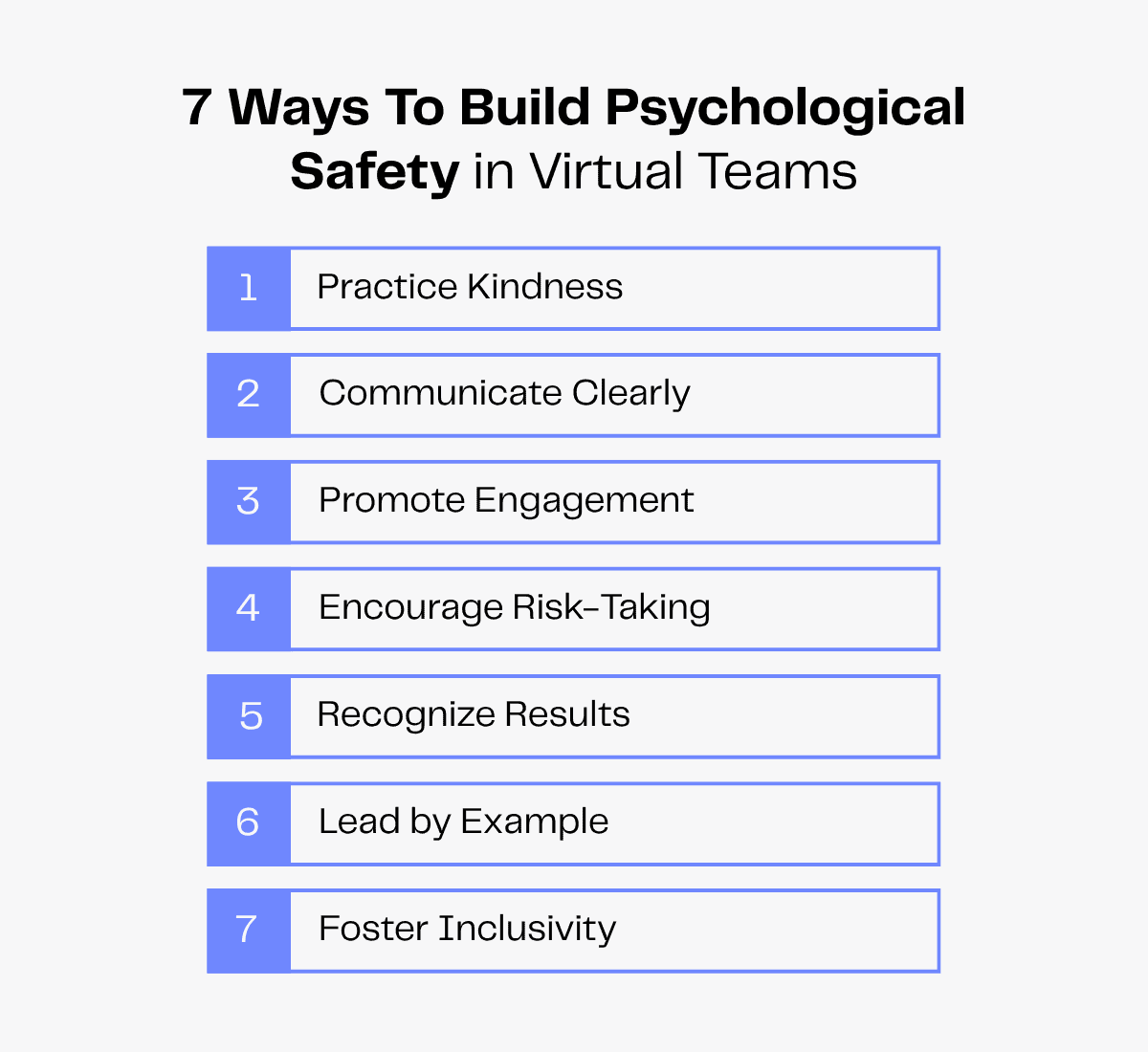
Here are seven ways you can create psychological safety in virtual teams.
Practice Kindness
A toxic workplace is an employee’s worst nightmare. If a leader displays a rude and unkind attitude, it can lead to unnecessary stress, lower morale and decreased productivity for employees.
And it will take a hit on the organization’s reputation, leading to a high employee turnover rate.
While managing virtual teams, the first and foremost thing a leader must do is practice kindness and compassion.
Leaders should emphasize a culture of inclusion and respect where every voice is valued.
Caroline Castrillon, Senior Content Strategist
One example is training teams on healthy communication strategies like active listening.
Active listening helps avoid and resolve conflicts by helping employees to understand the feelings and perspectives of others.
Rebutting opinions and concerns of your virtual team can quickly turn your work environment hostile. So practicing active listening is the first step you can take to create a positive workspace.
Start with being fully present when being spoken to, don’t jump to immediate conclusions and engage with both verbal and nonverbal cues to avoid misunderstandings.
Some other ways you can practice intentional kindness include:
- Starting virtual meetings with quick check-ins instead of jumping to task updates.
- Respecting time boundaries by avoiding after-hours messages.
- Being empathetic to your virtual team members’ experiences, emotions and perspectives.
- Acknowledging your team’s efforts, not just outcomes and also recognizing individuality.
- Ensuring workload is manageable and not overwhelming.
- Offering support proactively by asking questions like “Is there anything you need from my side to meet this deadline?”
- Sharing constructive feedback without using harsh language.
Communicate Clearly
In virtual teams, without hallway conversations or body language, even small gaps can quickly turn into confusion, hesitation, fear or worse—miscommunication can negatively affect your team members’ emotional safety.
In fact, research shows that 40% of people have experienced burnout, stress and fatigue due to communication issues in their business.
If your team members are constantly second-guessing themselves, they won’t be able to carry out tasks assertively.
When team members know exactly what’s expected of them, they act with confidence. So, as a leader, it’s your responsibility to communicate with clarity and ensure your virtual team does not rely on guesswork.
To practice effective communication, you must:
- Be specific about goals, roles, tasks, deadlines and success criteria and avoid ambiguity.
- Give actionable guidance like “clarify the second paragraph in this report” instead of vague phrases like “please improve this.”
- Practice the 80/20 rule, where leaders listen 80% of the time and speak for 20% to make team members feel heard.
- Check for understanding by asking questions like “anything unclear?” instead of assuming clarity.
- In case of changes or challenges, be transparent and give proper context.
- Use the right communication channel, for instance, video calls for feedback and chat for quick updates.
- Be honest but supportive during difficult conversations.
Promote Engagement
Research shows that highly engaged employees report significantly higher (70%) well-being, higher organizational participation (21%), lower absenteeism (78%) and lower turnover (51%).
If your team members are engaged and satisfied with their work, they’ll inherently feel psychologically safe.
You can promote engagement among virtual team members by:
- Scheduling virtual tea/coffee breaks and encouraging casual chit-chats.
- Conducting icebreaker sessions to help virtual team members get familiar with you and each other.
- Conducting online team building activities (such as game nights or quizzes) to help everyone feel comfortable with their teammates, reducing feelings of isolation.
- Inviting ideas, comments, suggestions, opinions and feedback from every member.
- Giving small incentives or shout-outs to motivate and engage team members.
- Celebrating birthdays and professional milestones virtually.
Strong sense of belonging in the team, feeling heard and valued and healthy interpersonal work relationships will strengthen engagement.
Encourage Risk-Taking
Innovation requires taking risks. You can never create something new without breaking from the norm.
In a survey, 39% of companies (the largest proportion) identified the ability to innovate as the most critical strategic driver of growth.
If innovation isn’t encouraged, your virtual teams become risk-averse, ideas stagnate and growth slows. This is because your team members stop speaking up on ideas and opinions when they don’t feel safe to fail.
In a psychologically safe environment, where innovation is encouraged:
- New ideas are welcomed, not judged, even if they don’t work out.
- Experimentation is prioritized over perfection.
- Teams are given autonomy to test and explore ideas instead of being heavily micromanaged.
- Fear of failure and criticism is drastically reduced, pushing teams to take more risks.
- Diverse perspectives and critical thinking take the front seats.
- Respectful disagreement takes over aggressive remarks.
When you support reasonable risk-taking, your virtual team members feel confident trying new things, which might give you a competitive edge. Experimentation, or tinkering as some say, can help build modern features, create better products and solve complex problems.
Recognize Results
Without feedback and recognition, teams operate blind—unable to see what’s working, what’s not and how to improve. If a team’s results remain unrecognized, motivation dips, efforts feel invisible and people quickly disengage.
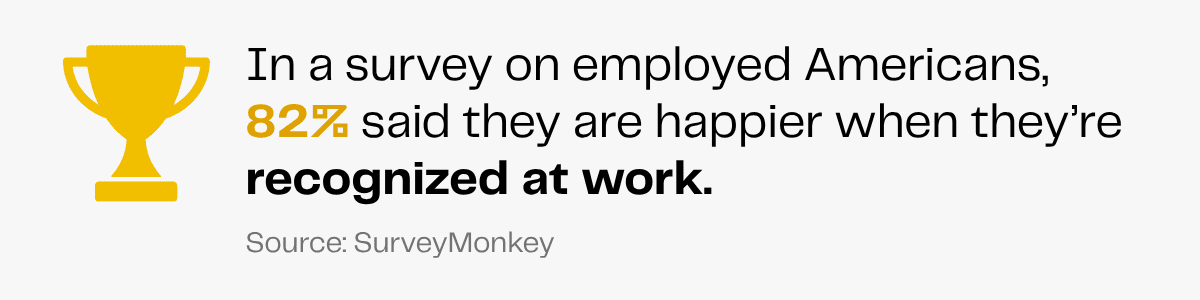
In fact, in a survey on employed Americans, 82% said they are happier when they’re recognized at work.
To feel psychologically safe, your virtual team members’ contributions must be valued. This will build confidence and trust, encourage continuous effort, reduce uncertainty about expectations and foster a culture of appreciation.
Recognizing good performance also enhances employee loyalty. Employees love supportive managers, even more than healthcare benefits!
Some tips to recognize your virtual team’s efforts include:
- Make it visible: Celebrate each member’s wins in team chats, team meetings or shared dashboards.
- Be timely: Acknowledge achievements as soon as they happen to boost confidence and reinforce positive behavior.
- Be specific: Highlight the exact action and impact to turn generic feedback into meaningful praise.
- Highlight quiet contributions: Recognize behind-the-scenes efforts also, instead of just visible outcomes.
- Encourage peer recognition: Create space for team members to appreciate each other and strengthen their bond.
| Appreciation Styles at Work | How It Shows Up |
|---|---|
| Public recognition | Team shoutouts, visible appreciation |
| Peer-to-peer recognition | Colleagues appreciating each other |
| Performance-based recognition | Rewards for results and goal achievement |
| Effort-based recognition | Valuing hard work and consistency |
| Instant recognition | Real-time praise and immediate feedback |
Lead by Example
Building self-awareness and staying humble are crucial to good leadership. It helps you identify and remove unconscious biases, enabling personal growth. It also allows you to admit and correct mistakes.
Expressing vulnerability and admitting mistakes without fearing punishment can inspire your virtual team members to do the same. And when they stop fearing failure, they’re better motivated to correct and learn from their mistakes.
So you must frame failure as a learning opportunity to create psychological safety.
To lead by example, you must follow steps like:
- Modeling the behavior you expect and the standards you set.
- Aligning actions with words consistently.
- Following through on promises.
- Approaching challenges with a constructive mindset.
- Embracing failures gracefully.
- Acting on received feedback.
- Treating everyone fairly.
- Respecting workspace boundaries.
- Expressing uncertainty honestly.
Read More: The Art of Leading Virtual Teams
Foster Inclusivity
Accepting and valuing your team members’ cultural differences and diverse perspectives builds an inclusive workspace. Even employees without significant cultural overlap will be able to comfortably work together.
And better collaboration reduces confusion, improves productivity and increases profits.
Some inclusive leadership practices to create psychological safety include:
- Using inclusive language.
- Challenging biased remarks immediately.
- Ensuring equal voice and opportunities for everyone.
- Acknowledging cultural norms and holidays.
Inclusivity promotes equality, which is essential for psychological safety.
Employees are less likely to feel prejudiced when you provide equal opportunity to everyone. It helps them feel safe, seen and heard. So they contribute unique outlooks, help solve complex problems and generate creative ideas.
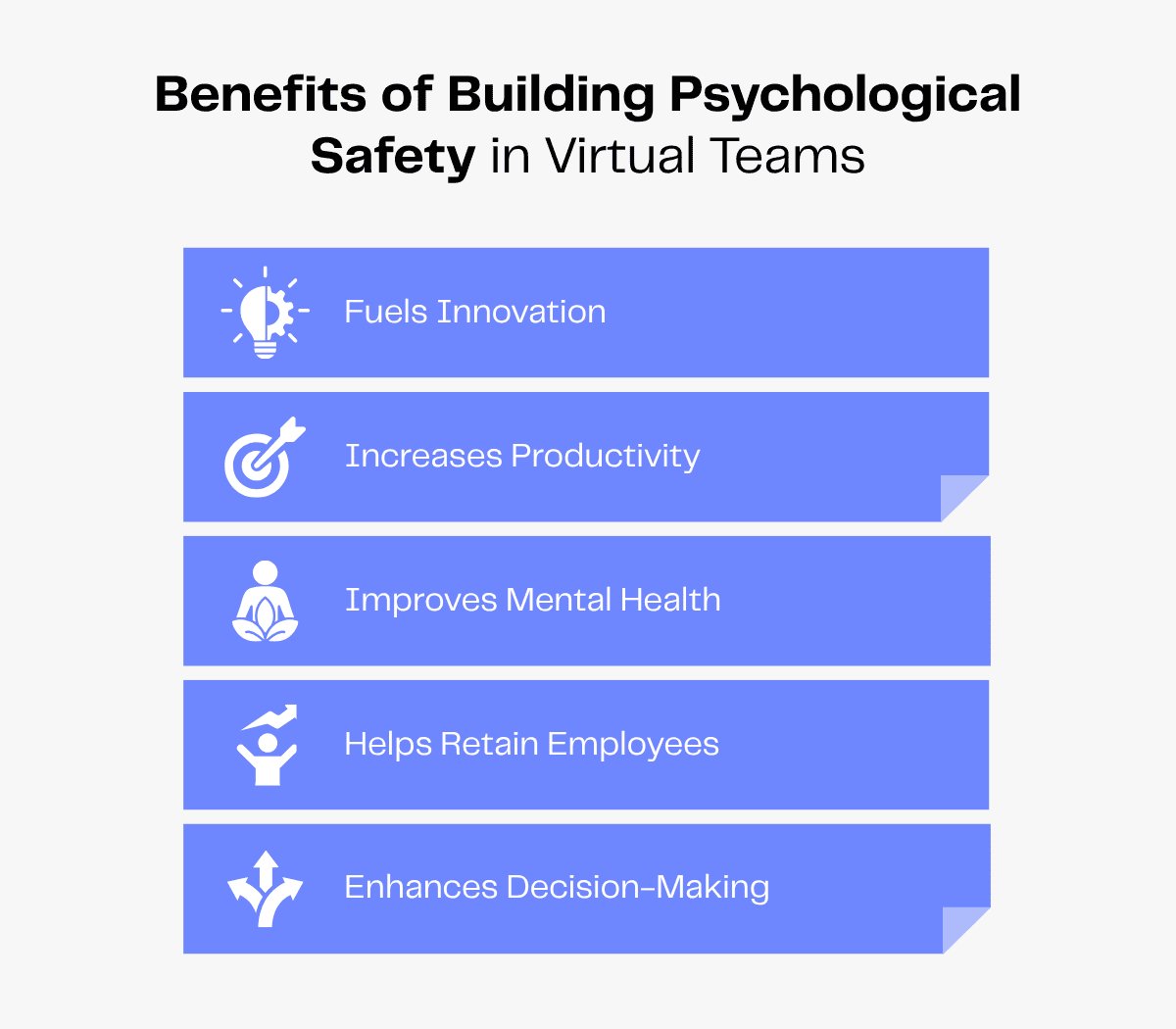
Benefits of Building Psychological Safety in Virtual Teams
Virtual teams may offer countless benefits, but without psychological safety, those advantages mean little—because a team that doesn’t feel safe to speak up or take risks can’t perform to its full potential.
A comfortable working environment, on the other hand, creates high-performing teams.
Here are the clear benefits of psychologically safe virtual teams for your business.
Fuels Innovation
Psychological safety encourages risk-taking, nurtures curiosity and fuels creativity. When your team can experiment without fearing pushback from failures, they can innovate.
Innovation helps you enhance existing products and services, adapt to changing market conditions, introduce new products, foster growth and gain a competitive edge.
When your virtual team feels psychologically safe in a judgment-free workspace, they take reasonable risks, pursue unorthodox methods and implement out-of-the-box solutions.
Increases Productivity
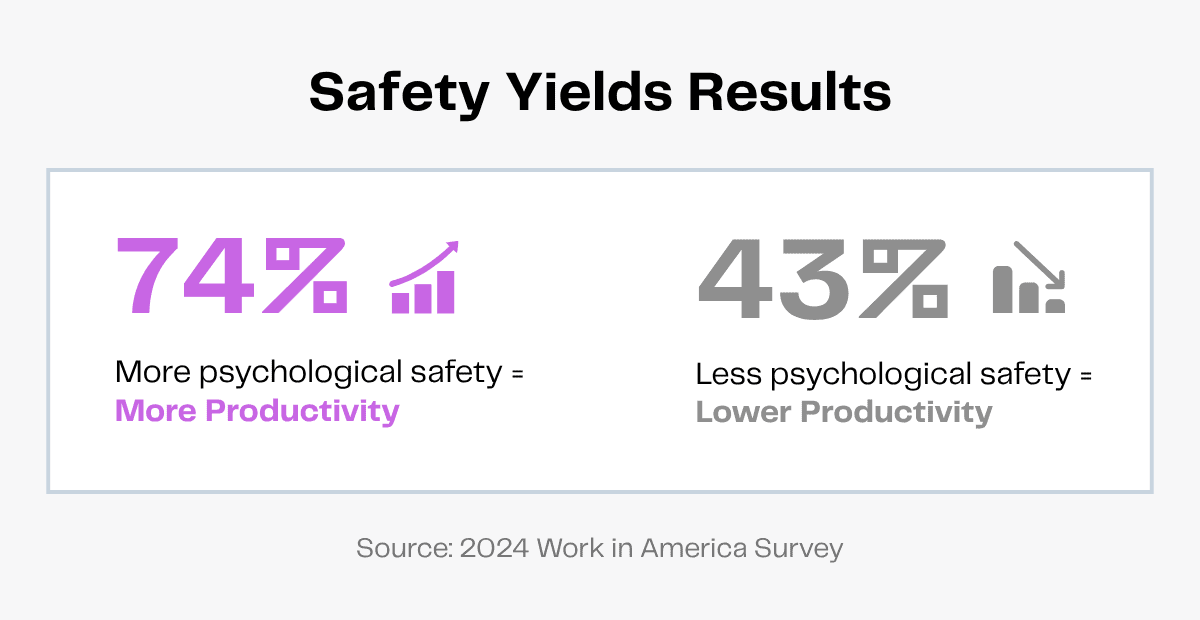
In a survey, workers who reported experiencing higher psychological safety at work were much more likely (91%) to rate their performance as “very good” or “outstanding” than those who experienced lower psychological safety (69%).
The same was found for rating productivity as “high”(74% vs. 43%).
Psychological safety allows people to communicate without fear. It enhances information exchange and encourages active participation. Improved engagement at work can increase productivity.
Better emotional safety also enables distraction from stress, saving time and increasing efficiency.
And an effective workforce boosts productivity and profits!
Improves Mental Health
In a survey, employees who experienced higher psychological safety at work were far more likely to report “excellent” or “good” mental health—84% compared to 67%.
Psychological safety creates a work environment where team members feel safe to speak their minds, make mistakes and express their authentic selves without fearing punishment and humiliation.
Once this fear-based stress is reduced, it lowers anxiety and prevents burnout.
Transparent communication and an emotionally safe space also allow concerns to be addressed maturely instead of building into toxic dynamics.
Over time, this reduces emotional exhaustion, boosts confidence, improves interpersonal relationships and helps your team maintain a positive state of mind at work.
Helps Retain Employees
Psychological safety creates strong ties between a leader and their virtual team and a sense of belonging. When employees feel safe and accepted, they’re more likely to continue working for your company for long periods.
A higher employee retention rate boosts your company’s reputation by establishing it as an ideal place for employment.
It also reduces your recruitment costs, as you don’t have to spend on hiring and training new employees repeatedly.
Enhances Decision-Making
Psychological safety helps you create a space where team members confidently share ideas, question strategies, offer dissenting views without fear and voice their firm opinions without hesitation.
This openness leads to more diverse perspectives and fewer blind spots. When team members challenge decisions constructively and admit uncertainties, they may make more informed, balanced and confident decisions, resulting in faster and more effective outcomes.
Final Thoughts
Traditional management practices are ineffective in modern virtual workplaces. So you must evolve your management style to overcome challenges unique to the virtual setup.
This includes taking proactive steps to ensure no one feels isolated, undervalued or humiliated.
A fear-free workspace is exactly where growth and innovation thrive. So you must build an inclusive and supportive environment to help your virtual team perform to their potential.
Building psychological safety starts with treating every member fairly, using professional tone, keeping your team engaged, allowing reasonable experimentation, recognizing good performance and respecting diversity.