Key Takeaways:
Research shows that a typical employer can save around $11,000/year for every person who works remotely half of the time.
For 9.27% of in-office U.S. workers, commute can take up to two hours/day, causing exhaustion. Without this stress of long commutes, your remote team stays more productive.
Companies fail to choose the right candidate 82% of the time! Go for virtual teams instead, who are hired based on specialized niches & specific industry requirements.
In a landscape defined by speed, global reach and spontaneity, businesses are finding new strategies to become more productive and efficient.
One such strategy is taking your business operations virtual.
Companies like Shopify, GitLab, Buffer, Kraken and Dribbble have adopted a remote-first strategy or have gone fully remote.
By breaking free from physical boundaries, virtual teams reshape how talent is accessed, collaboration happens and work gets delivered.
You’ll tap into a wider talent pool, optimize costs, access niche skills, improve employee satisfaction and retention and much more!
Explore all the advantages that virtual teams bring to the table and how you can leverage them most effectively for your business.
What Are Virtual Teams?
A virtual team is a group of remote professionals who connect from different locations and coordinate using online collaboration platforms like video calls, project management tools and cloud-based software.
Instead of sharing a physical office, they operate remotely across cities, countries and time zones to achieve common business goals.
While virtual teams mainly work remotely, many companies still provide workspaces in remote locations for their global workforce.
This remote model is both convenient and cost-effective, as it lowers your real estate expenses while still giving employees access to professional work environments.
Types of Virtual Teams
Before building a virtual team, you must ask yourself how your people will collaborate.
Will they coordinate all tasks in real time? Or can they hand over tasks in shifts and work on their own schedules?
Synchronous Virtual Teams
If you want your team to collaborate in real time, you must hire a synchronous virtual team.
In this case, team members are usually online at the same time and have overlapping working hours. They use video conferencing software, chat rooms and shared docs to work synchronously.
Sync teams help with immediate brainstorming and feedback, fast issue resolution and a strong personal connection.
This type of collaboration is ideal for fast-moving projects, customer-facing roles or tasks that require dynamic and spontaneous action.
Some examples of roles include sales, customer service, operations coordinators, event planners and human resources recruiters.
Asynchronous Virtual Teams
If you want your team to have flexible response times, allowing deep work, thoughtful responses and minimal interruptions, you can hire an asynchronous virtual team.
These teams work independently with minimal need for everyone to be online at the same time. In fact, team members can work on different shifts throughout the day and successfully hand off tasks to one another.
They collaborate through project management tools, recorded videos, shared docs and detailed updates.
The asynchronous model supports global collaboration across time zones, giving you access to a wide talent pool. It also reduces meeting fatigue and promotes deep work.
Some examples of roles include content writers and editors, graphic designers, web developers and researchers.
| Key Differences | Synchronous Teams | Asynchronous Teams |
|---|---|---|
| Work Style | Collaboration-focused | Deep work-focused |
| Communication Style | Real-time (live chats & meetings) | Time-shifted (shared docs & recorded videos) |
| Response Time | Faster | Slower |
| Working Hours | Requires overlapping hours | Can work across shifts and time zones |
| Flexibility | Lower flexibility (schedules must align) | High flexibility (members have independent schedules) |
What Are the Advantages of Virtual Teams in the Workplace?
Many U.S. employers offer some hybrid work options.
This shift highlights how businesses are embracing virtual collaboration to stay competitive.
Aside from the cost and hiring benefits, virtual teams come with skills and qualities that help your business thrive.
Remote or hybrid work is no longer niche—many companies now support some form of virtual work. Let’s understand why.
1. Access Global Talent
No matter where you are located, you can access the global talent pool and hire the best professionals for your virtual team.
Instead of spending money on hiring local talent who need office space to work and other utilities, you can hire a virtual team with professionals who give top-notch services without breaking the bank.
2. Save Costs
Virtual teams help businesses optimize costs across multiple layers.
At the most basic level, they eliminate major overhead costs such as office rent, utilities, devices and travel allowance.
Research shows that a typical employer can save around $11,000/year for every person who works remotely half of the time.
And if you build your team with Zenius, you won’t have to worry about paid leave, employee benefits or insurance. You’ll also get robust hiring and onboarding support, sparing you expensive hiring costs.
3. Increase Productivity
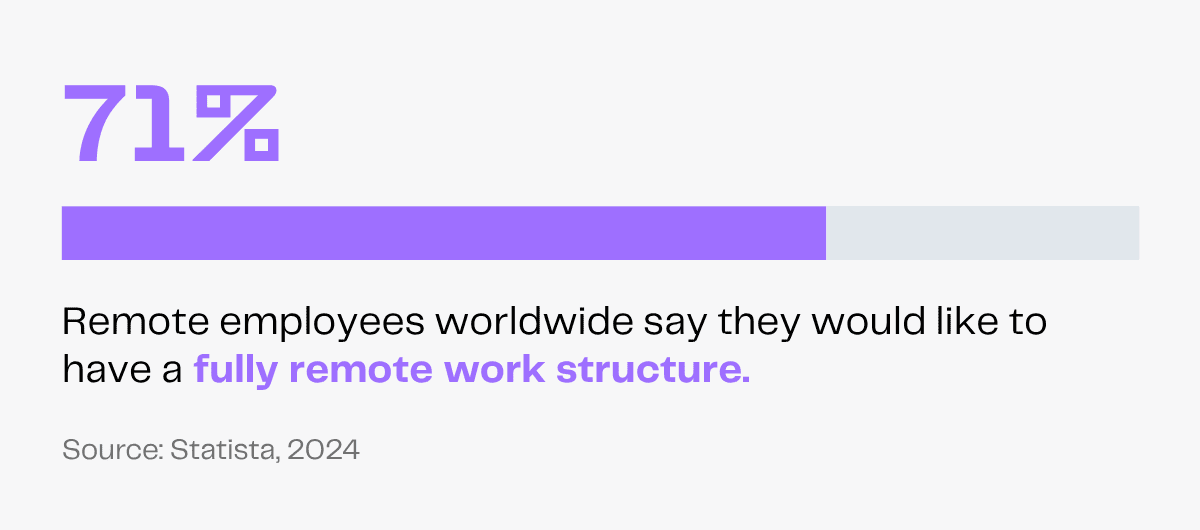
Around 71% of employees working remotely worldwide said they would like to have a fully remote work structure.
This shows that most people around the world are inclined to work from home to achieve a better work-life balance.
For 9.27% of in-office workers in the U.S., commute can take up to two hours each day—stretching their workdays and causing exhaustion.
Without the constant in-office interruptions, long commutes or unnecessary meetings, your virtual team members will be focused and dedicated to their work in their home offices.
More focus will mean more results for your business!
4. Receive Niche Services
Choosing the right candidate is important for your business’s success.
But Gallup finds that companies fail to choose the candidate with the right talent for the job 82% of the time!
An employee who can’t deliver results aligned to your business needs will delay your projects, drain your resources and dissatisfy your clients.
Virtual teams are made of professionals skilled in specialized niches and are hired based on specific industry requirements.
Suppose you are a small business owner with a primary target audience of Gen Zs. In that case, you can assemble a team of content writers, graphic designers and marketing specialists who will cater to the interests of that demographic.
Whether you want to build a marketing team for your vegan skincare brand or a customer support team for a high-tech appliance, you can delegate tasks unique to your business and get professional-quality results.
5. Improve Employee Retention Rates
In a workplace wellness survey, 56% of employees said that work-life balance contributes most to their sense of workplace well-being.
Virtual work gives your team members the flexibility to work from any part of the world. With fewer commute hours, your virtual team enjoys a better work-life balance and less burnout.
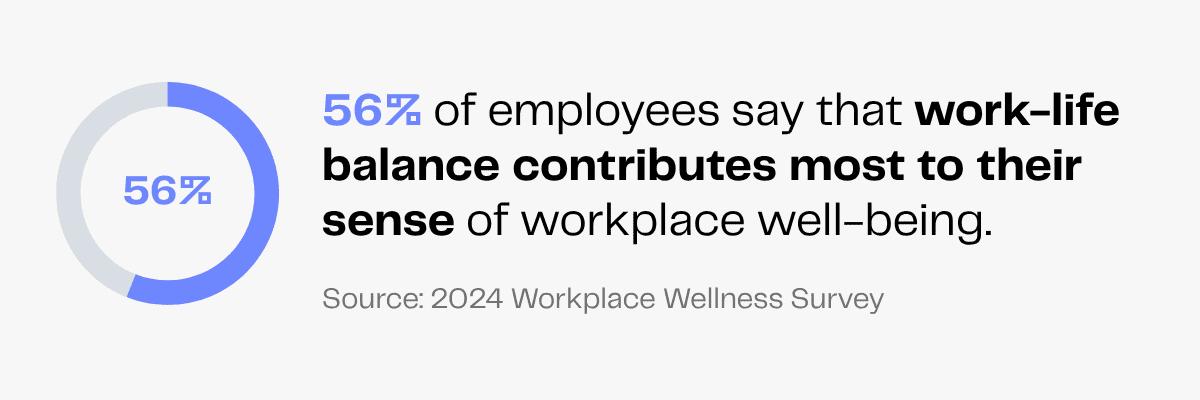
They are more likely to be satisfied with their job, resulting in higher employee retention rates!
6. Get Support for Multiple Shifts
If you build a global virtual team, you can hire members from different regions and time zones.
You’ll naturally get support for multiple shifts throughout the day without your employees having to sacrifice their work-life balance.
This is especially useful for businesses that need round-the-clock support, such as customer support, IT help desks or healthcare.
With expert collaboration and project management tools, team members can seamlessly hand over tasks without unnecessary confusion or workflow interruptions.
Which means your team will document every task, from progress updates to deadlines. When someone else steps in, they’ll easily get the full context and continue the work without spending hours just trying to catch up.
7. Cater to More Clients
With a virtual team, more clients don’t mean more chaos—just more growth!
When team members operate virtually, you’re not limited to one geography, one culture or one time zone. You can hire a multicultural team of professionals who bring in diverse perspectives, understand different markets and recognize various customer behaviors.
This diversity helps your business adapt to unique client needs and take on a versatile clientele.
Plus, having virtual team members spread across time zones creates a near-24/7 workflow. This means faster response times and project delivery for your clients. In short, when your team delivers quick turnaround times, you can easily cater to more clients.
8. Balance Demand and Supply
A big advantage of hiring virtual teams is their ability to help you meet the demands and supply on time.
If client demands increase and your internal team is facing overload and burnout, hiring a virtual team for that period can bring you the right talent at the right time.
Suppose your e-commerce store is facing holiday surges. Instead of turning customers away or delaying deliveries, you can hire a virtual team for order processing or customer support.
Or if you are a marketing agency and five new projects land at once, a virtual team of designers or social media managers can help you tackle the extra workload.
9. Move Faster Than Your Competitors
In a survey, more than two-thirds of employees (68%) said that much of their time is spent on low-value, inefficient tasks.
Such tasks take your team’s focus away from high-value tasks, increase stress levels and may also lead to low engagement.
One of the best benefits of virtual teams is that they take on a range of such tedious tasks, relieving your core team’s workload. With the right tools and software, they’ll manage the behind-the-scenes while you drive your business forward.
Which means, you and your team can prioritize working on big-picture strategies, launching new products and services faster and building strong client relationships and networks.
When your competitors are stuck figuring out how to accelerate business operations, your virtual team will already keep you a few steps ahead!
10. Scale Business Sooner
With virtual teams, you remove traditional hiring barriers such as high costs, wasted time and limited access to talent. This means critical roles are filled quickly, projects start sooner and growth opportunities aren’t delayed.
The saved costs on office space, devices and utilities can be reinvested into product development, marketing or customer acquisition, accelerating easy scaling without increasing financial risk.
Virtual teams can also be easily expanded or downsized based on workload, seasonal demand or growth stage.
This means you get the agility to respond faster to new opportunities, launch products quicker and adapt to fluctuating needs better than traditional staffing models.
11. Reduce Carbon Footprint
In-house employees have to use vehicles to travel to physical office locations. Burning fuel for long distances releases harmful emissions, causing pollution and harming the already hurting environment.
In fact, transportation emissions are the largest contributor to U.S. GHG emissions, accounting for about 28% of total U.S. greenhouse gas emissions.
Working with a virtual team reduces carbon footprint and helps you take a positive step towards the environment!
What Are the Challenges of Hiring a Mismanaged Virtual Team?
Even though remote work has its benefits, virtual teams come with their own set of challenges. If your virtual team isn’t managed properly, some problems may outweigh the benefits.
Here are a few issues that you may face when working with a mismanaged virtual team.
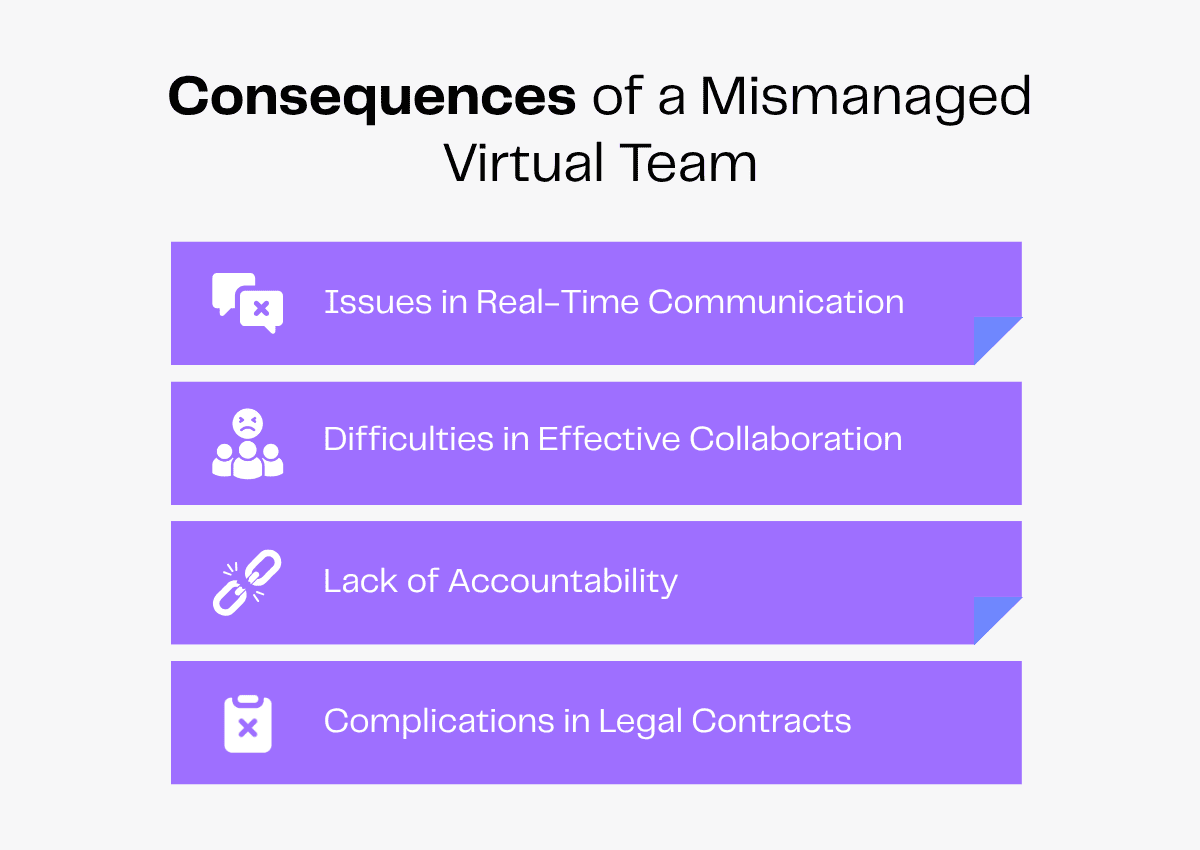
Issues in Real-Time Communication
Real-time communication helps with faster collaboration as it enables instant feedback and immediate problem-solving, eliminating unnecessary delays.
But as virtual teams work from different locations and sometimes coordinate from different time zones, getting instant replies may become an issue.
Research shows that communicating through various communication channels presents several challenges in remote working because of wait times and misunderstandings.
Delayed responses and late feedback may lead to slower decision-making, disrupting the continuity of your team’s workflows.
You’ll have to take the extra step of setting response time expectations or using overlapping working hours to eliminate such communication issues and manage your team performance better.
Difficulties in Effective Collaboration
If your virtual team does not use industry-standard tools and project management software to manage their common projects or collaborate, they may find it difficult to work together compared to a physical office.
In a research on communication in remote workers, one participant said,
It can create a situation where you’re maybe a little overly reliant on the technology and when it’s not available or when it’s not functioning properly, you may not be able to actually do your job or communicate with people that you may need to.
Technological issues, miscommunication, missed updates, inefficient virtual meetings or poor team bonding will affect their collaboration. If your team members are not on the same page, it will slow down productivity and project delivery.
A well-managed team overcomes this drawback by using the right project management and communication tools.
Lack of Accountability
When employees own their tasks, responsibilities and decisions at work, it fosters trust, boosts employee morale and enhances motivation—making performance management easier.
A lack of accountability will lead to not following through on commitments, stalling work progress indefinitely.
Since your virtual team members will work remotely and independently, you won’t get to supervise them as closely as you would in-house employees.
If you don’t assign clear tasks, deadlines, response times and follow-up regularly, you’ll find it harder to track their progress or hold them responsible.
To increase accountability, you must give proper deadlines to your team members and delegate tasks effectively.
Complications in Legal Contracts
Virtual assistants come from various states and countries with separate laws and regulations related to work. You may find it difficult to track all the different rules for wages and working hours.
Mismanaged legal contracts can lead to a huge penalty. So careful research is important to avoid heavy fines.
A helpful solution is hiring from agencies like Zenius, which take care of tax compliance and statutory regulations, saving you the hassle.
What Are the Strategies for Managing a Productive Virtual Team?
Leading a virtual team can be tricky and requires a different approach than managing a traditional in-office team.
It’s your responsibility to ensure they communicate often, collaborate effectively and stay accountable for their tasks.
From installing the most suitable collaboration platforms to maintaining good communication practices, you must adopt the best practices to manage a virtual team effectively.
Here are a few tips to overcome the perceived drawbacks of virtual teams.
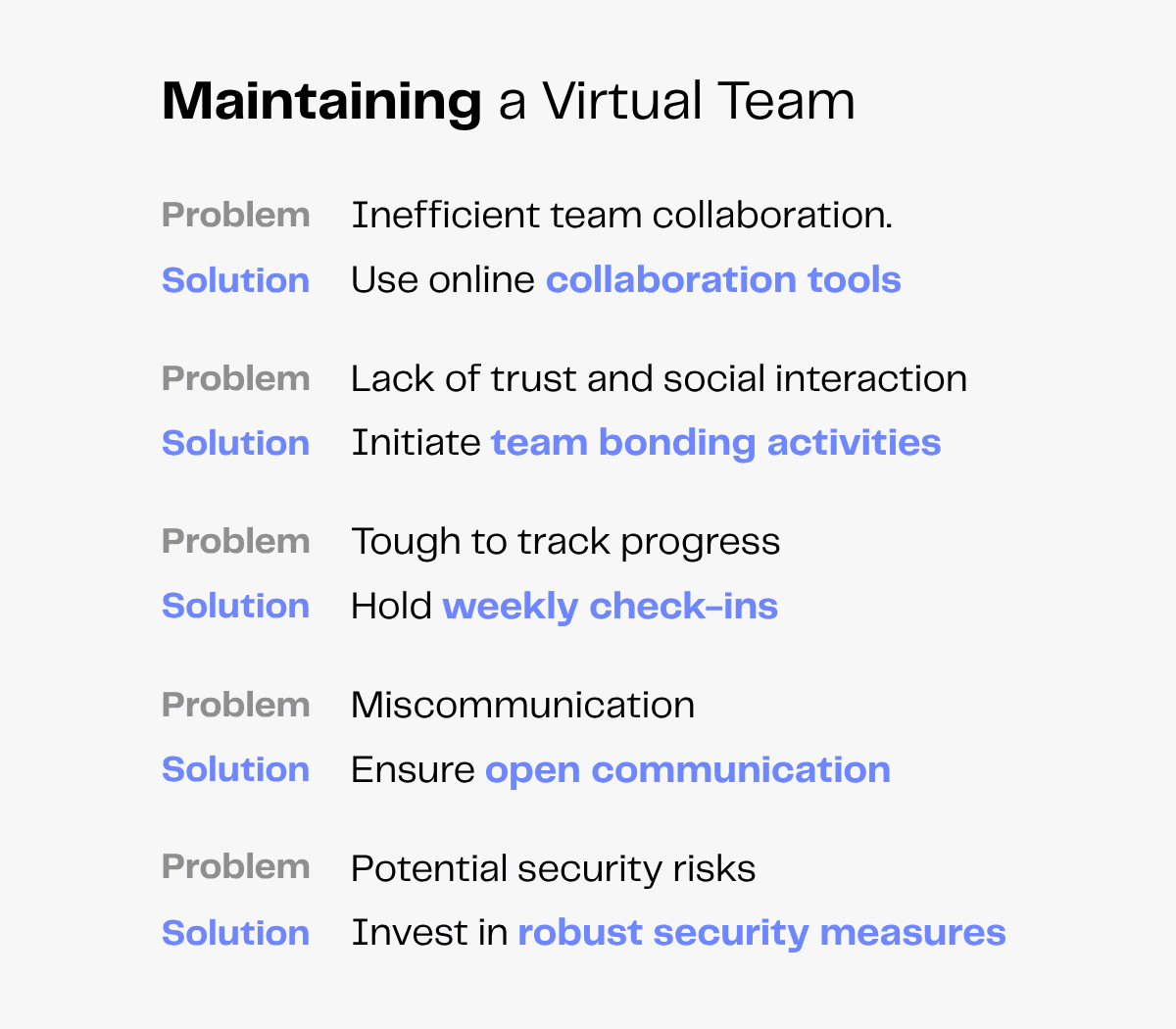
Use Online Collaboration Tools
Organizations that use virtual collaboration tools report a 35% boost in team productivity and 25% improvement in decision-making speed.
There are many collaboration tools that your virtual team can use to communicate and work on different projects together.
From quick video calls and team chats to shared project docs and shared team calendars, your virtual team must use these tools to stay connected throughout the project timeline.
With these tools, they can conduct in-depth discussions and work on projects synchronously to ensure on-time submission.
Read More: 30 Useful Virtual Assistant Tools and Software
Initiate Team Bonding Activities
Your virtual team must have a strong sense of teamwork spirit for successful, long-term collaboration. And you must ensure your team members bond with each other.
For this, you must use virtual team icebreakers and team-building activities.
They’ll get to share their diverse experiences, learn something new from each other and build stronger relationships.
Hold Weekly Check-Ins
Lack of clarity about your team’s progress or unnoticed roadblocks can delay your projects unnecessarily.
You must hold short weekly meetings with your virtual team to check in and understand their progress. This will help you:
- Know at what pace your virtual team is working.
- Exchange ideas with clarity.
- Discuss achievements and challenges to improve accountability.
- Recognize and validate their work.
- Manage conflict issues before they escalate.
Ensure Open Communication
Magic happens when collaboration isn’t one-sided. It leads to better innovation, faster problem-solving and a stronger sense of belonging.
You must encourage your virtual team to transparently talk about their concerns. They should also feel comfortable sharing their viewpoints and ideas to foster better quality work and creativity!
With a two-way dialogue, you’ll resolve all issues before they escalate.
Remember to:
- Create psychological safety to build trust within your team.
- Admit errors and lead by example.
- Invite members to ask questions freely.
- Value different perspectives.
- Ensure active listening on everyone’s part.
- Encourage staying respectful even during disagreements.
Provide Positive Motivation
A Gallup report suggests that 62% of global employees aren’t engaged and 17% are actively disengaged.
Your virtual team members work remotely without any physical interaction so they may need a morale boost to stay engaged.
Uplifting team spirit will help elevate your team’s mood, keeping them driven and inspired to work more productively.
You can motivate your team by:
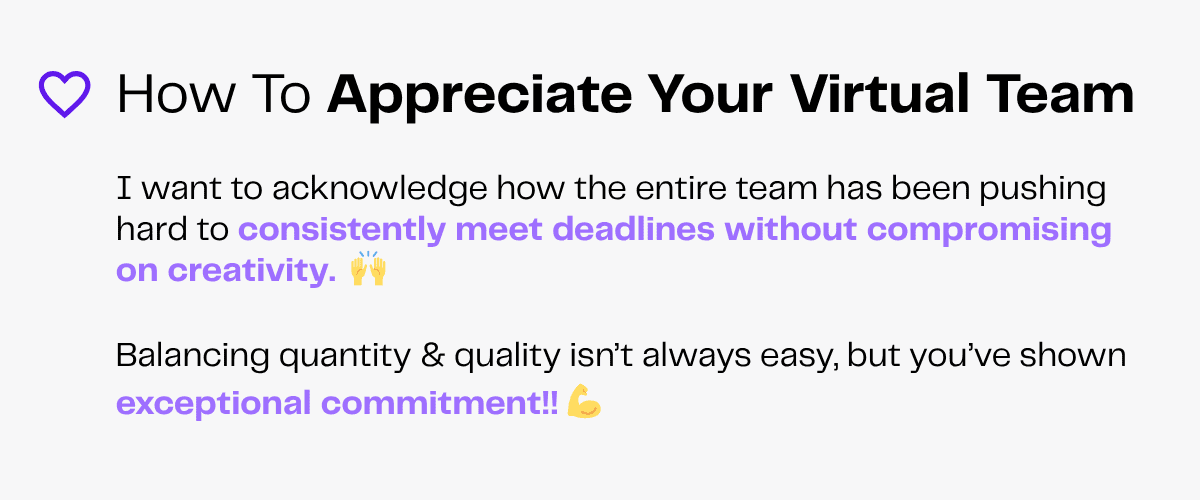
- Acknowledging every team member’s contribution.
- Celebrating collective milestones.
- Sharing healthy feedback.
Invest in Robust Security Measures
Frequently assessing risks is crucial to avoid data breaches and safeguard your company’s privacy, especially when working with virtual teams.
You must follow strong security measures, such as:
- Using trusted communication and collaborative tools.
- Updating your tools and software regularly.
- Implementing firewalls and antivirus software to ensure no third party can breach your important data.
- Educating your team regularly about following secure practices.
Why Is a Virtual Team Important in 2026?
With remote and hybrid work models on the rise, workflows have become more continuous, digital and borderless.
Work is no longer tied to a place or even a fixed schedule—it moves across time zones, specialized tools and diverse contributors.
Virtual teams offer more than just flexibility and cost-effectiveness. Here’s an overview of what more they bring to the table and how they benefit you and your business.
Access to On-Demand Skills
As the market gets more high-paced and competitive, there is a systematic shift from traditional, role-based hiring to a more agile outcome-based workforce.
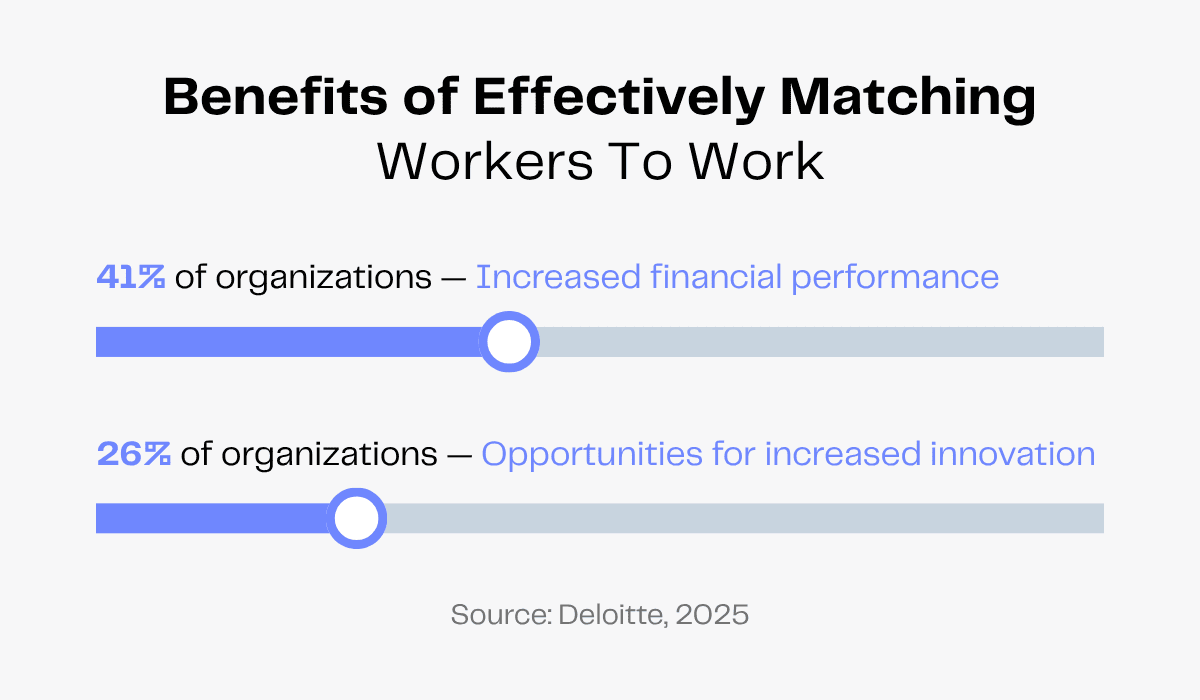
In fact, in a Deloitte survey, 41% of organizations said that the benefit of effectively matching workers to work is increased financial performance and for 26%, it’s opportunities for increased innovation.
Instead of maintaining large, fixed teams, businesses are now tapping into specialized talent through virtual teams exactly when needed.
Whether you need niche AI specialists or short-term content strategists, you can access precise skills on demand.
Enhance Your Quality of Life
Trevor Koverko, an influential entrepreneur, talks about how smaller decisions take up most of your mental space, leaving you burnt out by the time you face big, important decisions.
To avoid this, he suggests outsourcing smaller, routine tasks so you can focus on high-priority work.
Once you escape the hustle culture and work smarter by hiring virtual teams for tasks that can be easily delegated, you reclaim your own work-life balance.
Final Thoughts
Virtual teams have become very popular in redefining how businesses think about talent, efficiency and growth.
It’s not simply a shift in working style, but a strategic advantage enabling organizations to operate leaner, respond faster and scale smarter.
Companies that embrace this model aren’t just adapting to evolving changes but are positioning themselves to stay competitive in a more connected world.
So if you’re looking to onboard highly skilled virtual team members, you are at the right place!