Key Takeaways:
The global online recruitment market size is expected to be worth around USD 63.8 billion by 2033. This popularity can be attributed to the accessibility and convenience of this approach.
Manual screening processes stretch the hiring timelines up to 45 days. In comparison, AI-powered methods take as little as 12 days!
49% of workers find most employer application processes too long and complicated. With easy online applications, flexible interview options and faster onboarding, virtual recruitment accelerates the hiring process for candidates.
The old recruitment process often meant delayed hiring cycles, limited talent pools and missed opportunities.
In today’s competitive world, talent is no longer confined to office walls—or even countries!
Businesses around the world are shifting from traditional hiring models, once defined by lengthy processes, higher costs and geographical barriers, to a faster, smarter approach: virtual recruitment.
With global connectivity at our fingertips, companies can tap into skilled professionals from anywhere, without the constraints of location or infrastructure.
This shift has paved the way for virtual assistants and remote teams, who are agile, cost-effective and ready to scale with your business.
What Is Virtual Recruitment?
The global online recruitment market size is expected to be worth around USD 63.8 billion by 2033.
This popularity can be attributed to the accessibility and convenience of this approach, which is fueling the growing need for streamlined hiring processes worldwide.

Virtual recruitment is the modern way of hiring, in which the entire process, from sourcing candidates to onboarding, happens online using digital tools and platforms.
Instead of time-consuming in-person rounds, companies can now connect with talent anytime, anywhere, making hiring faster and more flexible.
This process includes:
- Online sourcing: Finding potential candidates through online job portals, social media or professional platforms.
- Candidate screening: Using Applicant Tracking Systems (ATS) and AI tools to manage job postings and quickly filter applicants based on skills, experience and job fit.
- Video interviews: Evaluating candidates through live virtual interviews (two-way) or recorded interviews (one-way).
- Virtual assessments: Testing skills through online assignments, quizzes or simulations.
- Virtual onboarding: Completing documentation, training and integration remotely.
What’s more, if you are hiring entirely remote workers like virtual assistants or virtual teams, you can tap into global talent pools and access diverse skills.
Even if you’re not looking to hire remote employees, virtual recruiting practices can help cut costs, especially for small businesses looking to hire efficiently.
What Are the Benefits of Virtual Recruitment
Virtual recruitment can benefit startups and enterprises alike.
You may use it to fill positions quickly and increase productivity. Or you may leverage it to hire overseas virtual assistants to save money.
Here’s an in-depth look at the major benefits of virtual recruiting.
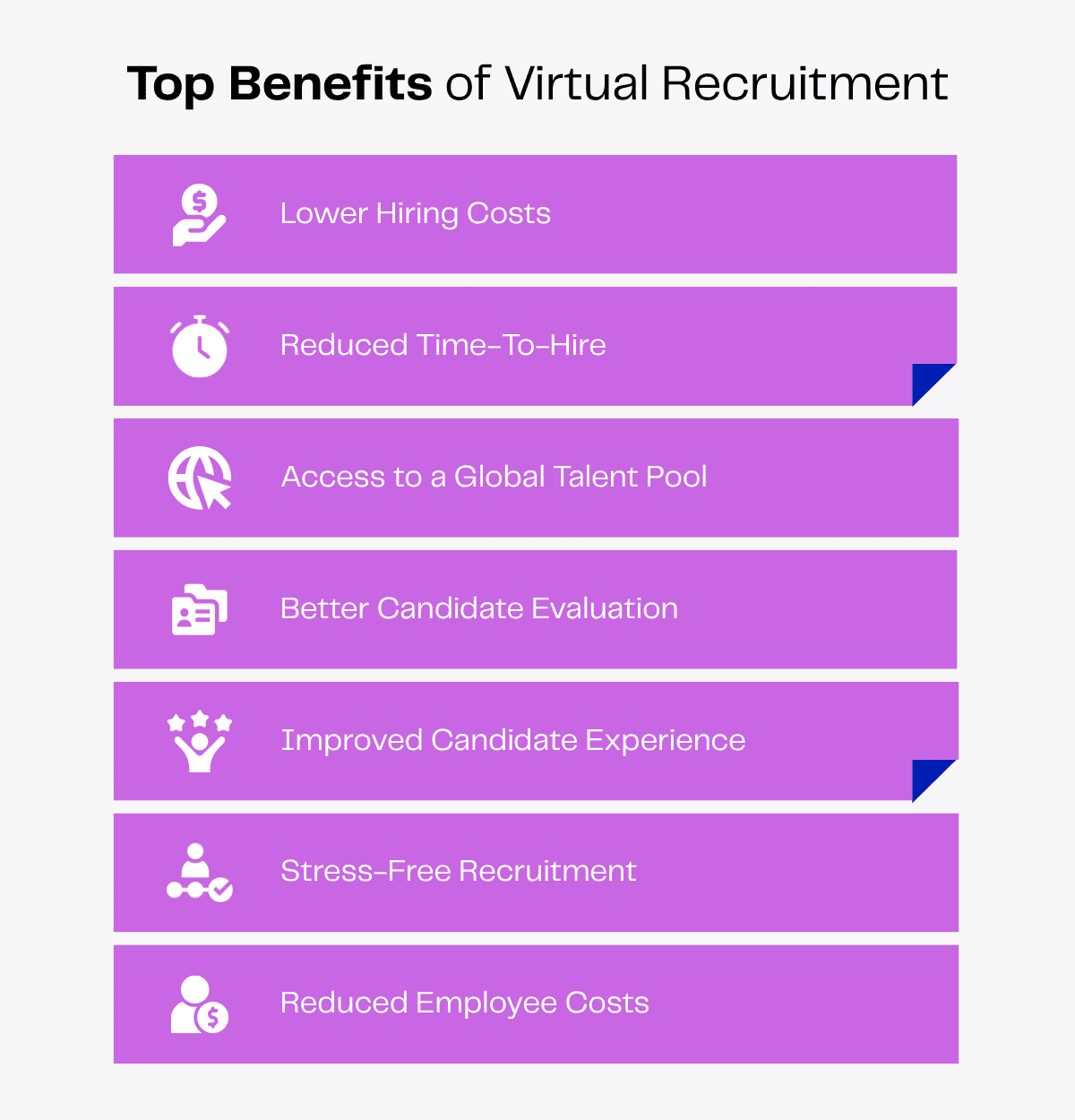
Lower Hiring Costs
Manual hiring processes require you to bear costs for office space, travel reimbursements and in-person interview logistics.
Virtual recruitment, on the other hand, eliminates expenses tied to traditional hiring methods by leveraging tools for automated screening, online assignments and video interviews.
Many platforms also offer free job listings, allowing businesses to post job openings and receive applications without upfront costs.
Reduced Time-To-Hire
Virtual recruiting removes the friction points that inflate time-to-fill in traditional hiring, keeping your HR teams more productive.
By helping you tap into global talent pools, it accelerates candidate sourcing. Digital platforms, job boards and AI tools help you reach relevant candidates faster, eliminating long wait times. Traditional manual screening processes significantly slow down talent acquisition, stretching the hiring timelines up to 45 days. Relying heavily on human effort to review, sort and evaluate large volumes of resumes is time-consuming.
Studies also show that such delays come at a cost—when productivity losses average at $1,200/day. Businesses can also lose $14,000 per role due to extended hiring cycles.
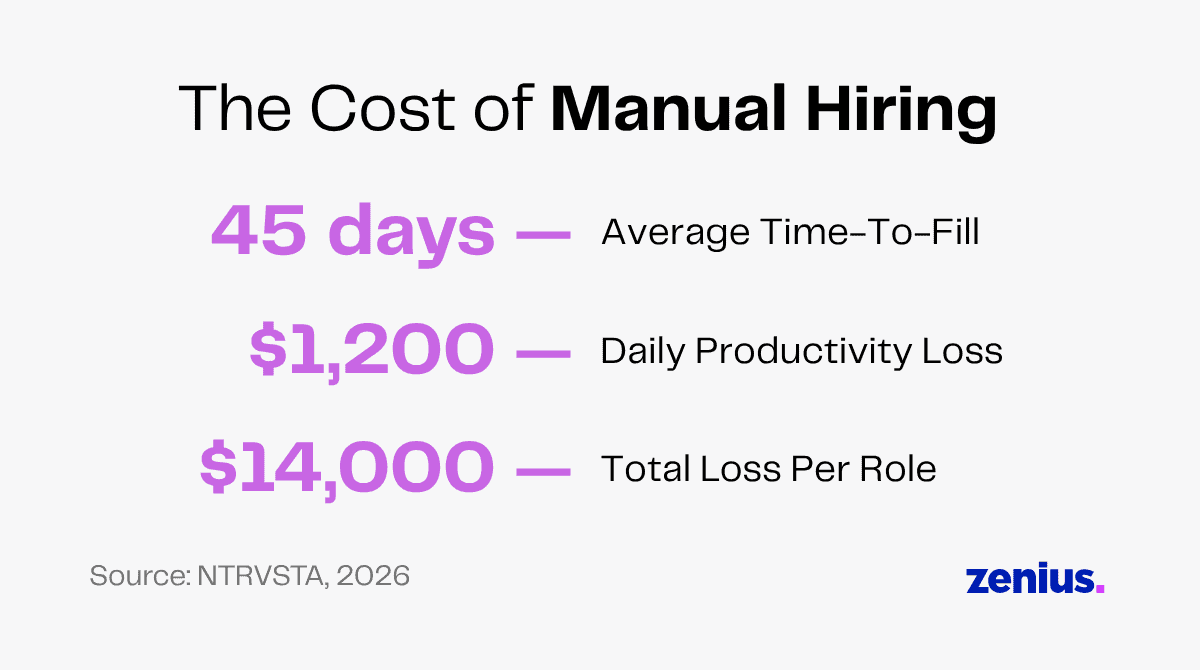
In comparison, AI-powered methods can shrink this hiring duration to as little as 12 days! Virtual recruiting leverages automated screening processes to cut down on the time spent on initial filtering stages.
Asynchronous and recorded video interviews also eliminate scheduling delays. Without the logistical constraints of manual hiring, you can evaluate multiple applicants in parallel, saving more time.
Access to a Global Talent Pool
When you recruit virtually, job seekers worldwide can access your job listings and apply for remote work opportunities.
So you can explore a diverse talent pool to build a global virtual team, expanding both the quality and quantity of applicants and catering to the evolving market needs.
This wider reach doesn’t just increase options—it also helps you find niche skill sets, multilingual talent and specialized proficiency that may be scarce locally, giving you a global competitive edge!
Whether you need innovative data scientists or creative graphic designers, virtual recruiting makes it easy to gain quality hires.
Overseas candidates, with diverse cultural and professional backgrounds, bring fresh perspectives and innovation to your company’s vision.
With a larger pool of candidates available at any given time, roles are filled faster.
What’s more, overseas talents from low-cost-of-living countries are more affordable than local workers.
Better Candidate Evaluation
In a competitive hiring landscape, speed alone isn’t enough—precision matters more.
Virtual recruiting elevates candidate evaluation by blending technology with structured processes, enabling HR managers and recruiters to assess talent more accurately than before.
It shifts hiring from solely intuition-driven decisions to insight-backed selection, ensuring every candidate is evaluated on true potential.
The virtual recruitment process facilitates better candidate evaluation by:
- Leveraging data-driven screening: Instead of relying on gut feeling, you leverage analytics, assessment tools and AI scoring to evaluate candidates objectively, reducing bias.
- Using recorded interviews: Video interviews can be revisited, compared, shared and analyzed by multiple stakeholders, leading to deeper reviews and collaborative decisions.
- Conducting skill-based online assessments: Virtual tools enable real-time tests, simulations, quick quizzes and case tasks, helping you evaluate real-life skills rather than just credentials.
By combining data analytics, collaboration and skill-based tests, you’ll not only identify the best-fit candidates faster but also build more capable teams.
But do not forget to implement this useful advice by Sherry Martin, a strategic HR leader:
Use technology to handle scheduling and logistics, then create genuine dialogue where interviewers share authentic insights about company culture, team dynamics and growth opportunities while candidates discuss their aspirations and potential contributions. This mutual transparency builds trust on both sides.
Improved Candidate Experience
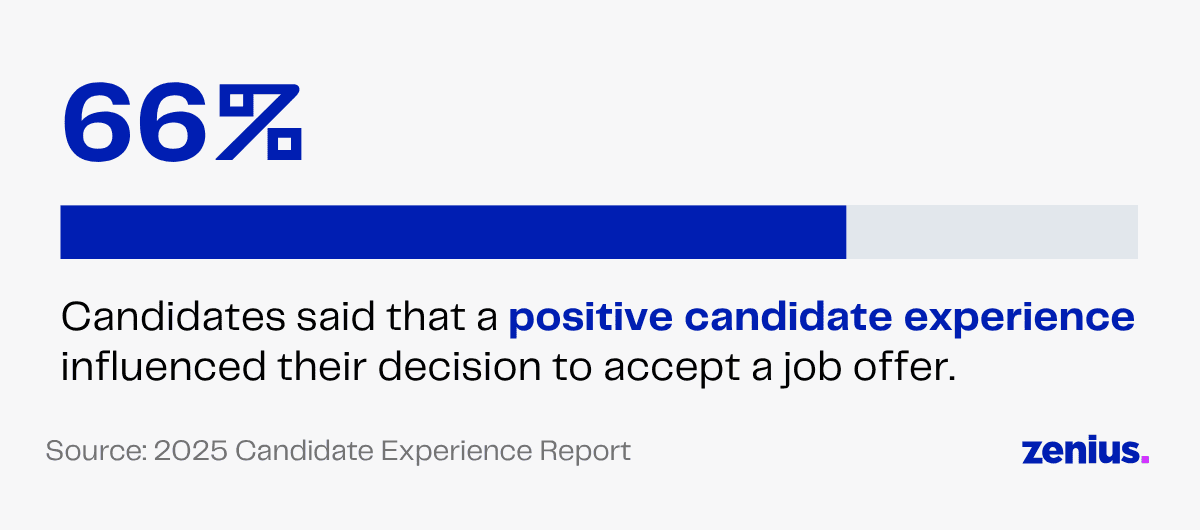
In a survey, 66% of candidates said that a positive candidate experience influenced their decision to accept a job offer.
So you must prioritize creating a fast, candidate-friendly hiring process that keeps your applicants engaged.
49% of workers in another survey said that they find most employer application processes too long and complicated.
With easy online applications, clear communication channels and faster onboarding, virtual recruitment accelerates the hiring process for candidates.
Another benefit of virtual recruitment to candidates is the flexibility. They can complete assessments and attend interviews from anywhere, often at times that suit them, making the process more seamless.
Joe McKendrick, an author, independent researcher and speaker exploring innovation, information technology trends and markets, says,
[In an] online AI-driven interview … the information a candidate is able to present may be more complete than what may be put forth in a live-human and perhaps intimidating, screening.
What’s more, a well-structured virtual recruiting process will also reflect your company’s efficiency. A smooth digital experience will build a strong first impression, enhancing your branding and increasing the likelihood of top candidates accepting your offers!
Stress-Free Recruitment
Traditional hiring can be stressful for recruiters and candidates alike.
Candidates stress about traveling to and interviewing in an unfamiliar environment. These additional burdens may affect their interview performance.
Talent sourcing teams and hiring managers may also struggle with accommodating candidates’ scheduling requests and blocking interview spaces (like conference rooms).
Online hiring, on the other hand, can reduce this stress. You can flexibly schedule interviews and don’t have to reserve office spaces. And even candidates can prepare and perform better from the comfort and familiarity of their homes.
So when both recruiters and the candidates are relaxed, recruitment becomes stress-free, even enjoyable!
Reduced Employee Costs
By choosing to directly recruit VAs or virtual teams, businesses eliminate the need for physical office space, utilities, infrastructure and in-house equipment that would otherwise drain their budget.
If you hire them through virtual assistant agencies, you also don’t have to worry about employee benefits such as paid leave or insurance.
You can hire remote teams for various kinds of tasks for your business. What’s more, you can scale up or down based on demand without long-term financial commitments.
Read More: 11 Top Advantages of Virtual Teams for Your Business
How To Hire Talent Online
Hiring online is all about choosing the right channel to find the right people for the job.
Whether it’s leveraging social media for networking or curating job descriptions for online portals, each method offers its advantages.
Here are a few hiring strategies to recruit employees virtually.
Networking
Networking means proactively nurturing relationships with potential candidates, peers and industry professionals to identify talent and engage with them even before vacancies arise.
To create strong networks and find talent, you must:
- Build a digital presence on social media platforms where you share insights, company culture and interact with communities.
- Joint relevant groups such as Slack channels, Discord servers and forums.
- Participate in panel discussions, virtual recruiting events, webinars, live sessions and online meet-ups.
- Encourage employee referrals.
- Reach out with personalized messages to people who show interest.
But networking can also be limiting as it focuses on known connections. It can limit diversity and stop you from finding objectively better candidates if you keep accessing the same circles. It also requires consistent time and effort to actively find talent.
Online Job Portals
Online job portals are websites where you can post vacancies, track applications and instantly communicate with applicants through direct messaging.
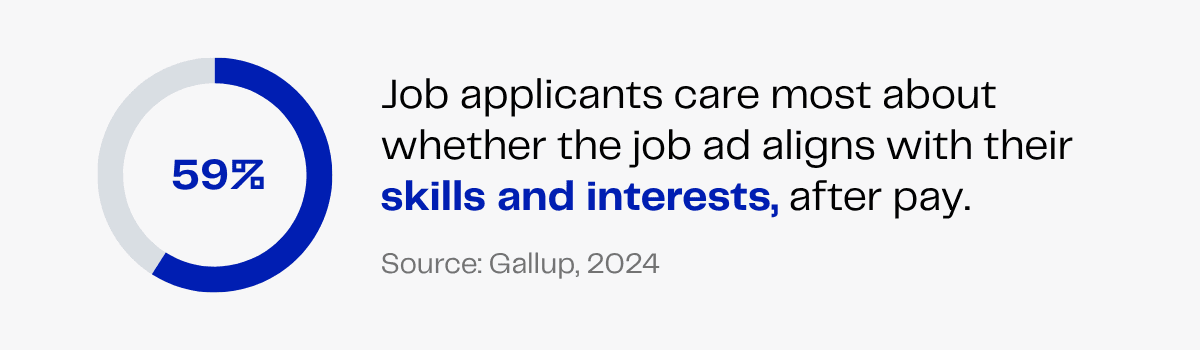
In a survey, 59% of job applicants said that alignment between the job advertisement and their skills and interests was the most influential factor, after pay, in their decision to apply for the job.
So you must remember to clearly and compellingly list the nature of the role, tasks, skills required and other details to attract the right candidates.
But using job portals can be frustrating. Almost all job seekers have access to online portals and you may find many unqualified candidates responding to your job posts.
So you’ll have to sort through overwhelming responses to create a relevant shortlist, which can be tiring and time-consuming.
Job portals also use different algorithms to show job listings to candidates. So your job posts may get buried under your competitors’ SEO-optimized ads. And low visibility can decrease your chances of attracting quality candidates via job portals.
Staffing Agencies
Staffing agencies are third-party firms that connect companies with remote professionals. They can help you seek suitable candidates for roles you can’t find yourself or don’t have the time to look for, offering convenience and expertise.
Virtual assistant agencies like Zenius can expedite your hiring process. We can help you hire overseas talent at a reasonable price. We also provide dedicated client support to handle any ongoing issues.
So you can add educated and experienced members to your virtual team and grow your business immediately!
You can refer to the table below to learn how hiring factors differ in various types of virtual recruiting.
| Hiring Factors | Networking | Job Portals | Agencies |
|---|---|---|---|
| Quick hiring | Sometimes | Sometimes | Always |
| Evaluation support | No | No | Yes |
| Recruitment marketing | No | No | Yes |
| Global talent access | Sometimes | Frequently | Always |
| Dedicated support | No | No | Yes |
Steps To Hire Virtual Teams
The virtual recruitment process is easy and reliable.
But it’s not automatic. You must prepare well to find the best possible fit for your business goals.
Here are the steps to build your perfect virtual team!
Set Job Expectations
You’ll find the most suitable candidate if your job description is thorough, so clearly define the job role you want to hire for.
You can draft a job description detailing:
- Overall role
- Daily responsibilities
- Expected skills (technical and creative)
- Performance metrics
- Working hours
- Required previous experience
Clear job expectations help you eliminate guesswork, align teams on roles and goals, reduce miscommunication down the road and ensure efficient results without delay.
Contact an Agency
Partnering with a staffing agency gives you instant access to pre-vetted talent, saving time and hiring effort.
Virtual recruitment is simple if you contact Zenius!
We can provide direct access to talented, English-proficient candidates matching your professional standards.
You can sit in for interviews to determine which candidates best suit your company’s mission, vision and values. So remember to ask mindful questions and make your choice.
Complete Extensive Onboarding
A thorough onboarding enables seamless virtual collaboration and professional development.
You must create a safe space to help new employees settle into your company.
You can achieve a fluent workflow by sharing extensive information during onboarding.
Inform them about:
- Workplace policies
- Communication guidelines and channels
- Training sessions
- Tech stack
- Weekly goals
- SOPs and guides
You can exchange feedback to understand their concerns, resolve their queries and build a trustworthy connection.
Remember to lead virtual teams with empathy to improve employee morale and performance.
Read more: Virtual Team Communication Tips for Proactive Collaboration
Final Thoughts
The benefits of virtual recruitment are manifold. You lower your expenses, fill up roles faster, go beyond surface-level talent and get niche skills, enhance candidate experience and curate an overall stress-free hiring process.
With the combined benefits of speed and skills, virtual recruitment is the edge that keeps you ahead!
Whether through networking, job portals or staffing agencies, you can find talent that empowers your business to catch up with the world without compromising on quality.
And if you want to accelerate results even further, the smartest move is to partner with an agency and streamline hiring!