
Key Takeaways
Lack of clarity prevents 93% of employees from aligning their goals. The SMART method helps by making goals specific and measurable.
Providing resources like digital tools and SOPs will help your VA meet their goals faster.
Since SMART goals are definite and rigid, they can sometimes hinder innovation. To avoid limiting creativity, leaders should stay adaptable and open to changes.
According to a Microsoft survey, 50% of practitioners said that clarity in goal setting motivates them in the workplace.
With unclear goals, you’ll steer your virtual assistant nowhere and end up wasting time and resources. Even worse, your business will never reach its true potential.
But you can change this by setting SMART goals.
SMART goal setting is an effective strategy to use VAs, helping them understand your expectations and work with purpose.
Learn all the methods and best practices for setting SMART goals for your virtual assistant.
What Is a SMART Goal?
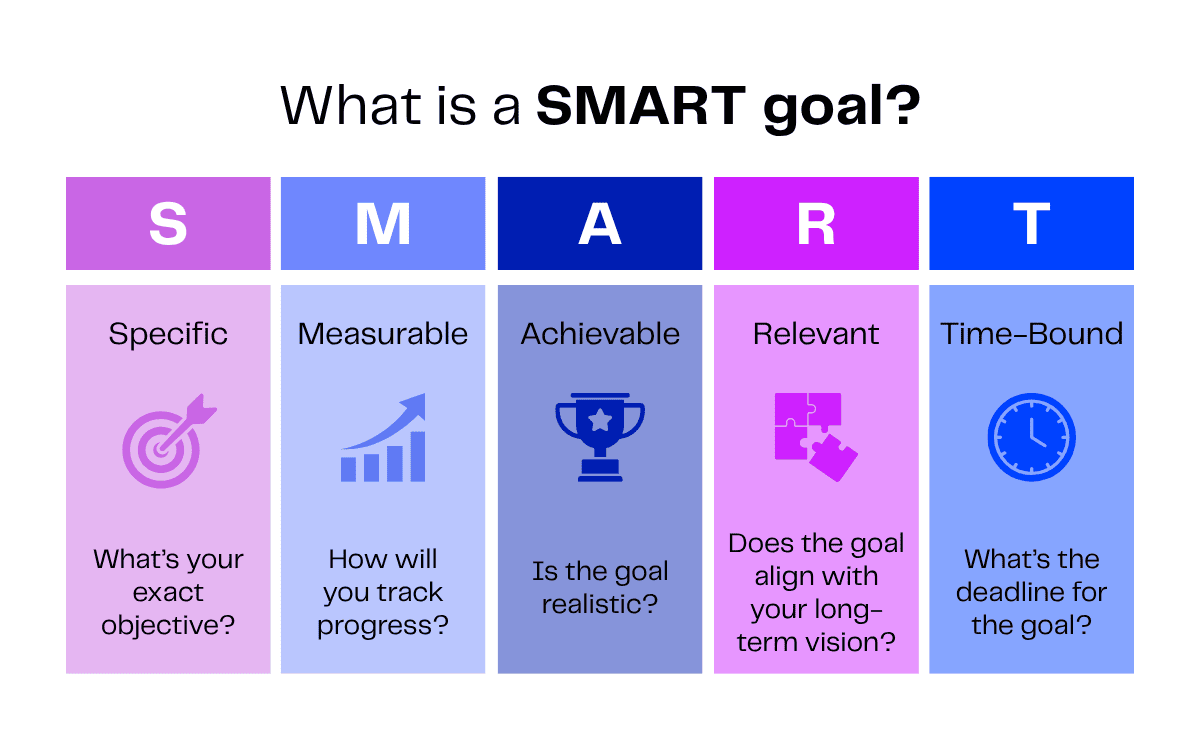
SMART stands for specific, measurable, achievable, relevant and time-bound.
It’s a method for setting clear goals that allows an individual or a group to reach a target within a certain time limit.
The framework was first developed in 1981 by George T. Doran to help businesses make impactful decisions.
SMART means:
- Specific: The goal should be precise.
- Measurable: The goal should be trackable via quantifiable metrics.
- Achievable: The goal should be realistic and not far-fetched.
- Relevant: The goal should contribute to your long-term mission.
- Time-bound: The goal should have a clear deadline.
Instead of making your goal, “I want to make more money,” turn it into a SMART goal: “I want to increase revenue by 10% by next year.”
Toni Pisano, Chief Customer Officer, PortPro Technologies
Now, we have something concrete to work toward. Drilling down into specifics helps define what you want to achieve in your business.
Here are some examples of SMART goals to help you get started with your virtual assistant.
- Generate 100 new sales in December by sending offer emails at peak open-rate hours.
- Conduct 50 phone surveys to acquire data for a new customer persona by next week.
- Format and proofread 10 organization reports in 3 days.
- Organize the data of 100 new employees within 5 days.
Benefits of SMART Virtual Assistant Goals
SMART goals boost your VA’s chances of hitting their objectives. Here are the top reasons why business owners should consider it.
Foster Self-Management
A SMART goal includes all the information your virtual assistant needs to complete a task, which equips them for self-management.
For example, if they know they need to make 20 calls a week and schedule 5 client meetings, they can independently create a timetable to hit those targets.
This will also help you avoid micromanagement. As your VA becomes familiar with your workflows, they won’t need constant instructions or check-ins.
Meet Short-Term Goals Effectively
SMART objectives work best for short-term targets. Since they are specific, measurable, achievable, realistic and time-bound, they create actionable targets that are easier to fulfill in the near future.
Instead of being confused about what to do every day, your VA can organize their schedule around specific targets. They can start with high-priority tasks and end with low-priority tasks based on the objectives.
Improve Time Management
According to a journal article, time constraints can affect how goals are pursued. Setting longer deadlines can reduce productivity, whereas shorter deadlines can increase it.
Since SMART goals promote clear, realistic deadlines, they can help your VA improve time management while pursuing a goal.
The goals are broken into small steps, making them easier to tackle without overwhelm.
Your VA can also use time trackers and scheduling tools to use time wisely based on your goal’s deadline and manage time-sensitive tasks.
Provide Clarity
A workplace survey reveals that a lack of clarity prevents 93% of employees from aligning their goals.
Setting SMART goals can ensure clarity.
The goal’s specificity and measurability will allow them to plan and work effectively. They’ll have a clear understanding of what to do and what to avoid from the first day.
This way, you’ll also ensure a faster onboarding process and receive the best benefits of working with a VA, from smoother workflows to higher efficiency.

How To Set SMART Goals for Your Virtual Assistant
To set SMART goals, you must turn vague desires into actionable objectives.
Start by analyzing your problem areas, creating a roadmap to complete the goal, setting a deadline and ensuring the goal aligns with your long-term plan.
Look for Improvement Areas
Start by identifying improvement areas. What operations and tasks in your business aren’t up to the mark?
What issues does a VA need to focus on? Are there any knowledge or skill gaps? Was there a single mistake or do you have a recurring problem? Then, evaluate which problems to prioritize.
For example, you want to boost customer support to retain more customers, but your team is unable to cater to all your customers.
Create the Goals
After finding what needs improvement, create the goals that will solve the problem.
For example, the goal of your virtual assistant could be to create a list of at-risk customers and then email them. You must set a specific number to measure daily progress, such as 50 emails a day. You also need a clear deadline.
There are two types of goals you can create. A process-based SMART goal is about maintaining a specific action or behavior. A result-based SMART goal, on the other hand, is about getting a desired outcome. You can even connect the two goals to your advantage.
You can set a goal for your VA to boost sales by 20% within six months (result-based target) by making 50 follow-ups per week (process-oriented goal).
| Result-Based Goals | Process-Oriented Goals |
|---|---|
| Focuses on achieving a target | Focuses on taking action or following steps |
| Has a fixed deadline to aim for | Continuous process with milestones |
| Measured by results | Measured by progress in action/steps |
| Less flexible to change | More flexible to changes |
| Get 100 new customers | Make 100 cold calls |
| Get 100 new sales in 30 days | Test and optimize 10 sales scripts every week |
Provide Helpful Resources
Resources like software, SOPs and tools will help your VA work faster and fulfill their goals more quickly.
Learn which tools can optimize work for your VA. For instance, if you’ve hired a proofreading virtual assistant, a tool like Grammarly can make their work easier.
You can also give them access to your knowledge base or e-learning resources.
Review the Roadmap
Once your virtual assistant starts working, assess the initial phase. They might have doubts or make small errors.
After tracking their performance, send them feedback. Ask them about any confusion and answer their questions to help them improve.
In business, I see leaders all the time spend hours crafting the perfect mission statement, making sure everybody in their organization understands what their goals are.
Chuck Wachendorfer, Author
But then they fail to help their team members understand what they need to do differently to achieve that goal. The result? Disengagement, frustration, and ultimately failure.
It’s like somebody asking you to bake a cake and then not giving you the recipe. No cake, no party.
Keep Goals Flexible
SMART goals are highly specific, which can create a disadvantage, such as less room for adapting to changes.
You could also miss new ideas, innovation and strategy in this process as you don’t try new methods.
As career coach Lucile Kamar explains,
The push for specificity can lead to tunnel vision, particularly in industries where innovation drives success. Additionally, narrowly defined goals frequently hinder original thinking, as teams feel discouraged from exploring alternative solutions.
Find a way to remain flexible with your goal. You can collaborate with your virtual assistant to discuss any issues that occur.
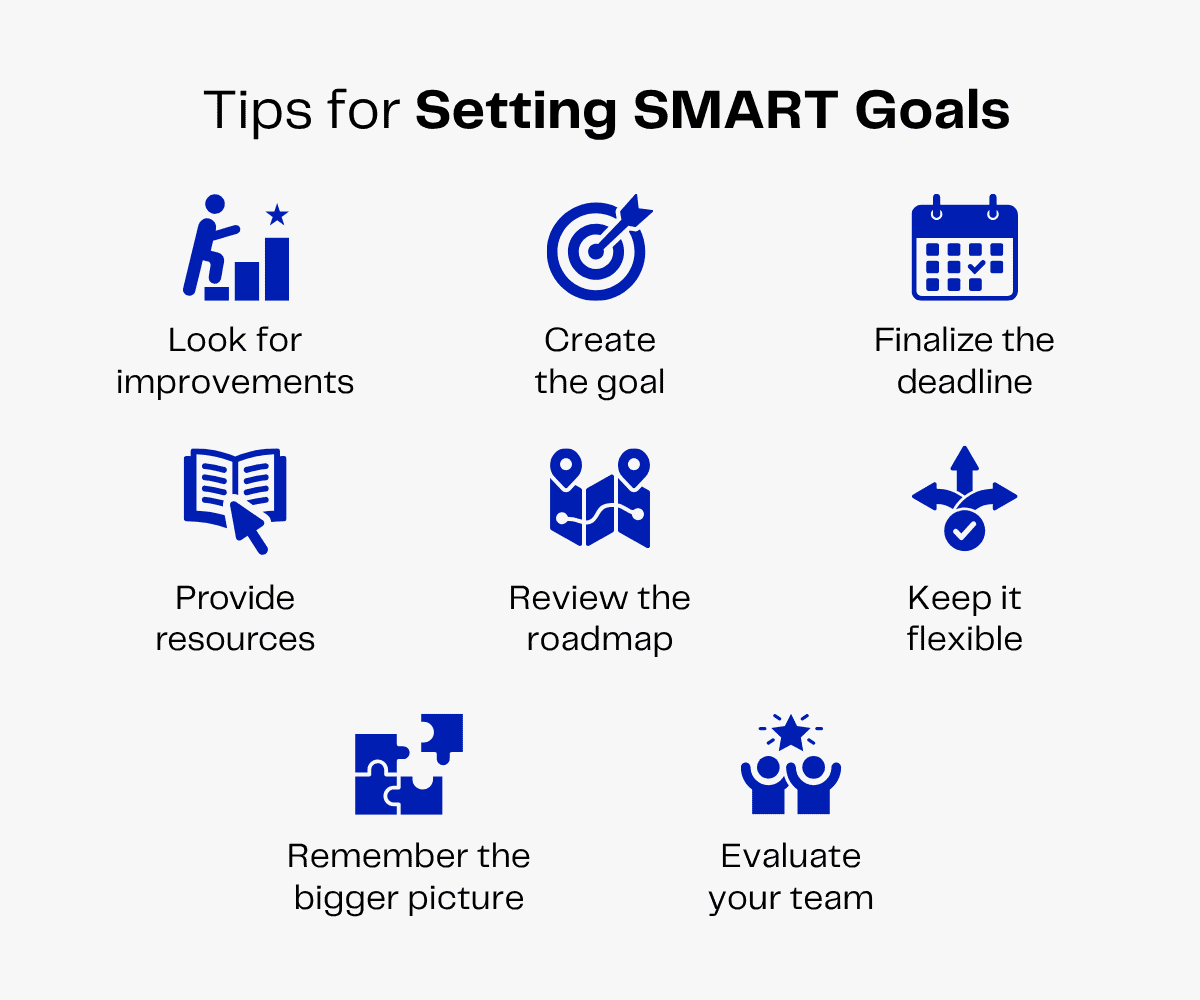
Evaluate Your Team
To hit your SMART goals effectively, you must have the right team members.
You can tell if your team can fulfill the target based on their range of knowledge and skills.
If a member lacks a skill, the other members should be able to fill the gap. Evaluate your entire team’s strengths and weaknesses.
Beyond technical skills, your teammates should also have strong communication skills and a team spirit to work toward common goals together.
If you want the best talents without waiting months, consider Zenius. Our pre-vetted talents will add valuable skills to your team and accelerate your business success.
Remember the Bigger Picture
Don’t forget the bigger picture, as it matters most in the grand scheme of things.
SMART goals are ideal for short-term objectives, but many issues can influence the course of the target. So be on the lookout for emerging competition or changes in laws and regulations that could affect your business.
Also, connect with experts who can predict trends and come up with a plan for potential threats in the future. This way, you’ll be able to keep your business moving in the right direction.
How To Set Long-Term Professional Goals for Virtual Assistants
If you want to become an industry leader or expand to global markets, you need to set long-term goals.
While short-term goals are met through immediate actions, long-term goals are met by repeatedly fulfilling multiple short-term goals.
For example, your long-term goal can be to get 1 million followers on social media, whereas a short-term goal is to post 10 engaging posts every week.
Here’s how you can keep long-term goals in mind even while setting SMART goals.
Prioritize Your Vision
According to studies on American, Australian and Thai businesses, effective vision statements can improve your business outcomes.
Knowing your vision with clarity can simplify your path to success. You will know the required actions and steps to reach it.
You can emphasize your vision statement by deciding where you want to be after a decade. Think about how a virtual assistant can assist you in reaching your ultimate milestone.
Align Your Short-Term Goals
A long-term target can come true only if it’s aligned with your short-term monthly goals. To increase your net profit margins in five years, you need a short-term plan to boost sales.
You can hire a virtual assistant to work on these short-term goals to help you reach your long-term vision.
Sharing your vision will motivate them to work harder and get you closer to the bigger picture.

Embrace Change
Change is inevitable, so assess your short-term and mid-term plans regularly. Look for challenges and opportunities. If change becomes necessary, embrace it.
But be transparent with your virtual assistant about any changes.
You’ll build better relationships with your VA this way. A strong relationship is essential to work together over the long haul and fulfill long-term goals.
How Virtual Assistants Help Businesses Meet Their Goals
Virtual assistants (VAs) are remote professionals who collaborate with businesses to provide different services.
Organizations can get many benefits by choosing different types of virtual assistants, such as:
- Admin virtual assistants can handle your routine tasks, such as data entry, emails, etc.
- Sales virtual assistants can partner with your sales team to help increase profits.
- Cold calling virtual assistants can connect with new customers through phone calls.
- Creative virtual assistants help with tasks such as editing images and creating graphics.
- Social media virtual assistants boost your digital presence on different platforms.
| VA Type | Goal |
|---|---|
| Administrative VA | Streamline daily workflows |
| Sales VA | Increase revenue |
| Cold calling VA | Acquire more customers |
| Creative VA | Strengthen brand image |
| Social media VA | Boost digital presence |
Here’s how virtual assistants help you meet your goals, both for the short and the long term.
Step Up Efficiency
Virtual assistants deliver efficiency in your organization. One way they do this is by handling repetitive tasks such as scheduling, data entry, email management and bookkeeping.
This allows leaders, managers and employees to focus on core activities.
Specialized VAs can do more than administrative tasks.
For example, tech virtual assistants can deliver IT solutions, creative virtual assistants can design graphics or write content and so on.
With a virtual assistant, you can boost your business performance without heavy investment. You can also scale them without hassle, which adds flexibility to your operations.
Minimize Growing Expenses
With inflation on the rise, hiring quality workers is expensive. Hiring a virtual assistant is a great alternative.
You don’t need to pay a large salary to them. For affordable monthly payments, VAs deliver valuable services to your business.
Hiring a VA also means reducing expenses on equipment, health insurance and physical office space.
Imagine how much you can save by hiring a VA rather than recruiting a full-time employee!
Get More Free Time
An organization with a virtual assistant can give business owners more time for making strategic decisions.
For instance, VAs can track employees’ metrics so senior leaders can stop chasing employee performance.
At the same time, your employees will also enjoy a better work-life balance with a VA managing routine tasks.
As your team completes their tasks on time, they can do some extra work with the free time at the end of the day. You’ll be able to meet organizational goals faster this way.
Read more: What Is Tim Ferriss’ Virtual Assistant Strategy?
FAQs
How do SMART goals help virtual assistants work better?
SMART goals give virtual assistants a clear direction. Specific instructions prevent confusion, measurability allows progress tracking, realistic targets prevent burnout, relevance ensures alignment with long-term objectives and clear deadlines ensure timely completion.
What are the 3 SMART goals for an administrative assistant?
Examples of SMART goals for an administrative assistant can include deleting spam emails by 6 PM every Friday to reduce inbox clutter, entering weekly sales data into a spreadsheet for the next month and sending reminders to attendees 2 hours before every meeting this week.
What are some other good goal-setting frameworks besides SMART?
Some other goal-setting frameworks include OKRs (Objectives and Key Results), V2MOM (Vision, Values, Methods, Obstacles, Measures), PACT (Purposeful, Actionable, Continuous, Trackable) and WOOP (Wish, Outcome, Obstacle, Plan).
Wrapping Up
Setting SMART goals for virtual assistants helps them work with ease and hit your targets without confusion.
However, don’t let the rigidity of these goals stifle your innovation.
Consider external changes and new opportunities and adjust goals accordingly along the way. If you want to develop a long-term plan, check if your short-term goals connect with it.