
Key Takeaways:
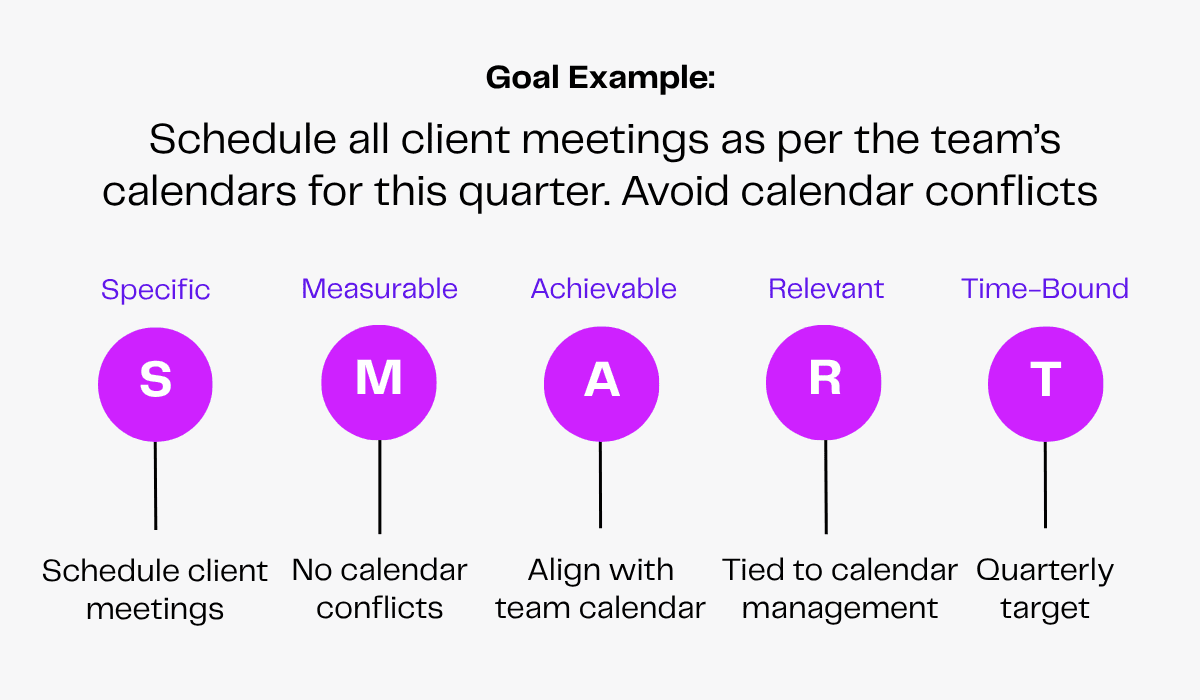
Follow the SMART goals approach to assign tasks, which means the goals must be Specific, Measurable, Achievable, Relevant and Time-Bound.
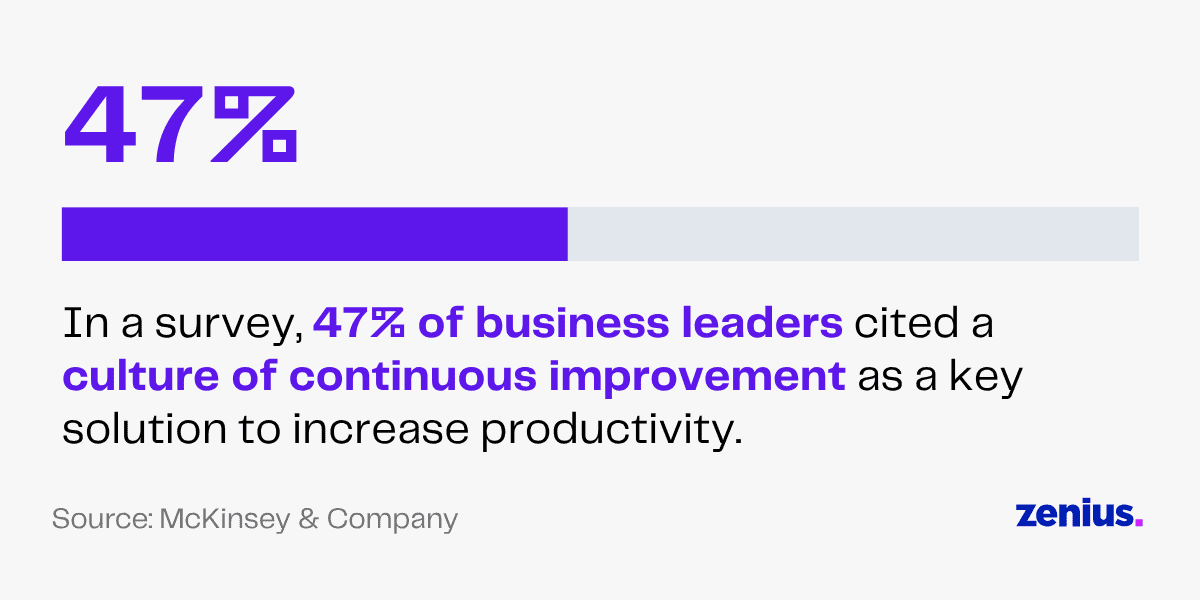
47% of business leaders cited a culture of continuous improvement as a key solution to increase productivity. So be open to your VA’s ideas & suggestions.
VAs aren’t superhumans who can handle multiple tasks in a very short time or stay available 24/7. Don’t set unrealistic expectations or demand perfection from day one.
Ever feel like your day disappears into emails, scheduling, follow-ups and endless admin tasks, yet your most important work remains unfinished?
You know what to do: hire a virtual assistant!
Many business owners hire a VA expecting instant results, only to realize that simply outsourcing tasks isn’t enough.
The real difference lies in how you effectively use and manage your VA.
Clear communication, defined processes, mindful delegation and regular feedback loops transform your VA from a regular professional to a productivity partner.
Discover practical tips and strategies to build an effective working relationship with your VA, maximize their potential and add value to your business.
What Can a Virtual Assistant Do?
A virtual assistant (VA) is a remote professional who supports different business operations. They offer assistance with admin, creative and technical tasks.
Is your schedule a mess? A virtual scheduling assistant can fix it for you. Your social media feed needs an update? A social media VA can curate engaging posts. Have 1000+ unread emails? An email management virtual assistant can clean and sort your inbox.
A VA helps you save time, increase efficiency, improve productivity and get a better workflow.
Virtual assistants are categorized into two types: general and specialized.
General virtual assistants handle basic administrative tasks in the workplace, such as scheduling meetings, sorting emails or organizing documents. Their purpose is to take over the routine tasks and help you stay organized.
Specialized virtual assistants possess in-depth knowledge in a specific area. These VAs work in niches like creative work, customer and sales support, IT or technical fields, marketing, e-commerce assistance and many more.
Read More: An Ordinary Day in the Life of Extraordinary Virtual Assistants
Tips for Effectively Managing Virtual Assistants
If you want to unlock the true potential of your virtual assistants, you must use specific strategies that will help you increase collaboration.
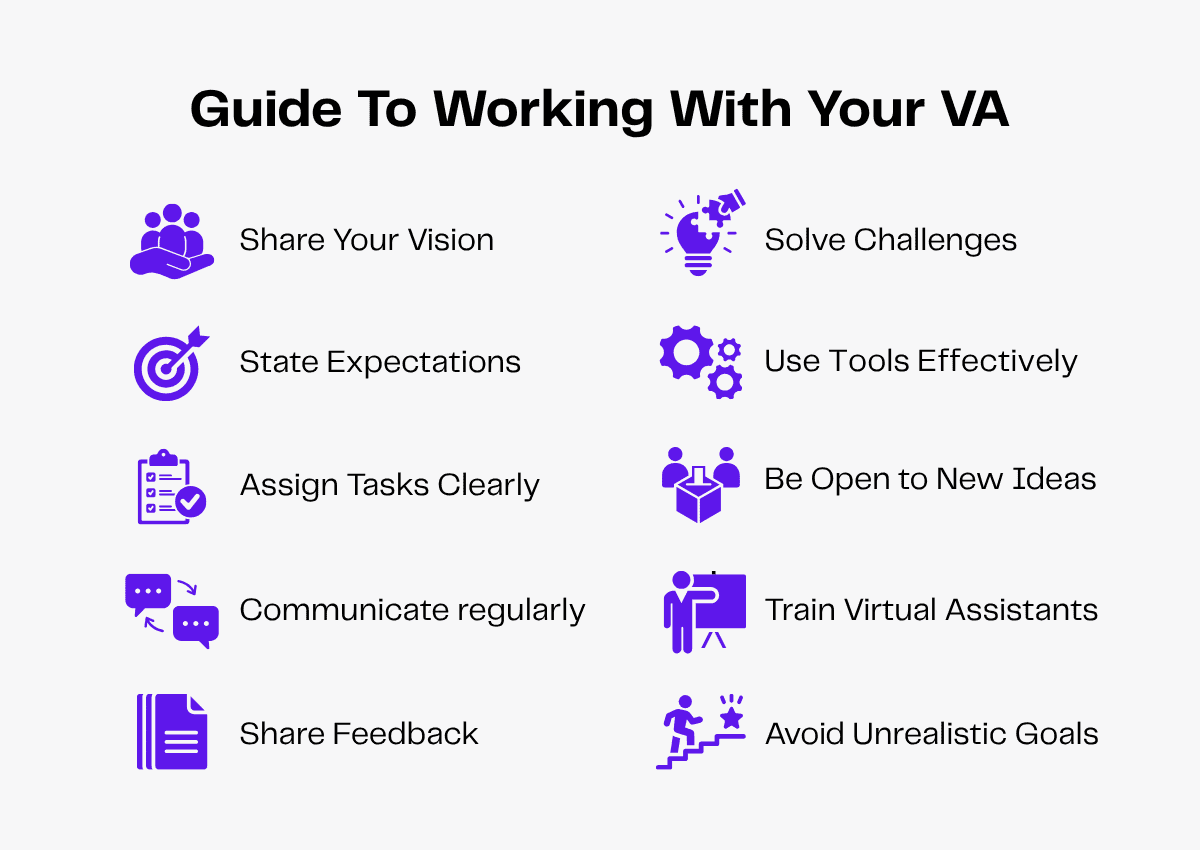
Here are ten tips (plus a bonus tip!) that will help you create a successful partnership with your VA.
1. Share Your Mission and Vision
Your virtual assistant should understand how they can support your business vision. So start by telling them what you want to accomplish in the near and distant future.
Your mission and vision will give them a glimpse of the impact they must bring to your business. This will give them a sense of purpose, elevate engagement and strengthen their bond with you.
When leaders have a clear vision but don’t share it, employees are left in the dark about why their efforts matter.
Dr. Diane Hamilton, Business Behavioral Expert
As a result, they can’t connect their daily tasks to a bigger goal and that often leads to burnout, frustration and disengagement.
… when you understand why your work matters, even the most mundane tasks can feel engaging.
With clear eyes on their goal, your VA will strive to increase their productivity and offer quality work to your organization.
2. State Your Expectations
Let your virtual assistant know what you expect from them. Remember to be as frank as possible.
Conduct a virtual meeting and discuss:
- Expected work quality.
- Creativity and precision you’d want to see after each task.
- Task timeline and deadlines.
- Expected response times.
- Importance of improvement in the workplace.
- Metrics to measure their growth.
- Short-term and long-term results.
You can also set SMART goals. These goals must be:
- Specific: Be clear and unambiguous about the tasks that the VA must accomplish.
- Measurable: State concrete criteria and metrics to reach the target.
- Achievable: Set realistic responsibilities and deadlines.
- Relevant: Align the task list with your business goals and the VA’s skills.
- Time-Bound: Provide a clear timeframe so the VA completes tasks on time, without delays.
3. Assign Tasks With Clarity
Vague tasks and unclear instructions to your virtual assistant will hamper the workflow. They might make mistakes or not meet the required expectations. And you’ll have to bear the loss of time, effort and resources.
To avoid delays caused by constant back-and-forth communication, assign them their tasks clearly.
You must:
- Keep the tasks specific and measurable.
- Identify the total tasks, their frequency and the number of repetitions.
- Define the right way to handle them.
- Discuss potential challenges and solutions for unexpected changes.
- Prioritize clarifying your VA’s doubts as you go.
- Set specific deadlines and reminders to help your VA stay on track.
Discussing tasks might take time and effort, but it will help the virtual assistants to thoroughly know their tasks and avoid misunderstandings.
One useful tip is to list all instructions in a document for the virtual assistant. They can refer to them to clarify doubts or recheck objectives without wasting your time on rediscussing tasks.
4. Ensure Regular Communication
Good communication is critical for building relationships at your workplace. It helps you stay aligned, avoid misunderstandings and build trust.
So when you work with your virtual assistant, it is important to maintain consistent and good-quality communication.
Developing a strategy and following it religiously can help ensure smooth and regular communication. You must:
- Find the right communication platforms for long meetings and quick updates.
- Be prepared with an alternative plan in case of technical errors in the communication software.
- Set up quick weekly meetings (either at the start or end of the week) to discuss work progress and upcoming tasks.
- If possible, use video calls to strengthen bonds and improve collaboration.
- Use a polite and professional tone in your virtual meetings.
- Create a safe space for your virtual assistant to ask questions, discuss tasks or raise concerns.
- Be a patient and good listener.
5. Share Feedback and Reviews
Sharing feedback with your employees is important to improve the communication flow and work quality. It also helps to reduce errors and maximize efficiency.
Make a habit of sending feedback and reviews for your virtual assistant’s work on a daily or weekly basis. Use a chat platform for short feedback. For longer reviews, you can either email their review with both positive and constructive feedback or conduct a virtual meeting.
When giving feedback, remember to:
- Appreciate your virtual assistant’s good work.
- Use a gentle and polite tone while sharing constructive feedback.
- Send them tips to improve.
- Help them spot their mistakes and rectify any errors.
- Listen and understand the problems from their perspective.
- Encourage them at the end to boost their confidence and morale.
- Consider having a longer discussion for a solution in case of a recurring error.
Feedback sessions should not be a one-way lecture. It should be a dialogue. Here’s a table highlighting how business leaders must deliver feedback.
| Don’t Say This | Say This |
|---|---|
| “Let’s only talk about what you did wrong.” | “Let’s start with what you did right.” |
| “Why can’t you get this right?” | “Let’s make sure we’re aligned on our tasks moving forward.” |
| “This is just common sense.” | “Let’s walk through what went wrong and how we can fix this.” |
| “You’re capable of more.” | “I appreciate what you’ve done so far—let’s take it to the next level.” |
| “I don’t want to hear excuses.” | “I’d like to hear your perspective on this.” |
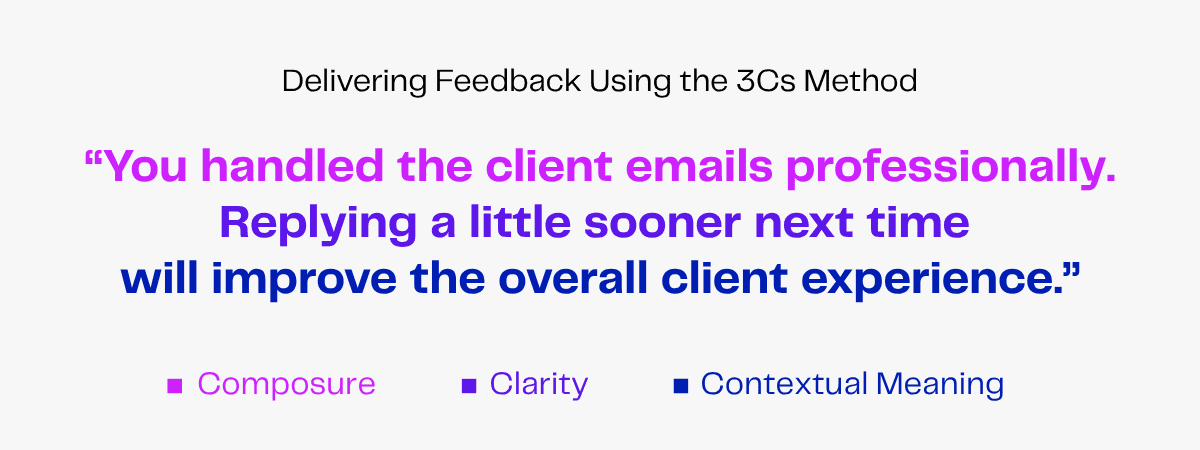
You can also follow the “3Cs of feedback” method to deliver lasting feedback. This approach includes:
- Clarity: While sharing feedback, be specific about your suggestions and expectations and avoid vague language.
- Contextual Meaning: Remember to contextualize your feedback to relevant tasks or the current situation.
- Composure: Stay calm and professional while sharing negative feedback and be mindful of your VA’s perspective.
Clear feedback will help your VA with precise directions to improve their performance. Contextualizing will maintain the relevance and impact of the feedback. And staying composed will prevent unwanted anxiety.
6. Solve Challenges and Barriers
While working with a virtual assistant, you may come across certain challenges, as with any employee. Such roadblocks can hinder the workflow and progress.
You can deal with them by:
- Identifying the problem: Look for technical errors, knowledge gaps, workflow issues, productivity issues or task-related doubts.
- Exploring options: Discuss it with your virtual assistant and list down all the potential solutions.
- Choosing the ideal solution: Find the most effective solution that also ensures that the problem doesn’t repeat.
- Assessing and reviewing the solution: Check whether the solution has worked both now and in the future.
- Repeating the process: Continue searching for potential barriers and challenges to handle them beforehand, saving time.
Solving problems will allow your virtual assistant to function better in your business. It will give them more experience and insights about your organizational needs.
7. Use Tools Effectively
You must adopt all the tools that will help your virtual assistant work on their assigned business tasks.
Whether it’s communication tools, project management tools, CRM systems, social media software or design tools, ensure all tools are accessible. Some virtual assistants may also come with their own tools to support your business operations.
When you adopt these tools, remember to:
- Find the most appropriate tools for your business and your virtual assistant.
- Discuss your preferred tools with your VA and consider their suggestions as well.
- Provide them with the required training if you give the professionals a new tool.
- Create a handy guideline for tool use.
- Give your VA the time to learn an unfamiliar tool for maximum output.
- Stay open to upgrading to better tools.
- Consult your virtual assistant before making any tool replacements.
8. Be Open to New Ideas
In a survey, 47% of business leaders cited a culture of continuous improvement as a key solution to increase productivity.
Improvement comes from sharing and testing new ideas.
When working with virtual assistants, you must be flexible to changes and be willing to adopt new ideas.
First, encourage your virtual assistants to speak freely. They could grasp your systems better than you. Your VA may also suggest new tools, workflows or shortcuts that help you improve your efficiency.
When you fail to see a flaw or opportunity, they could notice it before you. If they have a good experience, they might even predict the consequences of an error.
You may choose which idea you want to implement and which you want to reject. But being open to your VA’s ideas will help you create a more collaborative workplace. Your virtual assistant will feel trusted and contribute innovative ideas proactively!
9. Train Your Virtual Assistants
Train your virtual assistant in different phases. The process might seem daunting, but it is how you’ll be able to maximize their potential.
First, understand the onboarding process. Virtual assistants are different from full-time employees. You won’t need a new space and setup, as they work remotely. But that also brings issues, such as connectivity and communication.
Give them a tour of your organization to solve such issues. You can create a course that walks them through the information and details for onboarding and working effectively.
Also, provide lessons on tools in the initial stages. Let them bring their own tools. But if you have a tool that they don’t use, provide them with training to use it. Ask them if they can improve its utilization.
Lastly, always stay prepared to fill any knowledge gaps. The better they know, the better they can perform for your business.
10. Avoid Unrealistic Expectations
Virtual assistants are an effective tool for a business. But they aren’t superhumans who can handle multiple tasks in a very short time or stay available 24/7. If you have unrealistic expectations, you are setting yourself up for failure.
So don’t expect perfection from day one.
To avoid disappointments, be clear about:
- The ‘What’: Set tasks and goals that are quantitatively and qualitatively achievable.
- The ‘How’: State your preferred tools and methods and give time to adapt to them.
- The ‘When’: Set realistic deadlines and be flexible to adapt them to your VA’s pace.
More than the quantity, you must pay attention to your virtual assistant’s quality of work. With open communication and two-way feedback, you can come to a middle ground that helps you and your VA develop a productive working relationship!
| Unrealistic Expectations of Working With a VA | Realistic Expectations of Working With a VA |
|---|---|
| My VA must know everything from day one | They’ll take some time to learn and adjust to my workflow |
| They can multitask without any errors | They can manage many tasks, but within a set timeline |
| They’ll never make mistakes | I should expect occasional errors—what matters is improvement |
| There’s no need for me to train or explain tasks and processes | I should assign tasks, explain instructions clearly and guide them when needed |
11. Bonus Tip—Be Patient and Enjoy the Process
Hiring a virtual assistant is not the ultimate fix to all your business problems. If you want to build a strong, long-term partnership with your VAs, then patience is the key!
Virtual assistants are here to work for your daily needs, but they’ll take time to learn and adjust to your workflow. From onboarding your VAs to working with them full-fledged, stay calm and guide them patiently.
If things take time, view it as a process to enjoy. Learn from each other and improve as the journey moves forward.
You will meet business goals faster if you embrace the ride!
Read More: Managing Virtual Teams for Ultimate Success
Virtual Assistants Hiring Tips for Businesses
Looking for some tips, tricks and advice to hire a good virtual assistant?
Here are some important guidelines you can follow before hiring the right VA for your business.
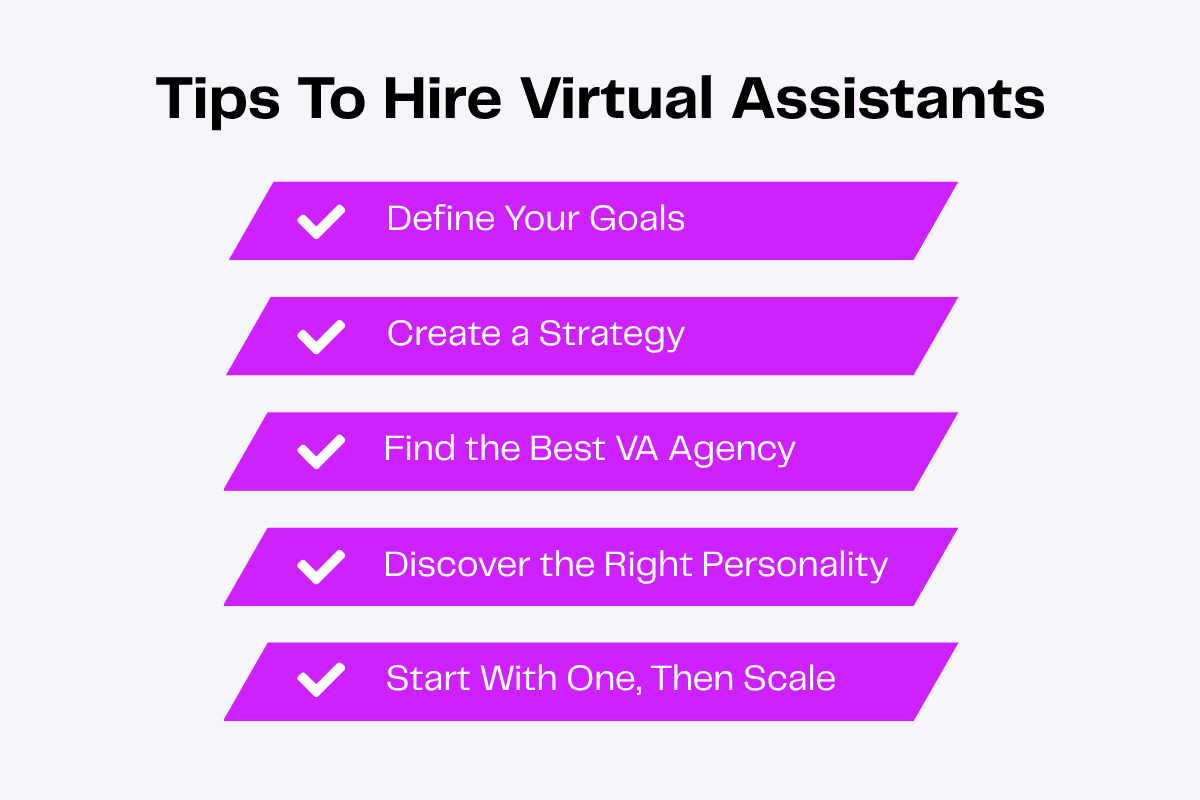
1. Define Your Goals and Reasons
Hiring a virtual assistant must begin with realizing your goals and reasons.
What are your goals and objectives for your business? What do you want to accomplish in the short term and the long term?
The reason could be to enhance your profit, cut expenses or get more time to make big decisions for your business.
Knowing the purpose can help you strategize for your business growth.
2. Always Think Strategically
Once your reasons are clear, think of a potential strategy.
How would you use a VA if you want to reduce expenses? You could stop the in-house recruitment and let the VA handle certain tasks.
If you are overwhelmed by administrative work, you can assign those tasks to virtual assistants.
You can conceive different strategies and tactics to ensure efficiency.
Remember to consider your budget, project, team, resources and other factors. Also, confirm the length of time to work with them. You can go for short-term VAs or dedicated VAs, depending on your needs.
3. Find Companies With Flexible Virtual Assistant Options
Once your strategies are set, find a virtual assistant agency that matches you with the right VA.
Going with a virtual assistant staffing agency gives you some advantages, like:
- Finding the right service for your strategy.
- Saving more time by sticking to one company.
- Saving time on the hiring process.
- Getting easy VA replacements in case you have an issue.
- Enjoying other benefits, such as statutory compliance or payroll management, that the company offers.
Partnering with a company that offers diverse virtual assistants will help you build strong relationships in the long run. The company will understand your problems and needs. Gradually, they will learn to provide you with better experiences and custom services.
If you want to hire from the best agency, go with Zenius!
4. Discover the Right Personality
Regardless of the virtual assistant company, a professional with the right personality for your organization is non-negotiable.
Skills and talents are the fundamentals before selecting a candidate. But looking beyond their skills can help you more.
Consider testing your virtual assistant’s skills, attitude and personality. You can interview the professional to get to know them better.
You will gain more confidence in knowing that you have the right person. They will integrate with the work process and enable more efficiency.
5. Bonus Tip—Start With One
Consider hiring one virtual assistant at the start.
The first step is to learn how to use a virtual assistant. Unless you know the optimal way to use them, focus on working with one assistant.
Also, you will make mistakes and learn from them. You will gradually gain experience and insights to use a virtual assistant effectively.
Then you can start building a virtual team for various projects.
FAQs
What tasks can virtual assistants handle?
You can assign many tasks to a virtual assistant, including calendar scheduling, data entry, customer service, CRM Management, bookkeeping, research, content creation, social media management and email marketing.
What do I need to do/know before hiring a virtual assistant?
Before hiring a virtual assistant, you must clearly define the tasks, goals, budget, communication expectations and tech stack they’d use to ensure a successful partnership.
How can I make onboarding a VA quick and effective?
Hiring your VA through an agency, equipping them with SOPs, sharing access to the right tools, providing training and setting clear expectations from day one will ensure fast and effective onboarding.
Wrapping Up
Hiring virtual assistants is an effective strategy to help an organization deal with high expenses and low efficiency. They work on repetitive tasks, support your business operations, help you focus on high-value tasks and boost workplace productivity.
To effectively manage a VA, you must set clear expectations, define tasks thoroughly, communicate regularly, share honest feedback, give tool training and be open to trying new working practices.
And before hiring a VA, you must find the ideal company to get the right people for your organization.
And if you’re still looking for the finest agency, your search ends with us.