Key Takeaways
Outsourcing real estate data entry to virtual assistants from low-cost countries is more affordable than hiring full-time employees.
Real estate data entry VAs maintain accurate records, helping you comply with laws like RESPA and TILA.
By recording client data, such as budget, property preferences, lead status and more, VAs help you personalize communication for conversions.
Real estate businesses deal with a huge amount of data, from property details to financial information.
It’s necessary to keep these records clean for smooth client communication and legal compliance.
For instance, you must provide clients accurate information about closing costs to comply with the Real Estate Settlement Procedures Act (RESPA). You also need to disclose loan terms and interest rates in lease agreements for compliance with the Truth in Lending Act (TILA).
But real estate business owners, brokers and agents don’t always have time to collect and verify property data before presenting it to clients.
These routine data entry tasks also distract you from doing what you do best—closing deals!
To save time, you can outsource data entry to a virtual assistant (VA).
These remote workers can simplify real estate data management and maintain clear, accurate records for your business.
What Is Outsourcing?
Outsourcing means delegating business tasks to a third party. These external agents can manage internal duties at lower costs than in-house employees.
You can hire freelancers via online job platforms or virtual assistants via a staffing agency.
Based on the geographical location of these third parties, you can outsource business functions in three ways:
- Onshore: Hiring external agents from your country. This method can ensure smooth collaboration with people from the same time zone, but you may struggle to find specialized talents.
- Nearshore: Recruiting third parties from a nearby country. This method can streamline task coordination as outsourced agents work in proximate time zones, but you can’t minimize expenses.
- Offshore: Delegating internal duties to professionals from a distant country. This process helps reduce expenses and add rare skills to boost your ROI.
Offshore outsourcing is the most cost-effective way to delegate business processes.
You can offload multiple real estate business functions, like bookkeeping, customer service and data entry, to save time and boost operational efficiency.
Why Real Estate Businesses Outsource Data Entry
Hiring virtual assistants for data entry is a smart move for your business. It helps you:
- Avoid paying high in-house salaries.
- Save time and focus on core activities.
- Prevent problems arising from inaccurate data.
- Comply with real estate laws and avoid penalties.
- Reduce errors and improve data quality for effective decision-making.
Besides data entry, you can also hire admin virtual assistants for tasks like scheduling or email management.
On the other hand, specialized VAs can help with lead generation, customer service or social media management.
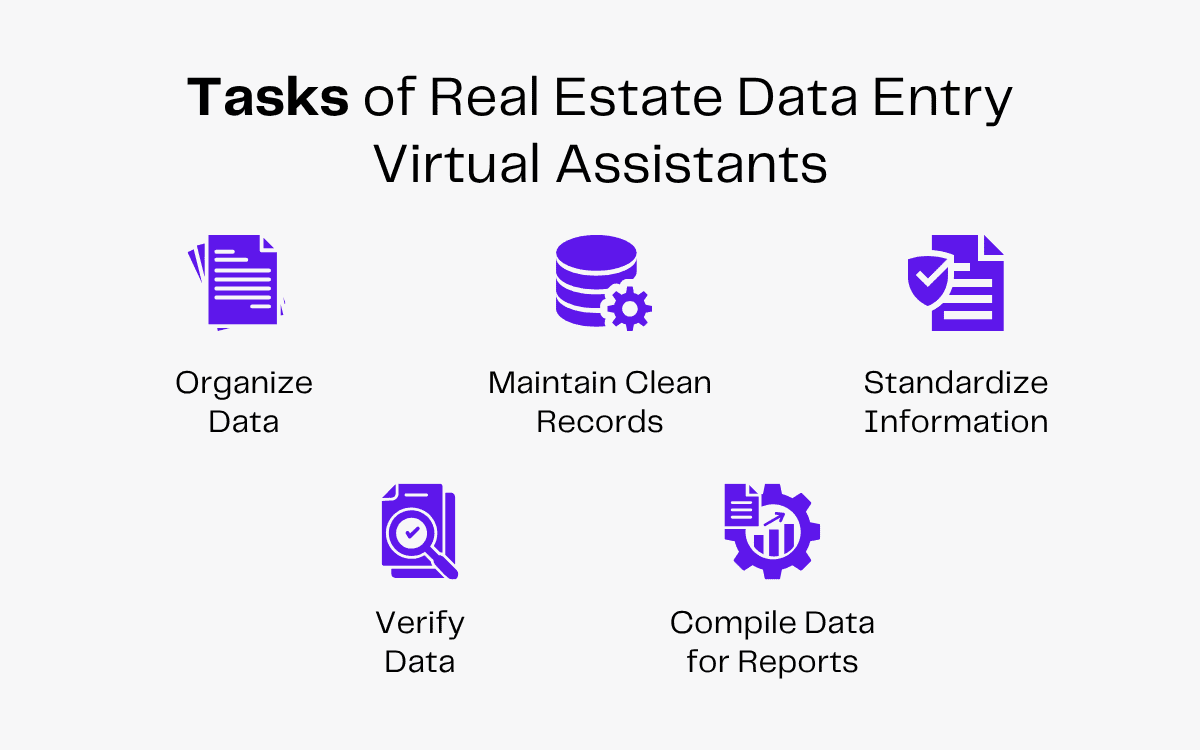
Tasks of Real Estate Data Entry Virtual Assistants
Virtual assistants can handle various tasks to simplify data entry for your real estate business.
They can collect, organize, format and clean datasets to improve data accuracy, accessibility and navigation.
Here’s everything they can do.
Organize Data
Virtual assistants can compile property data from homeowners and online listings and then enter these details into spreadsheets to create a database.
This includes information on property location, size, pricing and more—crucial data for creating listings.
VAs can also record property tax details, organize zoning documents and link safety certificates in spreadsheets to ensure legal compliance.
This comprehensive property database can help you share accurate and up-to-date information with potential buyers.
Virtual assistants can also collect client data from website forms and email inquiries. They can enter lead data into spreadsheets or real estate CRM systems like Follow Up Boss.
Your VA can also log client inquiries and feedback into your CRM database to improve lead tracking. They can validate referral sources and add referral data (ID and commission %) to your client database for easy commission calculation.
Additionally, data entry virtual assistants can track transaction status, verify payments and create invoice copies.
They can enter mortgage application data (loan amount, lender information, insurance number) and rent agreement details (rent, payment schedule, transaction IDs) into ledgers for accurate financial recordkeeping.
Maintain Clean Records
Your sales and marketing teams rely on clean data for their efforts.
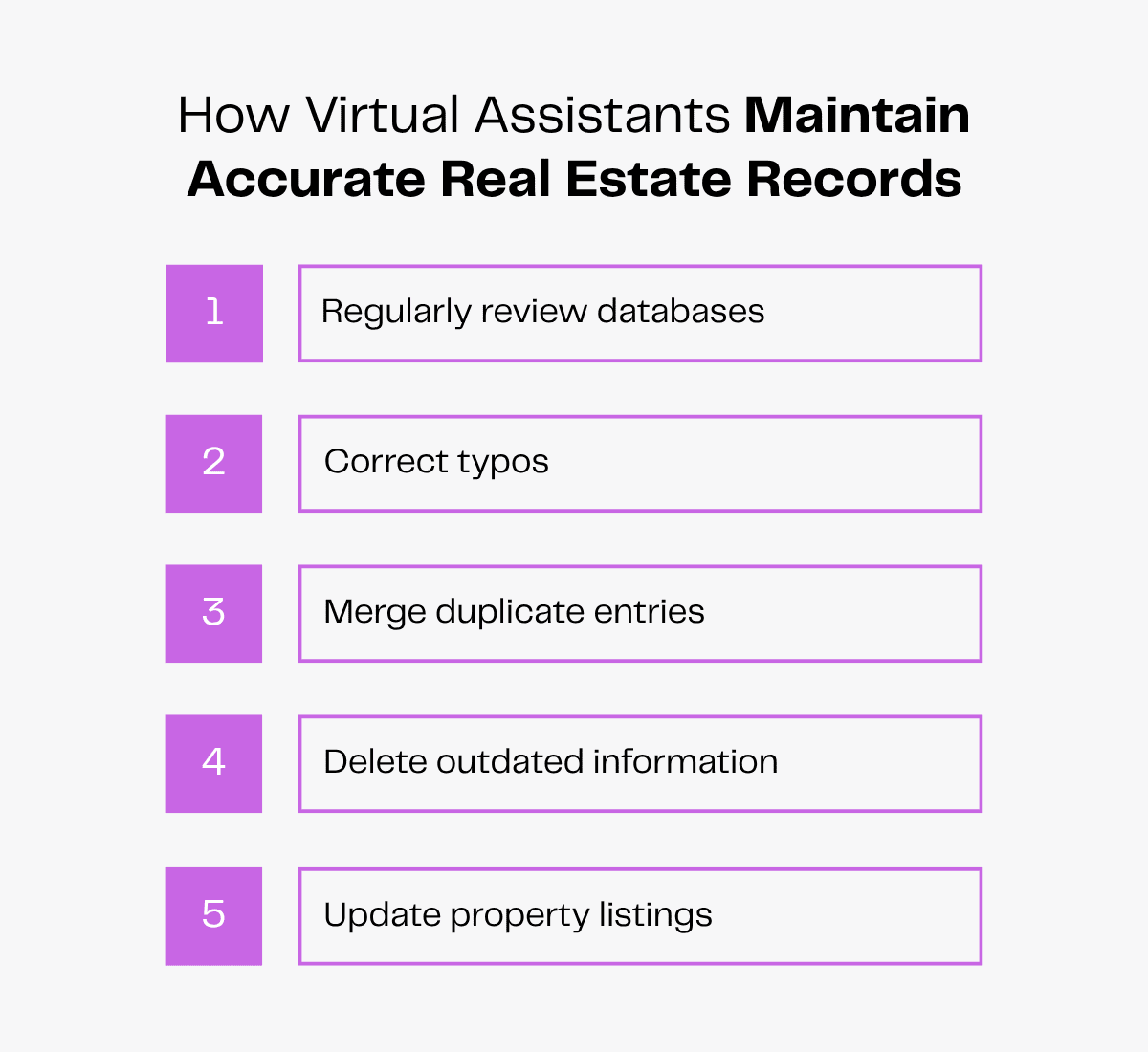
Virtual assistants can identify, remove and update outdated data to clean databases. They can also merge or delete duplicate entries and correct inaccuracies.
This thorough data cleaning gives you accurate records to create more effective strategies.
What’s more, VAs can monitor listings on Zillow or Realtor.com to check a property’s current value and availability. They can adjust prices and remove sold properties from your database to minimize client confusion.
Virtual assistants can also correct grammatical, numerical and formatting errors.
For instance, if two records show different sale prices, VAs can cross-check transaction statements to confirm and update the correct figure in both databases. This can prevent costly errors.
Standardize Information
Without a common format, data can get messy and confusing.
Virtual assistants can apply uniform formatting rules to real estate data for consistent records. This standardization process can improve database quality and streamline navigation.
Here’s an example of how VAs can standardize different types of data.
| Data Type | Elements | Standardization Example |
|---|---|---|
| Property data | 1. Measurement units 2. Listing dates | 1. Converting property area into square feet. 2. Formatting listing and open-house dates as MM/DD/YYYY. |
| Client data | 1. Name fields 2. Contact details | 1. Splitting ‘First’/’Last’ name into separate columns to minimize duplication. 2. Prefixing phone number formats (+1-234-567-8910) and email address layouts ([email protected]). |
| Financial data | 1. Currency units 2. Rounding rules | 1. Setting USD as the default currency for quick calculations. 2. Rounding rent or commission amounts to two/three decimal points. |
| Legal data | 1. Document IDs 2. Zoning codes | 1. Naming permit documents as ‘Permit-DD/MM/YY’ for fast access. 2. Formatting zoning codes uniformly, like ‘Z-1’, not ‘Z1’ or ‘Zone 1.’ |
Besides applying standardization rules to different data, VAs can add specific filters to improve navigation. They can:
- Tag specific property features (pool/parking/fireplace) in spreadsheets for accurate information sharing.
- Mark clients as prospects (P), active viewers (A) or buyers (B) for streamlined lead tracking.
- Hyperlink legal documents in spreadsheets for reliable referencing.
By standardizing data and adding relevant filters, your VA can reduce retrieval time and improve data quality for real estate businesses.
Verify Data & Keep It Updated
Your VA can regularly review and update databases to ensure accuracy and regulatory compliance.
They can cross-check property datasets with online listings, maps and directories to confirm addresses and status changes (rent to sale) and ensure accurate visual representations (images and videos).
This helps you comply with the Federal Trade Commission’s (FTC) advertising and marketing guidelines.
Virtual assistants can also follow up with clients to verify name, address, property preferences and update datasets with new lead information.
Plus, they can remove incorrect client data to ensure compliance with the EU’s General Data Protection Regulations, in case you target foreign investors.
To correct discrepancies in legal data, your VA can audit records periodically against public sources as well.
For instance, they can track changes in tax slabs and update interest rates in property databases.
This helps you adapt to changing real estate laws so you can practice your business ethically, prevent legal issues and boost credibility.
Compile Data for Reports
Having essential information in one place lets you quickly spot trends or gaps in the market.
Virtual assistants can compile data and create accurate real estate reports for you.
They can collect property data, such as ‘average prices in specific ZIP codes’ and ‘cost per square foot’ for real estate market analysis reports. These documents can help calculate property value and taxes.
VAs can also collect client data for prospect reports. They can document clients’ contact details and property preferences to help track leads.
This documentation lets you showcase industry expertise during client meetings to increase conversion rates.
Your VA can even help while onboarding new clients. They can record payment data, pending tasks and due dates to create client status reports.
This way, you and your clients can keep track of the sales process for efficient collaboration.
Additionally, VAs can validate referral codes and match them to affiliate lists to prevent misallocated commissions. These steps help avoid costly errors.
If you need monthly sales reports, your VA can organize data (properties sold, income, commission expenses) to help you file taxes and comply with real estate laws.
Types of Data in the Real Estate Industry
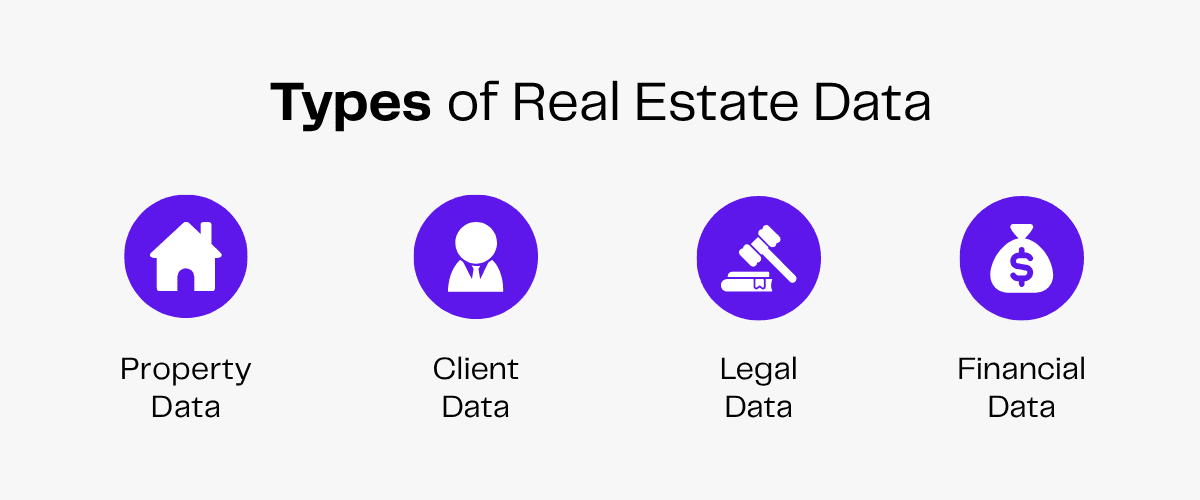
Real estate businesses deal with various types of data related to properties, clients, finances and real estate laws.
Accurately storing and cleaning this data is crucial for listing properties, communicating with clients and measuring financial performance.
Here are the different data types your virtual assistant can record for you.
Property Data
Property data in real estate includes:
- Location details: Address, coordinates and map link.
- Size specifications: Floor area, bed+bath counts and parking space.
- Amenity details: Pool, fireplace, wooden floors and EV charging.
- Pricing status: Sale status, price and rent/lease conditions.
- Homeowner Association information: Contacts, bylaws and fees (type, value and frequency).
Accurate property data helps update real estate listings accurately to avoid false advertising claims.
Client Data
Client data in real estate includes:
- Personal details: Name, contact, lead source (website or referral) and follow-up time.
- Property requirements: Budget, space requirements, property type and preferred amenities.
- Insurance policy details: Insurance ID, claim amount and bank account number.
- Communication history: Dates and notes of client calls, emails and meetings.
- Lead status: New lead, visitation scheduled, offer submitted or closed deal.
Precise client data can simplify lead tracking and enhance marketing efforts to increase sales.
Legal Data
Legal data in real estate includes:
- Property deeds: Owner name, number of tenants and legal land measurements.
- Legal permits: Environmental, building and zoning.
- Property tax data: Market value, tax rate, exemptions and tax-payment history.
- Additional permissions: Parking, renovation and land use (commercial or residential).
Correct legal data can enable ethical business practices and ensure regulatory compliance.
Financial Data
Financial data in real estate includes expenses and income related to:
- Properties: Sale price and additional expenses (insurance, zoning and legal fees).
- Mortgages: Loan amount, interest rate and lender fee.
- Leases: Monthly rent, deposit amount and payment schedule.
- Taxes: Tax rate, reimbursement from exemptions, due dates and transaction records.
Correct financial data can facilitate timely tax filings, accurate commission payouts and revenue calculations.
Read more: Keep Your Finances in Check With a Bookkeeper Virtual Assistant
Benefits of Outsourcing Real Estate Data Entry
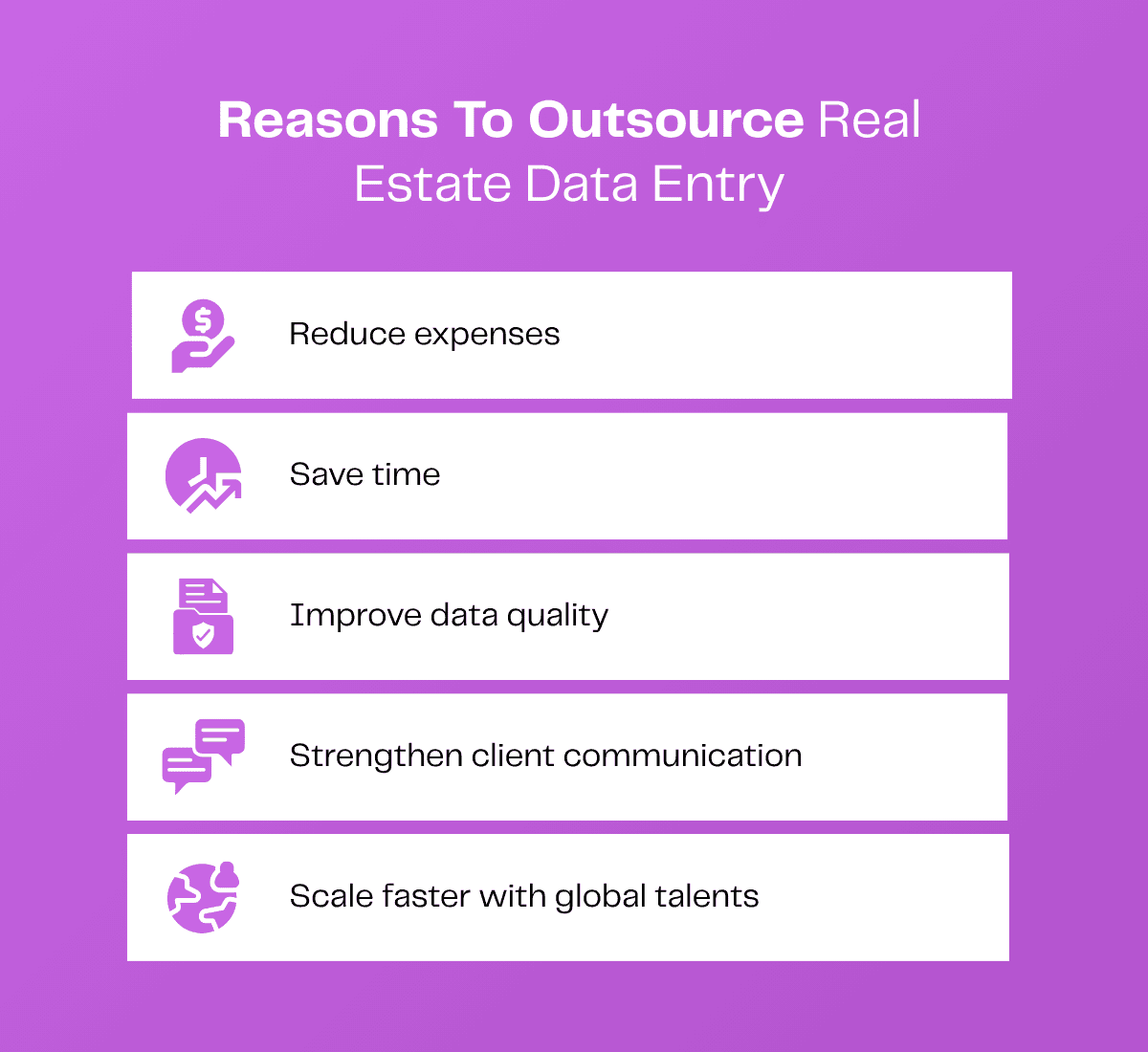
Outsourcing to virtual assistants has many benefits for your business.
While outsourcing reduces costs, VAs can save time and improve data quality. They enhance operational efficiency, helping you scale faster.
Reduce Expenses
Outsourcing data entry to virtual assistants can reduce operational costs.
Unlike in-house employees, VAs don’t require employment benefits or health insurance. As remote professionals, they also eliminate infrastructure and utility costs from your business.
Plus, data entry VAs save you money by preventing costly errors.
They can collect the latest property prices so you don’t mark down listings and take a loss. They can also clean client data to ensure legal compliance and help you avoid fines.
Save Time
With an average time on the market of 66 days, homes are taking longer to sell.
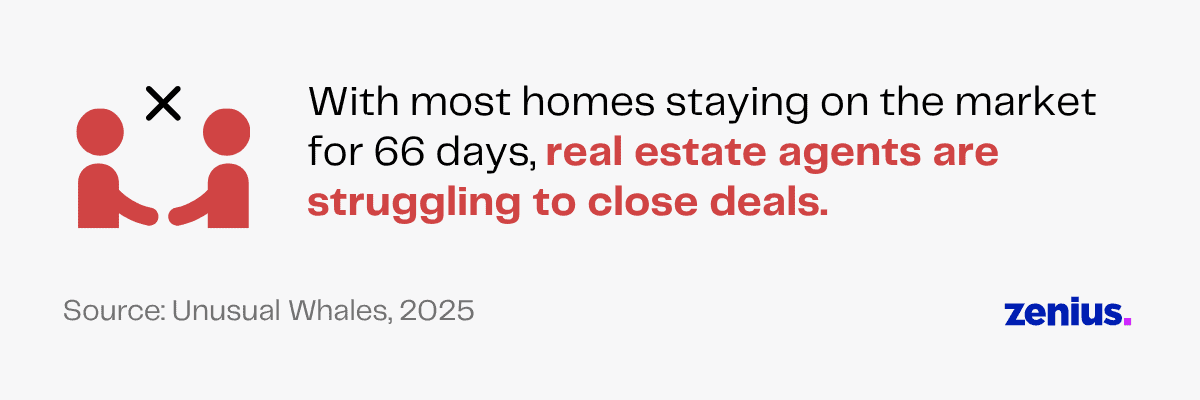
This means real estate agents need to double down on their efforts and focus on closing deals.
Data entry VAs can help by removing other distractions and saving you more time.
They can handle time-consuming data entry tasks daily, from data compilation to correction, normalization and validation.
They can also add search filters to help you quickly navigate large datasets. This fast accessibility lets you make safe and profitable decisions on time.
Improve Database Quality
Virtual assistants can improve database quality by standardizing file names, removing/merging duplicates and updating outdated data.
They can also cross-check real estate data with reliable sources to ensure factual accuracy. This complete, consistent and precise data boosts operational efficiency.
For instance, your VA can review rent agreements to ensure correct entries for property value and rent payment schedules.
Accurate financial data can simplify rent collection, fast-track maintenance requests and facilitate tax filings. It’s also crucial for avoiding legal prosecution and keeping clients satisfied.
Enhance Client Communication
To build stronger relationships with clients, you need to stay in touch with them consistently.
Your VA can promptly enter prospect details in CRMs to simplify lead tracking and follow-ups. They can also verify clients’ contact information to ensure effective outreach via email marketing campaigns.
And by updating outdated property data, VAs can minimize client confusion, too.
Plus, virtual assistants organize data for prospect reports, helping you personalize lead communication and make new clients feel more confident in your business.
VAs can also tag amenity details (pet-friendly, gated community) in property datasets to help buyers find their dream house quickly.
Scale Faster with Global Talent
Offshore outsourcing lets you hire specialized professionals from the global talent pool.
You can hire overseas virtual assistants to add unique perspectives to your workforce. These data entry specialists, familiar with real estate laws, can manage real estate data effectively.
Plus, as remote workers, they enable you to save on overhead costs and retain more of your profits. They can also continue operations during your local holidays to boost productivity.
Offloading non-core tasks like data entry to virtual teams from low-labor-cost countries frees up your in-house staff as well.
While VAs handle everyday tasks, your full-time employees can focus on client service and property maintenance.
This cost-efficient workload distribution can help you scale your real estate business faster.
How To Outsource Data Entry
You can outsource data entry via a virtual assistant agency. A reputable VA agency can help you hire a good virtual assistant by searching and screening candidates from the global talent pool.
But before approaching a VA agency, you must assess your requirements and goals. Here’s how you can do this effectively.
Set Goals
You can start your search by listing all data entry tasks you want to delegate to virtual assistants. These duties can include:
- Entering client information and property details into your database.
- Documenting transactions and attaching them to financial reports.
- Cleaning, standardizing and validating databases.
- Organizing compiled data for creating real estate reports.
After finalizing the responsibilities, combine your budget and task requirements to create a comprehensive job description.
Contact an Agency
You can outsource real estate data entry services by contacting a reliable VA agency like Zenius.
Give us the job description and we can streamline recruitment for your real estate business. Based on your requirements, we search for data entry professionals and evaluate them on their technical aptitude.
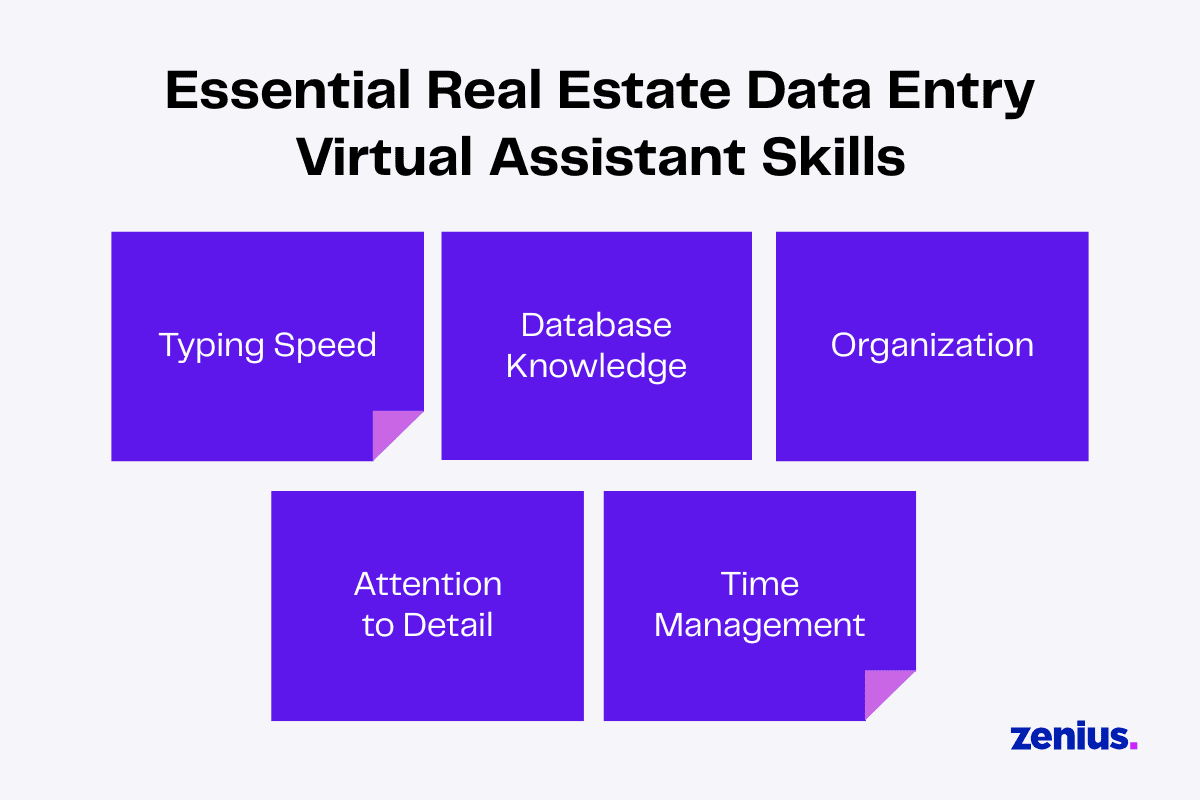
We also assess candidates on typing speed, organization, attention to detail and time-management skills, which are crucial for effective data entry.
You can interview our recommendations to test their skills as well.
With our timely, transparent and quick client support, you can reliably hire virtual assistants or build a virtual team to scale your business.
Onboard Your Virtual Assistant
After finalizing recruitment, you can start onboarding your virtual assistant by sharing necessary business details.
Inform your virtual assistant about:
- Business processes: Communication guidelines, company policies and industry specialty (residential, commercial, rental).
- Data entry standards: Data collection methods, standardization formats and filter requirements.
- Expected deliverables: Report formats and frequency of data cleaning and validation.
You should also give your virtual assistant access to your CRM systems and spreadsheet tools so they can organize and format real estate data.
Make sure to assess your VA’s performance in the early days and share feedback to align their work with your expectations.
Answering any questions and resolving their doubts will also help them perform better.
How Real Estate Data Entry Is Changing in 2026?
Real estate data entry has changed due to technological progress in multiple sectors.
Large language models (LLMs), Optical Character Recognition (OCR) software and Robotic Process Automation (RPA) bots have all contributed to the shift in real estate data management.
For instance:
- AI tools like ChatGPT can check documents to extract and organize data. But ChatGPT can distort data, which can lead to factual, textual and logical errors.
- OCR software can extract data from images to speed up data compilation. But these tools can’t process low-resolution images, cursive handwriting and various fonts.
- RPA bots can automate data transfer between datasets for faster data entry. But these systems can’t process unstructured data and can be costly and difficult to use.
- Immersive 3D tours have become part of property listings. Their rising demand requires you to add these features to your real estate listings. But high scanning fees can increase expenses and technical issues (downtime, 3D generation glitches) can negatively affect customer experience.
Instead of using unreliable and costly tools, you can invest smarter by hiring a data entry virtual assistant. They can:
- Review AI-generated tables to spot and correct errors manually.
- Identify different fonts and handwriting (unlike OCR) and revise image-extracted data for accuracy.
- Break down unstructured data (unlike RPA) to solve complex logical problems, like separating lease agreement data from mortgage contract details.
- Find reliable and affordable vendors (within your budget) to schedule house scanning, verify integrated 3D links and add virtual tour URLs to listings.
Tech-savvy VAs can leverage different tools and manually supervise datasets to help you maximize your return on investment.
Wrapping Up
With access to global talents and reduced overhead costs, outsourcing gives you a strategic edge over competitors.
Outsourcing real estate data entry to virtual assistants can also improve workflows, boost data quality and enhance client communication.
Outsource real estate data entry to Zenius virtual assistants!