
Key Takeaways:
If you hire your virtual assistants as independent contractors and pay them more than $600 per year, remember to file Form 1099-NEC.
When hiring VAs as employees, file Form W-2, withhold & pay payroll taxes and avail tax credits in special cases.
When you hire a VA through an outsourcing agency, you don’t have to deal with tax forms, payroll taxes or employee benefits.
If 66% of US businesses are outsourcing at least one department, it’s only valid for you to do it too.
Outsourcing to virtual assistants enables you to free up time, reduce operational bottlenecks, focus on growth and get specialized support at budget-friendly costs.
With more time on your hands, you can spend your energy on strategy, customers and other revenue-generating activities.
But as you start enjoying the productivity benefits, another question may arise: Does hiring a VA come with complicated tax obligations?
Don’t worry! Whether you hire VAs as independent contractors, as employees or through an agency, we’ll give you a complete breakdown of virtual assistant tax deductions.
We’ll cover useful tips, tax forms you must fill out, payroll taxes and exemptions so you can stay informed, avoid costly mistakes and hire VAs with confidence!
How a Virtual Assistant Adds Value to Your Business
Before diving into virtual assistant taxes, it’s important to understand what a VA can do for your business.
These remote professionals will manage your administrative, executive, creative or personal tasks while you work on scaling your business. They’ll take over tedious tasks and help you achieve a healthy work-life balance.
Some tasks a VA can perform include:
- Administrative tasks such as calendar management, inbox management, receptionist services and research tasks.
- Data-related tasks such as data-entry, database management, data cleansing, CRM management and more.
- Marketing tasks like managing social media platforms, writing content, curating creative copy, managing websites or designing graphics for many marketing needs.
- Sales-related tasks like appointment setting, outbound calling, lead generation, order processing and more.
- Industry-specific tasks for e-commerce, real estate, IT & software, hospitality or architecture industry.
Read More: Everything You Need To Know About the Virtual Assistant Industry
Are Virtual Assistants Tax Deductible?
We have good news—your virtual assistants are tax deductible!
As per the Internal Revenue Service (IRS) guidelines in the United States, virtual assistants count as a business expense under “ordinary and necessary expenses”.
But if you hire a VA only for your personal errands, such as booking vacations or household budgeting, those expenses are not deductible.
You can subtract your VA’s business expenses from your taxable income and avoid overpaying your taxes.
But some factors affect how you deduct these expenses and file your taxes, such as:
- Your business location: There might be state-to-state differences in tax laws that you’ll have to check.
- Your hiring process: Whether you hire your VA as an independent contractor, as an employee or through a third-party VA agency, that will determine how you report your taxes.
Virtual Assistant Taxes: Things To Remember
There are a million things you look after in your business. From annual budgets to new policies, from studying profits to building customer loyalty, from product research to business strategies—your to-do list is full.
Amid this chaos, don’t forget about virtual assistant taxes!
Here’s your guide to doing your VA’s tax write-offs right.
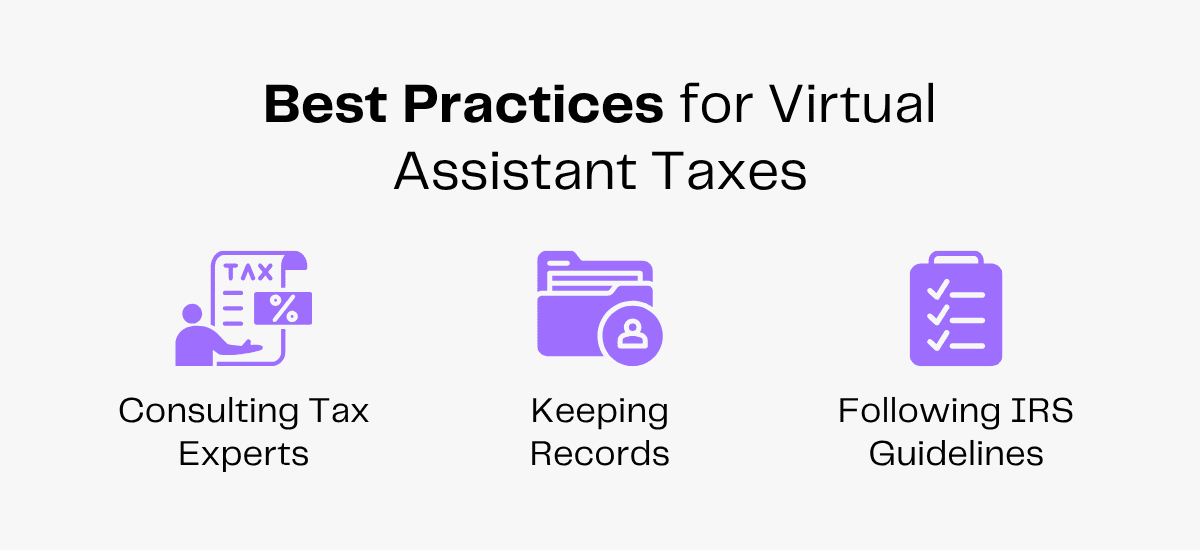
Keeping Records
Before calculating your VA tax deductions, you must gather all information about your virtual assistant. If you maintain detailed data records, filing your taxes will be simple. You’ll have all the necessary proof of expenses and your tax reports will be accurate.
So keep thorough records such as invoices for all VA services, proofs of payment, signed contracts & other agreements, VA’s daily work logs and copies of required documents & tax forms.
For convenience, you can use templates that will help you maintain records efficiently. This will speed up the process and reduce the chances of errors.
Consulting Tax Experts
Following all legal rules and regulations can be daunting to do on your own. If you add your daily business roles to that, you won’t get much time to oversee your taxes properly.
Running a successful business requires more than just providing a great product or service—if you want to grow your business and become profitable, it won’t happen if you keep overpaying the IRS every year.
Barbara Schreihans, CEO and Founder of Your Tax Coach
… a tax strategist will do an intensive deep dive into all facets of your business. Since no two businesses are alike, there isn’t a blanket tax strategy that works for everyone.
Hiring a tax strategist can make all the difference in increasing your profits.
If you want, you can consult a legal professional to understand all virtual assistant tax deductions. They can classify your VA, help you comply with current tax laws accurately and prevent tax errors.
Following IRS Guidelines
In the United States, the Internal Revenue Service (IRS) is responsible for collecting federal taxes. They publish tax forms that you must choose from to file your taxes accurately.
No one wants to face penalties or legal consequences due to misreporting. So you must follow all IRS guidelines and thoroughly understand all legitimate deductions.
These regulations will help you:
- Separate your personal expenses from business expenses.
- Follow the criteria your virtual assistant meets.
- Avoid the risk of misclassification.
- Establish your VA’s work as a legitimate business.
- Maximize your tax benefits.
- Avoid IRS audits.
Once you have understood and followed all IRS rules, you’ll be able to comply with all tax laws related to your virtual assistant and optimize your deductions.
Tax Deductions For Virtual Assistants
After you’ve maintained your payment records, consulted a tax professional and reviewed the latest IRS guidelines, you can report and file your taxes.
Here’s how you can calculate and report your virtual assistant tax deductions depending on the hiring process.
| Factors | Independent Contractor | Employee | Hired Through an Outsourcing Agency |
|---|---|---|---|
| Tax forms | Form 1099-NEC (for $600+ salary per year) | Form W-2 | None |
| Payroll taxes | None | Yes | None |
| Tax complexity | Moderate | High | Lowest |
Hiring Virtual Assistants as Independent Contractors
If you hire your virtual assistants as independent contractors, their work will come under your business expenses as “contract labor” and they will be tax deductible.
If you pay them less than $600 per year, you don’t have to file any tax form. Your VA will report their income to the respective tax authorities.
But if you pay more than $600 per year to your virtual assistant, you must remember to file Form 1099-NEC. This form is used to report all your payments made to independent contractors, freelancers and self-employed professionals.
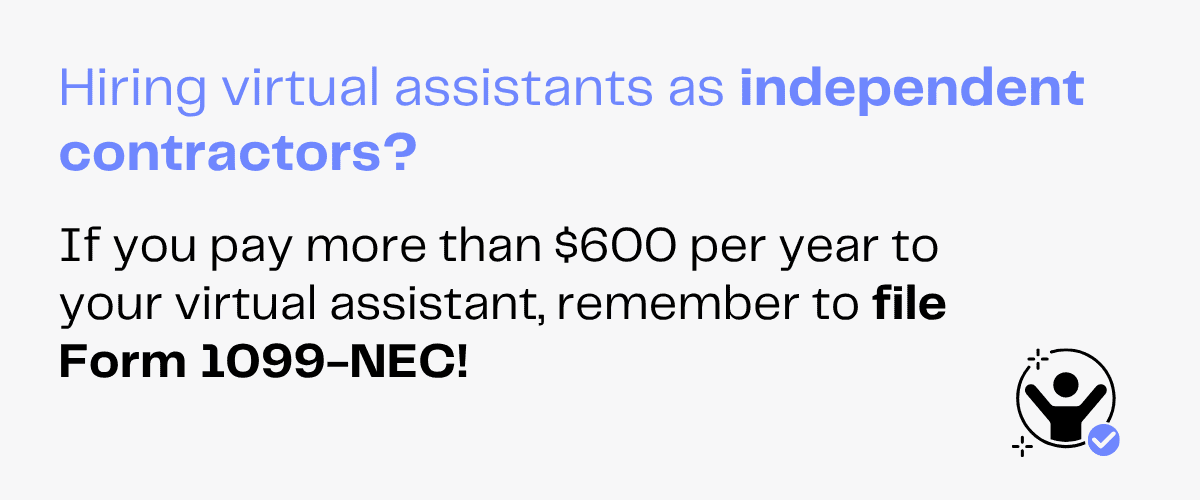
You will have to issue this form with your details, such as name, business name, address, taxpayer identification number, etc. You’ll have to include your virtual assistant’s similar information and the total amount paid in a tax year. Send that form to the IRS and give another copy to your VA.
For a VA who is an independent contractor, you don’t have to pay any payroll taxes.
Hiring Virtual Assistants as Employees
If you classify your virtual assistant as an employee in the US, you’ll have to follow the IRS guidelines. Their salaries and expenses (utilities, equipment and software) are usually tax-deductible under business expenses. But you’ll have to submit tax reports.
You’ll also need to comply with tax rules and labor laws. Remember that state payroll taxes vary by state.
Tax Forms
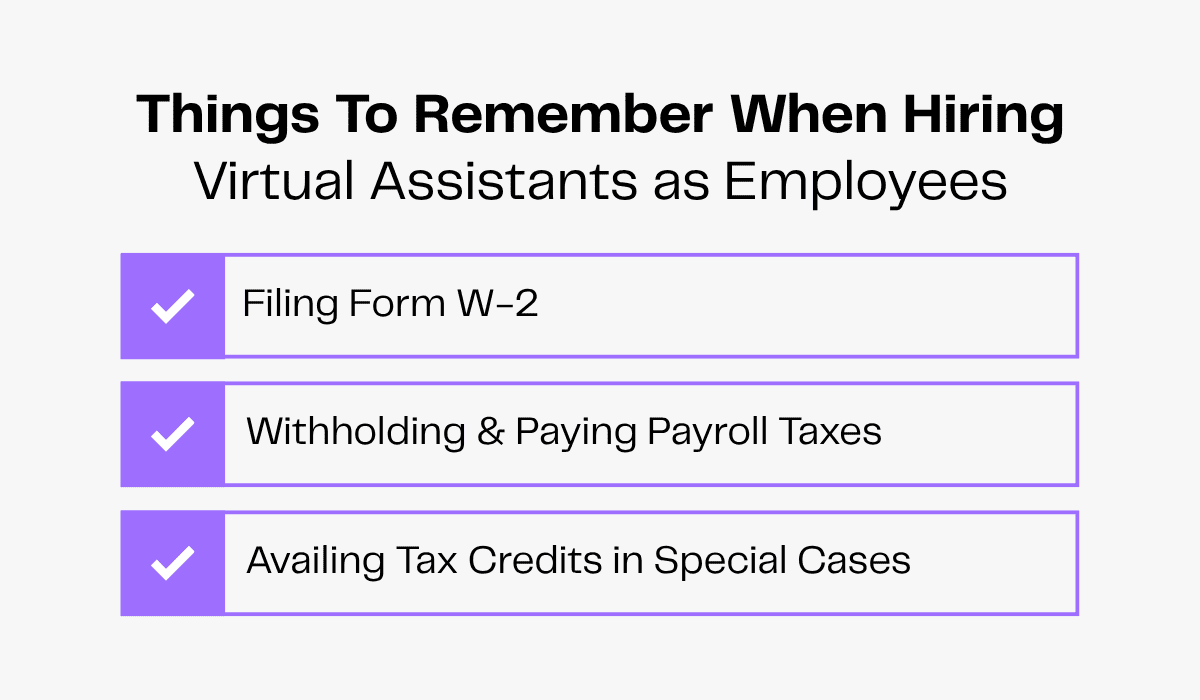
For your VA who is registered as an employee, you’ll have to file Form W-2.
This form, known as the Wage and Tax Statement, shows the income your VA has earned and the taxes you have withheld. You’ll have to send this document to the IRS and your virtual assistant on or before January 31.
Payroll Taxes
Even if your virtual assistant employee is tax deductible, you’ll still have to withhold and pay the payroll taxes in the US, like:
- Social Security: You’ll have to withhold and pay 6.2% of each of your employee’s wages and send it to the IRS (for income lower than $168,600).
- Medicare Tax: You must withhold and pay 1.45% each from your employee’s wages and send it to the IRS.
- Federal Unemployment Tax (FUTA): You’ll have to file Form 940 and pay FUTA tax (6% on the first $7000) annually or quarterly to the IRS.
- State Unemployment Tax (SUTA): Many states may collect an additional unemployment tax from you.
Tax Credits
In the US, you can benefit from tax credits like the Work Opportunity Tax Credit (WOTC). This credit is applicable only if you hire your virtual assistant as an employee from targeted groups such as qualified veterans or ex-felons. Remember that your VA should be US-based and not an overseas employee to avail of this credit.
Hiring Virtual Assistants Through Outsourcing Agencies
An outsourcing agency acts as a bridge between you and your virtual assistant. Most commonly, the VA is the agency’s employer and works on your business tasks.
You simply delegate tasks to your VA and pay the agency’s subscription or service fees. There’s no need to file tax forms like 1099-NEC or W-2.
You don’t have to deal with either payroll taxes or employee benefits. As your VA is the agency’s employer, the agency itself will be in charge of managing the payroll taxes.
The outsourcing agency will handle tax compliance and follow labor laws while you catch a break. This is why, to avoid paying payroll taxes, hiring VAs through an outsourcing agency like Zenius is the most convenient option.
Benefits of Hiring VAs Through an Outsourcing Agency
Hiring a virtual assistant is a prerequisite if you want faster outcomes at an advantageous price. They offer you seamless technological integration and improved workflow, among many other benefits.
With saved time and resources, you’ll get a lot done in less and find the right opportunity to upscale your business.
Hiring VAs through an outsourcing agency has added advantages. You get the cost-effectiveness of an independent contractor and the reliability of an employee in a single professional. A VA who is affordable and dependable—that’s a win-win for your business!
Here’s how a virtual assistant hired through an agency benefits your business.
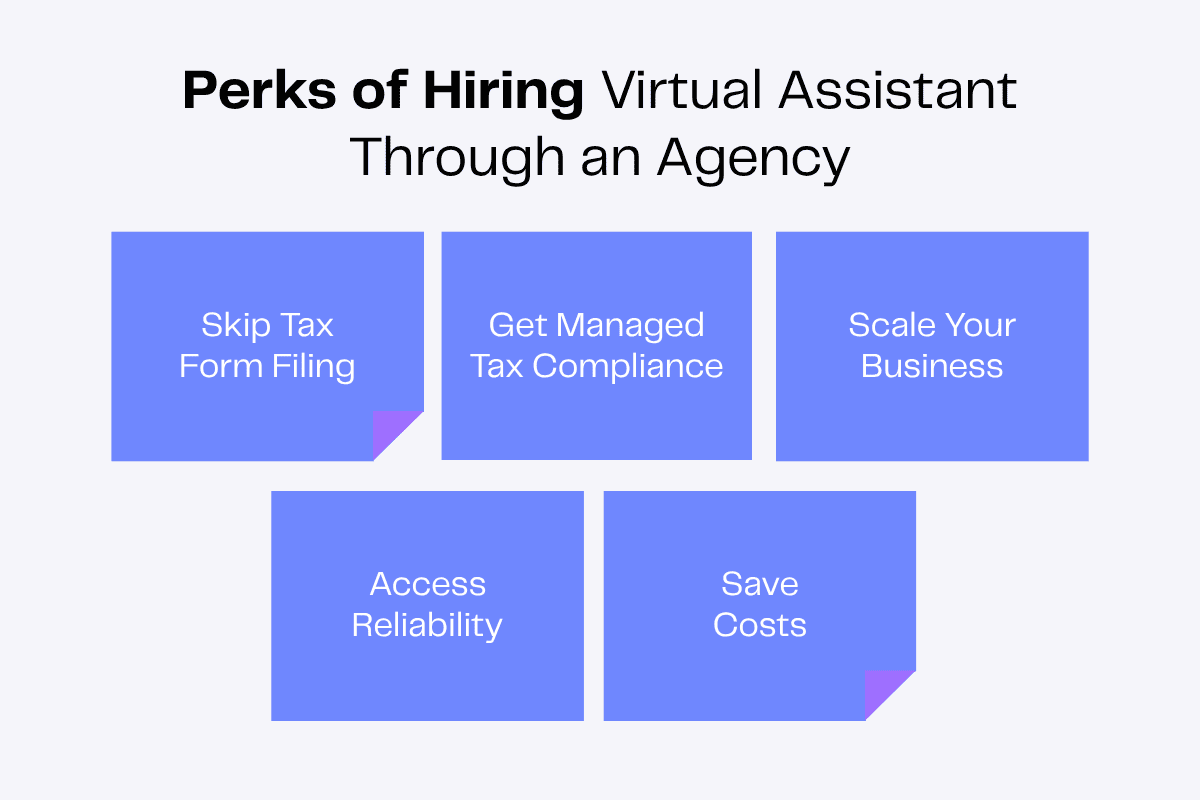
1. Skip Tax Form Filing
When you hire a VA through an outsourcing agency, you can forget about dealing with tax forms or keeping up with deadlines.
You wouldn’t have to file tax forms like W-2 or 1099-NEC. You can skip tax form-filing related to your VA altogether because you pay the agency fees directly.
With an outsourcing agency, you’ll be stress-free as you:
- Don’t have to keep track of tax-related documentation.
- Don’t have to deal with extra paperwork hassle.
- Save your time and effort.
- Avoid tax-related errors.
With less administrative burden, you can focus on other business priorities.
2. Get Managed Tax Compliance
With an outsourcing agency handling all tax-related matters of your VA, you don’t need to consult an outside expert. The agency provides ease of management as it tackles tax compliance.
You don’t have any tax withholding responsibilities. You don’t even have to provide employee benefits like insurance. Leave it all to your agency. They will:
- Ensure they comply with the legal rules and regulations.
- Manage your VA’s payroll.
- Handle your VA’s employee benefits.
3. Save Costs
In addition to tax-related benefits, a VA who is hired through an outsourcing agency also helps you save costs. You can reinvest the saved money in your business.
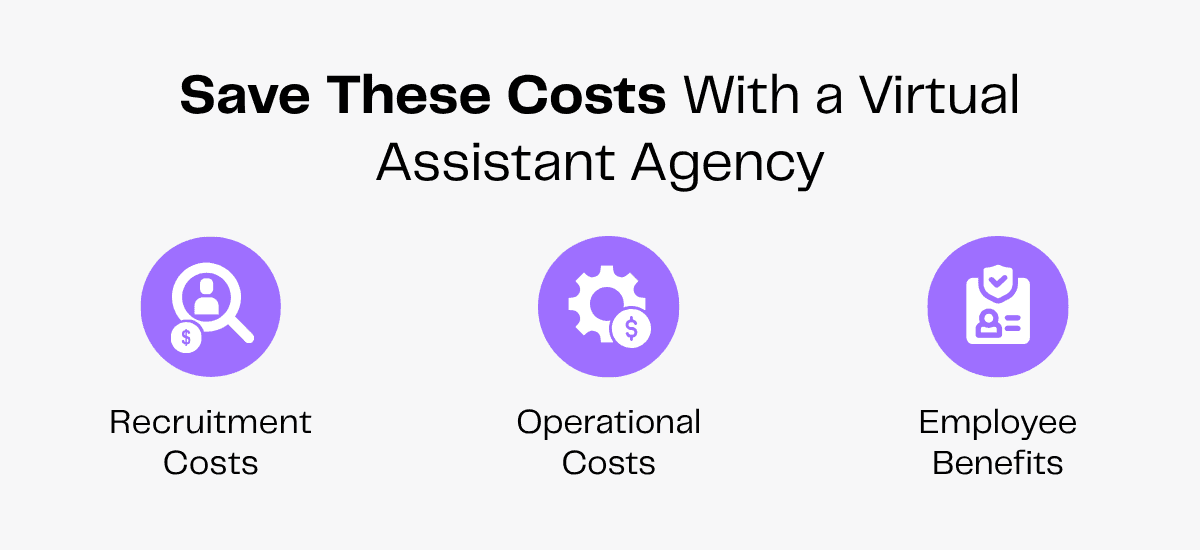
Agencies help you reduce expenses on:
- Recruitment: Since agencies handle the hiring process of virtual assistants, you save money on recruitment.
- Operational costs: Your VA doesn’t need you to provide any office space, utilities, equipment or internet connection.
- Employee benefits: The agency will manage your VA’s benefits, such as paid leave or retirement benefits.
Hiring overseas virtual assistants through outsourcing agencies has an added advantage. Offshore countries have low labor rates, making them cost-effective hires.
You’ll access global talent at competitive rates—what more do you need?
4. Access Reliability
Offshore VAs compete in a global market. They develop relevant skills to stand out in the competition. Such VAs come with industrial skills to provide maximum support in your business tasks.
Agencies rigorously screen and review VAs before outsourcing their services so you get access to high-quality, dedicated work.
Such virtual assistants are reliable and trustworthy. You can easily delegate administrative or creative tasks and get quality work.
Outsourcing agencies provide ongoing support to your business. Agencies like Zenius monitor your VA’s work and give you detailed reports.
5. Scale Your Business
When you hire a cost-effective virtual assistant, you save money that you could use to scale your business. With your growing business, you can hire multiple VAs or even build a virtual team that fits your budget.
Your VAs will handle routine tasks and speed up the workflow. Your workdays will become more productive and you and your team will be able to focus on core roles.
You will save time and money, which will fuel your business growth. Your VAs will accommodate your company’s changing needs and assist you at every step.
Wrapping Up
Your virtual assistants are tax deductible. But if you don’t want any legal worries, you must follow all IRS guidelines to report your taxes correctly.
With virtual assistants who are independent contractors or your employees, you have to go through all the tax hassles. You’ll have to keep a check on the tax forms and payroll to file taxes on time and avoid penalties.
But with a virtual assistant hired through an outsourcing agency, you can keep all tax troubles away.