
Key Takeaways:
The virtual assistant services market size is projected to grow at a CAGR of 28.44% during the forecast period 2026–2032.
The average base salary of VAs in the U.S. is $26.01/hour. This is nearly 25 times higher than the $1.07/hour for overseas VAs.
94% of companies believe that skill-based hiring is the most effective. When hiring VAs, remember to look for education & experience and test their skills.
Running a business often means wearing too many hats, juggling endless priorities and struggling to find enough hours in the day.
As routine work piles up and business demands more attention, even the most capable teams can feel stretched too thin.
That is why outsourcing has become a practical solution for businesses looking to stay productive without overloading their internal resources.
And rising among this shift is the virtual assistant industry, a fast-growing space that has transformed the way professionals collaborate—that too across borders!
Powered by remote work, virtual assistants now support businesses with flexibility, efficiency and specialized skill sets from virtually anywhere in the world.
Curious to know more about the VA industry? Explore some fascinating facts and insights about virtual assistants and how they continue to redefine modern business support.
What Are Some Fun Facts About Virtual Assistants?
Virtual assistants are remote professionals who handle the day-to-day operations for a business, helping leaders and teams stay organized and productive. They combine flexibility, niche proficiency and seamless collaboration to become a reliable extension of your team without being in the same office.
The virtual assistant services market size is projected to grow at a CAGR of 28.44% during the forecast period 2026–2032.
This shows that businesses are now demanding skilled VAs and relying on remote support to scale efficiently. It’s a clear sign that VAs are evolving from simply a cost-saving option into a long-term strategic workforce solution.
As virtual talent continues to reshape how companies work and grow, there is much more to discover than just productivity gains.
Here’s a list of ten interesting facts about virtual assistants.
1. Virtual Assistants Are More Affordable Than In-House Hires
After years and type of experience, the minimum expected salary is what affects recruiters’ initial review of a candidate.
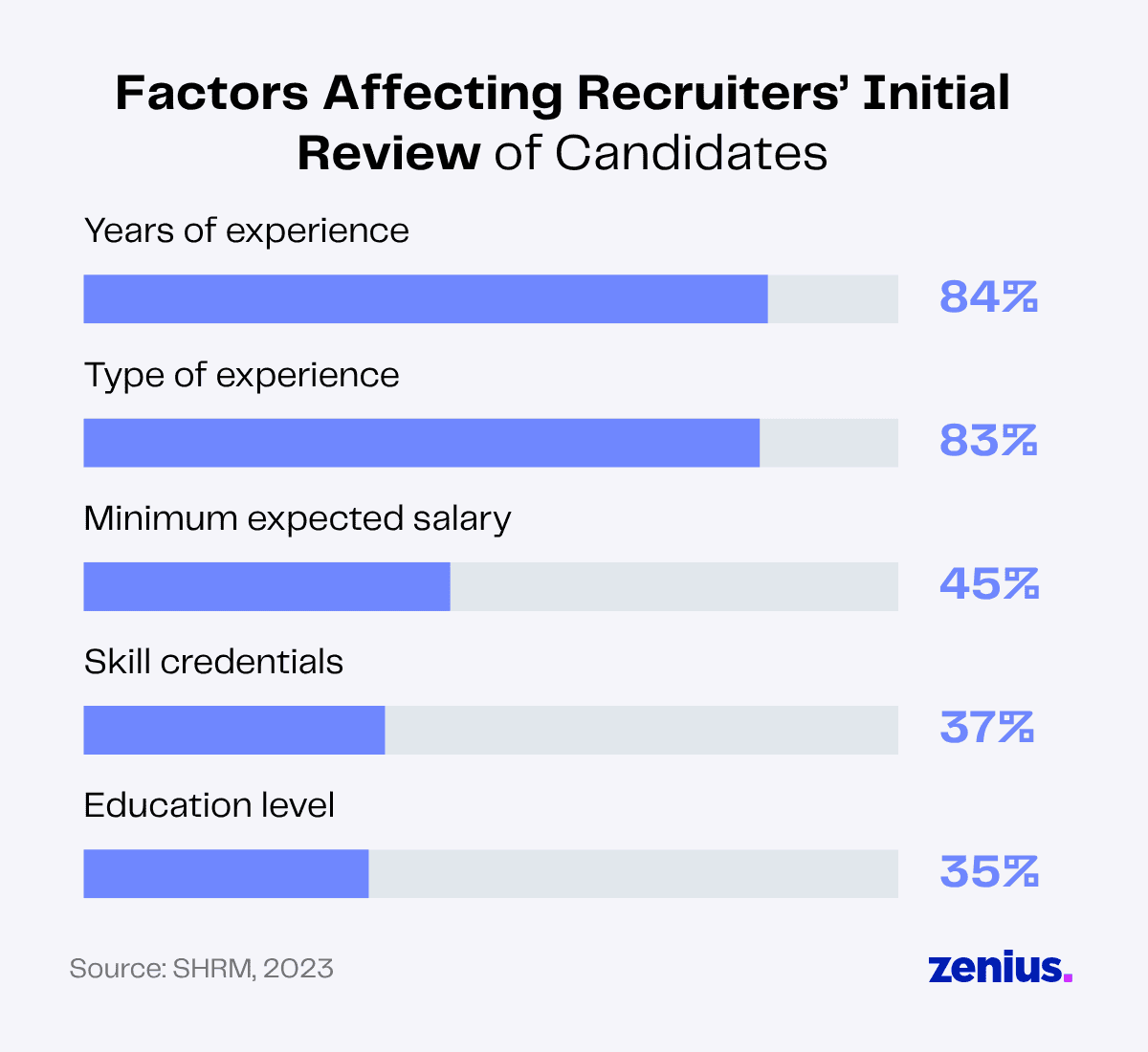
But with the current talent shortage in America, employing US-based candidates is more competitive and costly than ever. Even if you offer high wages to attract in-house employees, you’ll pay more for office rent, equipment, utilities and employment benefits.
Fun fact—virtual assistants are more affordable than in-house employees! You avoid the additional expenses that come with in-house hires without compromising on talent quality.
VAs don’t need in-office facilities, new equipment and work benefits. This reduces infrastructure, utility and other overhead expenses.
And you save more when you hire overseas virtual assistants! This is because VAs from low-cost-of-living countries have modest wage demands compared to American professionals.
For example, the average base salary of VAs in the U.S. is $26.01/hour. This is nearly 25 times higher than the average overseas VA salary.
Your business can achieve substantial cost savings if you want scalable support and want to build a team of remote assistants.
2. Virtual Assistants Offer Diverse and Niche Services
Virtual assistants can handle 300+ tasks for a business! These tasks include diverse services such as bookkeeping and marketing, as well as niche services such as industry-related research and technical writing.
This is because in every business, there are tasks that can be handled remotely.
Even in blue-collar industries like construction, a marketing assistant is responsible for generating and converting leads. Or a virtual assistant for a roofing business can compile lead data from inquiries, organize it into CRM systems and create customized service proposals to convert specific leads.
Specialized VAs manage common and niche marketing channels for businesses from diverse industries. Whether it’s social media, email marketing or affiliate marketing, virtual assistants handle them all.
Some types of virtual assistants and their tasks include:
- Administrative VA: Manages email, calendar and records for effective communication, scheduling and documentation.
- Bookkeeping VA: Processes payments, tracks income and expenses and creates financial reports for internal audits and legal compliance.
- Data Entry VA: Compiles, organizes, cleans, deduplicates and validates data and secures databases using two-factor authentication.
- Research VA: Compiles information on industry trends, market topics and competitors from reliable sources.
- Marketing VA: Develops, executes and manages promotional campaigns and monitors campaign performance.
- Social Media VA: Writes captions, schedules posts and engages with followers across social media platforms.
- SEO VA: Identifies SEO keywords using tools like Ahrefs and Semrush to optimize website content and landing page copy.
- Customer Service VA: Responds to customer inquiries, generates support tickets, resolves client complaints and collects customer feedback.
- Technical Writer VA: Interviews subject-matter experts and drafts product guides, repair manuals and FAQ documents.
- HR VA: Searches, screens and interviews talent, negotiates contracts and onboards new hires.
Read More: What Services Does a Virtual Assistant Offer to Your Business?
3. Virtual Assistants Can Be Creative
Think virtual assistants only work with spreadsheets, inboxes and calendars? Think again!
Many virtual assistants wear a creative hat too, turning ideas into compelling content, eye-catching visuals and memorable customer experiences.
Content writing VAs use SEO keywords to draft informative and persuasive blogs, case studies and whitepapers. They format content using bullet lists and tables and explain complex concepts in clear, concise language.
This SEO-optimized, easily readable and quickly navigable content ranks high on search engines, increasing brand visibility and readers’ engagement.
Graphic designer VAs utilize design software and a brand’s moodboard colors, fonts and textures to create illustrations. They also design charts, graphs, newsletter covers, social media posts and other images that complement textual content, helping visual learners engage efficiently with blogs and articles.
These branded graphics help distinguish your business from competitors and help attract new leads and clients.
Video editor VAs edit raw footage into short or long videos. They can also convert video files into different formats for posting on specific platforms. They also enhance video quality by adding standard special effects using tools like Adobe Premiere Pro or Canva.
This video editing support enables repurposing content for specific platforms, such as short Reels for Instagram and longer videos for YouTube.
4. You Can Also Hire a Personal Virtual Assistant
When people hear “virtual assistant”, they often think of business support.
But what if we told you that VAs can handle your personal errands and make everyday life easier too?
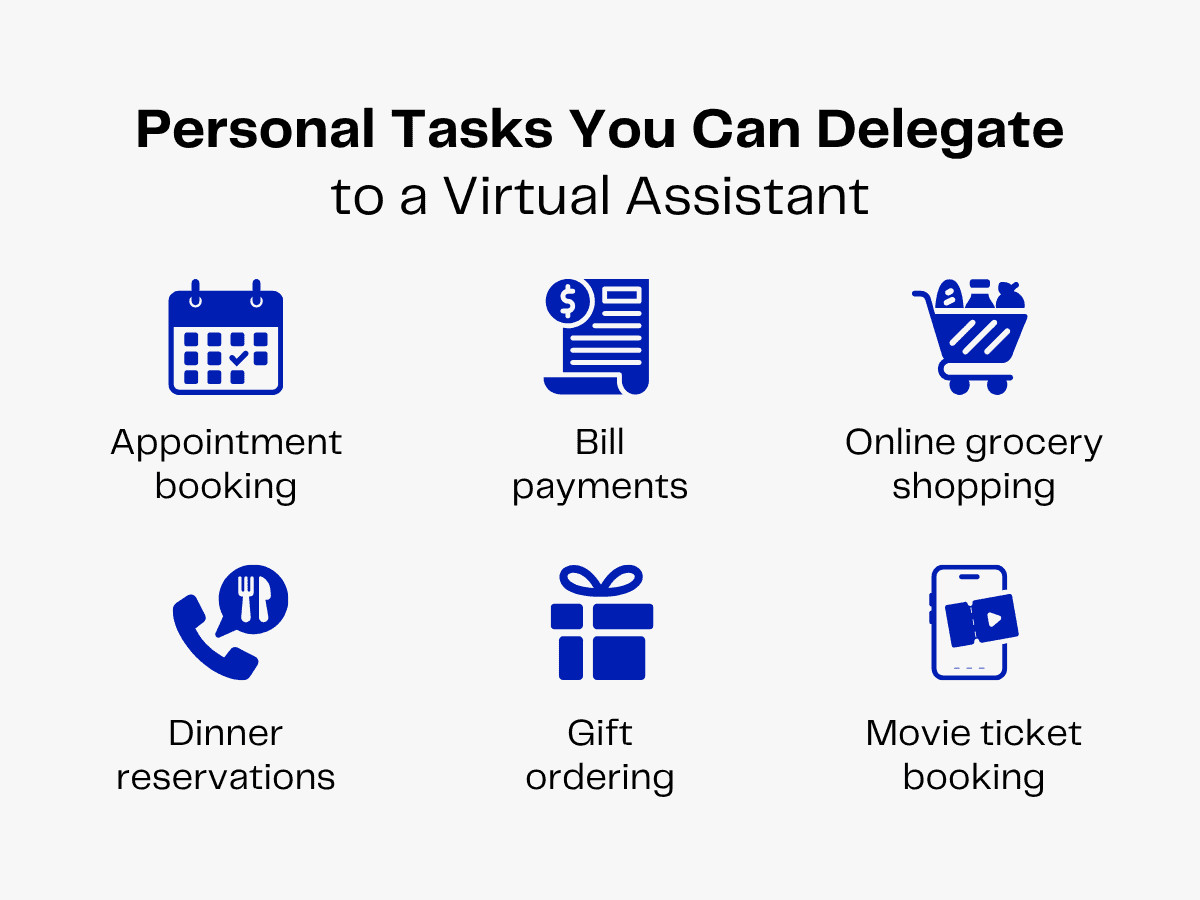
As a business owner, you often juggle a busy life and may not have the time to take care of the smaller personal tasks. Such tasks can be easily delegated to a personal virtual assistant. These tasks include:
- Booking medical visits, salon appointments, fitness classes, etc.
- Tracking due dates and ensuring bills (such as electricity, water, housing or insurance) are paid on time.
- Researching products, comparing prices and placing shopping orders based on your preferences.
- Making dinner reservations for birthdays, family gatherings or personal events.
- Finding thoughtful gifts, placing orders and arranging delivery.
- Booking movie tickets, concert tickets, spa sessions and other entertainment activities.
- Arranging parcel deliveries, home services and repairs.
- Researching holiday destinations, activities and transport under budget.
- Monitoring, renewing or cancelling subscriptions and memberships.
5. Virtual Assistants Support Businesses Across Industries
In every business, there are back-office tasks that must be efficiently handled.
These routine duties distract C-suite executives and core employees from strategic responsibilities. That’s why virtual administrative assistants are employed in various industries.
But VAs can also offer customized support for almost every industry.
For instance, an e-commerce VA responds to product inquiries, updates customers about order status, removes unavailable stock items from product listings and processes refunds. This helps online sellers enhance client relationships, increasing sales on Facebook Marketplace, Amazon and other e-commerce websites.
Real estate VAs post property videos, respond to inquiries and resolve complaints on multiple platforms, including Instagram, LinkedIn and Facebook. This helps increase brand awareness and generate leads.
A hospitality VA can schedule reservations, verify guest data, collect feedback and coordinate service staff for house cleanings.
A healthcare VA handles intake forms, organizes patients’ data into EHR systems and follows up with clients on treatment progress. This way, busy doctors and nurses focus on treatment and develop customized therapy plans, helping patients recover rapidly.
A paralegal VA can organize client and case data, proofread affidavits, monitor case status and create mock deposition questionnaires.
6. The Majority of Virtual Assistants Work in the Private Sector
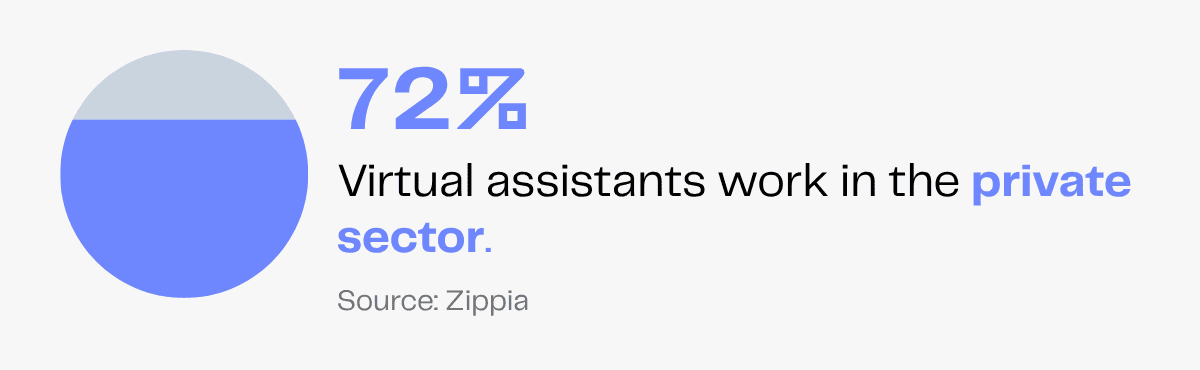
72% of virtual assistants work in the private sector, 18% are employed in the public sector, 5% in education and 4% in government. Among them, the private sector is usually most concerned with revenue growth.
Private businesses hire virtual assistants because of the competitive edge gained via remote employment. Companies reduce overhead costs by hiring overseas VAs from the global talent pool. These professionals add unique viewpoints and rare skills to the workforce.
With help from specialized VAs, private companies boost productivity and efficiency. They also increase savings and reinvest their resources in core business areas for long-term profitability. And hiring VAs is viable and valuable for private enterprises of all sizes.
Essentially, company size is inconsequential for VAs. Whether you have a startup, small business or an enterprise—every business simply needs virtual assistants!
7. Entrepreneurs Are the Top Recruiters of Virtual Assistants
With multiple profiles to choose from at affordable rates, it’s no surprise that virtual assistants are employed the most by entrepreneurs.
This trend isn’t entirely driven by the cost-efficiency of hiring VAs. Startups have unique needs and compete with established businesses. So entrepreneurs hire virtual assistants to increase productivity at a faster pace.
A VA for startups handles vital tasks, such as scheduling meetings, creating pitch decks and organizing lead and client data. This saves entrepreneurs’ time and energy. And that’s what startup owners truly need—time to persuade investors and energy to lead strategic operations!
For example, Trudy Stewart, a broker associate at Keller Williams NW in Tampa, hired a VA. Within the first month, she made her biggest sale. In the following three months, she sold properties worth $4 million! She credits her VA for this great and swift success.
It was magic from the start.
Trudy Stewart, Broker Associate
After my first interview with her, I knew she was the one. There was even an emotional connection.
8. Over Half of Virtual Assistants Have a Bachelor’s Degree
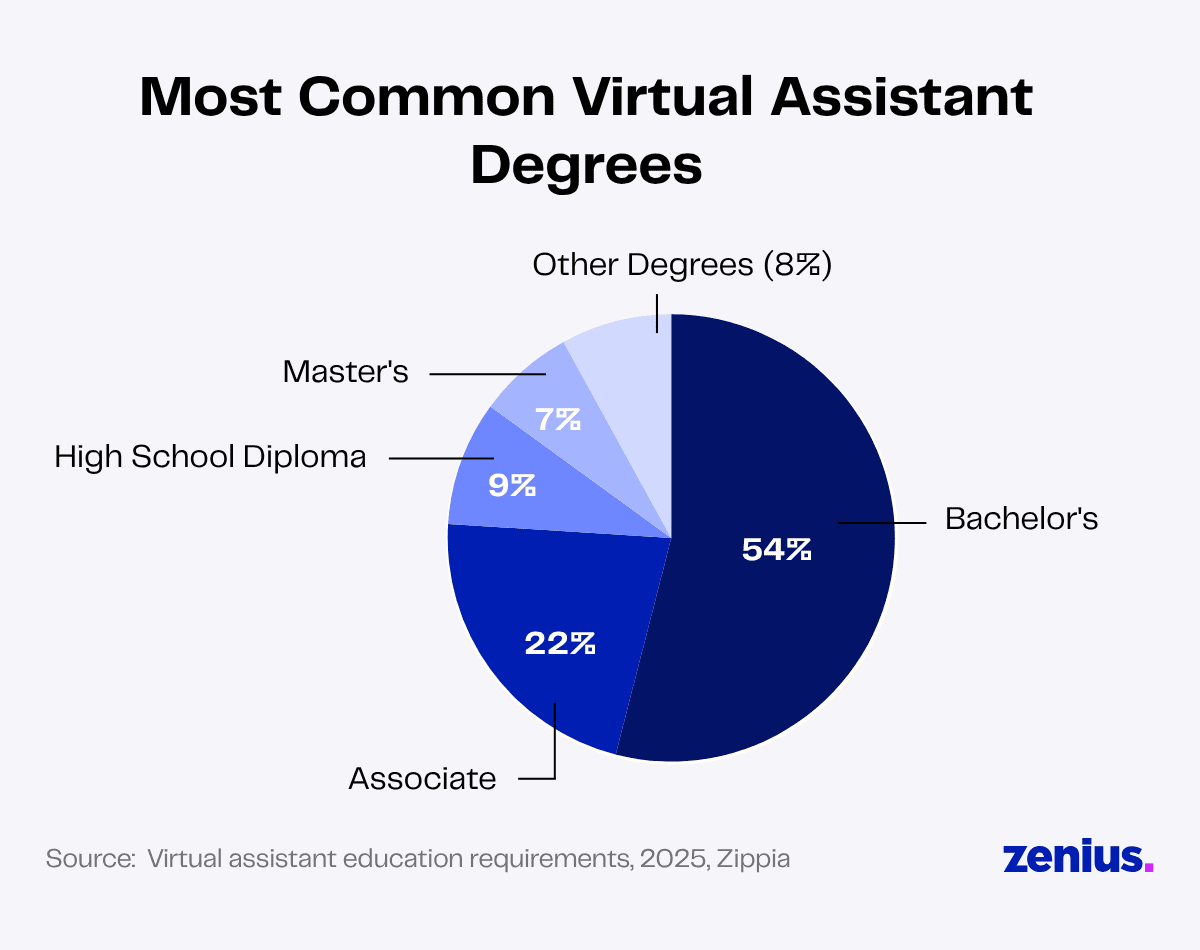
54% of virtual assistants have a bachelor’s degree. The next most popular VA qualification is the associate’s degree (22%), followed by high school diploma (9%) and master’s degree (7%).
As for their education streams, VAs major in:
- Business Education: 30.9%
- Psychology: 10.7%
- Communication: 6.6%
- Accounting: 5.2%
- English: 5.1%
- Marketing: 4.0%
- Healthcare Administration: 3.7%
- Others: 10.3%
Although educational background is important, skills matter more than degrees.
According to ADP’s HR Trends Guide, 94% of companies believe that skill-based hiring is the most effective. And with 87% of businesses worldwide currently reporting or expecting a skill shortage in the next five years, specialists will be sought even more.
When hiring VAs, remember to look for education and experience and, most importantly, test their skills.
You can hire educated, English-proficient and skilled virtual assistants from Zenius. We thoroughly evaluate each candidate on technical and interpersonal skills. You can also assess our pre-vetted VAs by asking them intentional questions. This will ensure you hire the right VA who is organized, adaptable and a problem solver!
9. You Can Turn Time Zone Difference Into a Business Advantage
One of the biggest hidden perks of working with an overseas virtual assistant is the time zone advantage.
Instead of your business coming to a halt overnight, tasks keep moving behind the scenes, extending your business’s working hours without requiring you to stay online.
This follow-the-sun workflow means emails can be answered quicker, reports prepared faster and customer queries handled before you log in for the day.
The result? Fewer pending tasks and faster turnaround times!
Companies like Zenius guarantee a 4-hour work overlap, giving you enough real-time collaboration for meetings, quick discussions, task handover and instant feedback while still benefiting from extended productivity.
10. You Can Hire Virtual Assistants in Three Ways
Hiring virtual assistants is easy. First, you need to set clear expectations and create a comprehensive job description. Then you can recruit virtual assistants using one of the ways listed below.
Job Platforms
You’ll find hundreds of freelancers offering general and specialized services on platforms like LinkedIn and Indeed.
But this process is time-consuming and tiring as you must handle all recruitment steps.
Freelance VAs may also work for multiple clients simultaneously, which can affect their dedication toward your tasks.
Managed Service Providers
These businesses completely take over your internal tasks. They retain a pool of professionals who handle specific duties, such as customer support or accounting.
But by utilizing managed services, you may lose control over the day-to-day activities of business processes.
Virtual Assistant Agencies
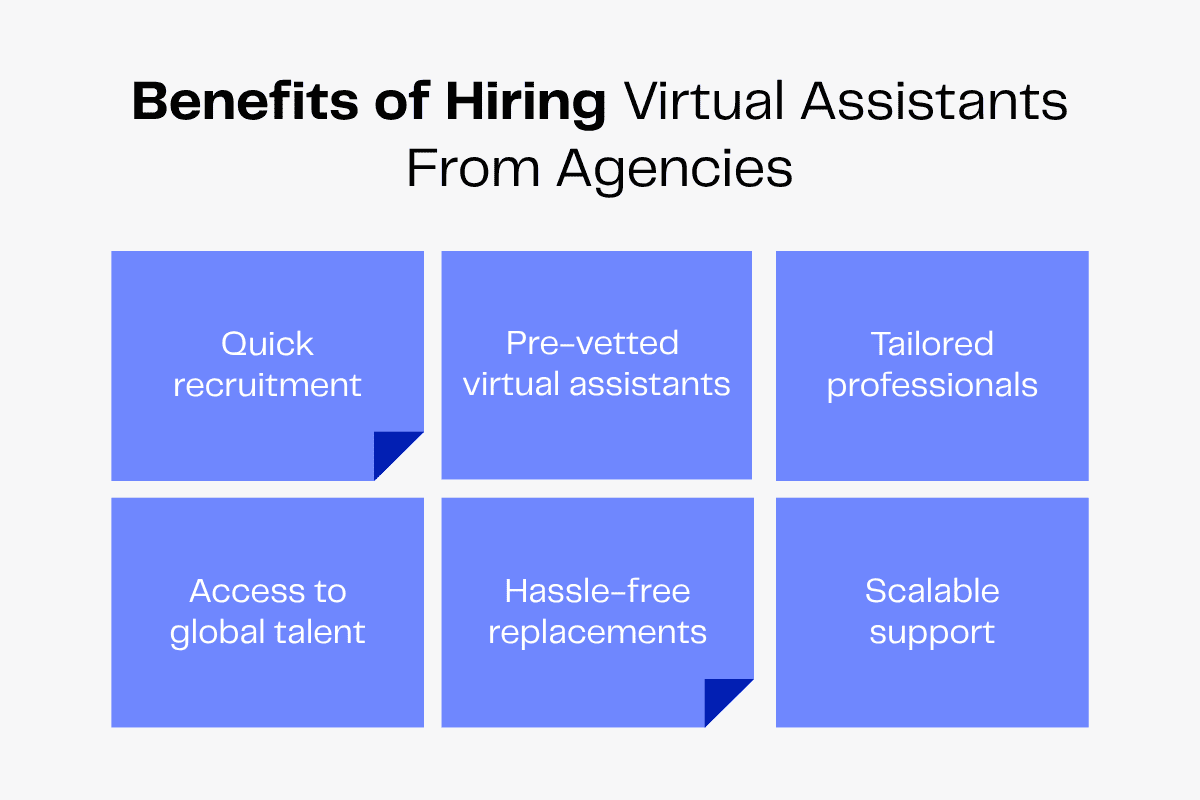
These organizations, including Zenius, match you with skilled virtual assistants and also help businesses build remote teams.
Instead of assigning your tasks to whoever’s available, we search for talent most suited to your requirements. We also handle attendance tracking and daily management of our VAs, giving you flexible control over delegated operations.
Also, the agency is technically the VA’s employer. So you can avoid paying for additional expenses such as insurance and bonuses.
This makes VA agencies the most cost-efficient and hassle-free option for remote recruitment!
Read More: An Ordinary Day in the Life of Extraordinary Virtual Assistants
FAQs
What is a typical day for a virtual assistant?
A virtual assistant’s day typically revolves around planning priorities, staying responsive, managing shifting deadlines, communicating proactively and keeping work moving smoothly.
Who needs virtual assistants the most?
Virtual assistants are best suited for business owners juggling hectic schedules, growing faster than available time, needing extra support or looking to fill skill gaps cost-effectively.
What makes a great virtual assistant?
A great virtual assistant combines industry knowledge, proactive communication, time management, adaptability, reliability and strong problem-solving skills to support businesses.
Final Thoughts
Virtual assistants are far more than remote support—they are affordable, versatile and scalable.
From handling admin tasks to offering creative solutions, they support entrepreneurs and teams across industries.
Add time-zone advantage, global talent access and quick onboarding to this and it’s easy to see why VAs have become a smart way to scale.
Want to redefine how you do business?