Key Takeaways:
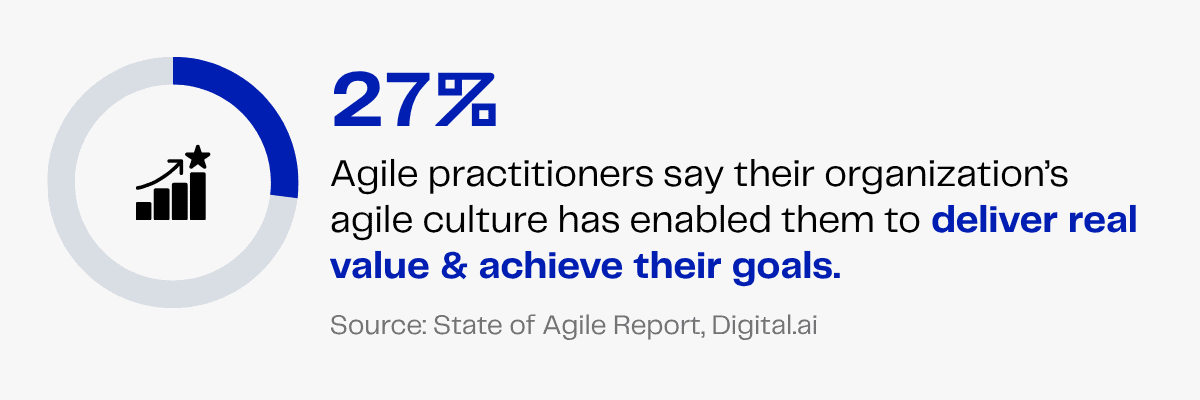
27% of agile practitioners say that their organization’s agile culture has enabled them to deliver real value and achieve their goals.
23% of organizations are already using Scrum frameworks and 29% are using lean principles as part of their agile models.
For over 40% of employees, poor communication reduced trust in both their leaders and team—that’s why agile teams focus on open communication.
With the changing dynamics of modern workspaces and remote work, many companies are hiring virtual teams to delegate numerous tasks. These teams can manage administrative, creative, marketing, financial and many more duties together.
While collocated teams naturally enjoy real-time collaboration, virtual teams need strategic planning and project management techniques to use the virtual environment effectively.
Virtual agile teams will use agile frameworks that will not only create higher employee engagement but also deliver high-quality results in less time.
With more time on their hands, your team will be a powerhouse of creativity and redefine your business processes.
When you onboard a virtual agile team, you onboard innovation!
Agile Virtual Teams: Game-Changing Strategies
A virtual agile team is a small group of professionals with diverse skillsets working together. They work remotely and collaborate digitally to work on the same projects or goals for a business.
These teams use the agile working principles and online collaboration tools to break tasks into phases. Instead of working in stages, the various phases of your work will run in parallel to maximize efficiency.
Agile methodologies are project management practices that help your business get faster and better results. With these flexible approaches, your agile virtual team manages business projects and streamlines the workflow.
In a survey, 27% of agile practitioners said that their organization’s agile culture has enabled them to deliver real value and achieve their goals.
The same survey also found that 23% of organizations are already using Scrum frameworks and 29% are using lean principles as part of their agile models.
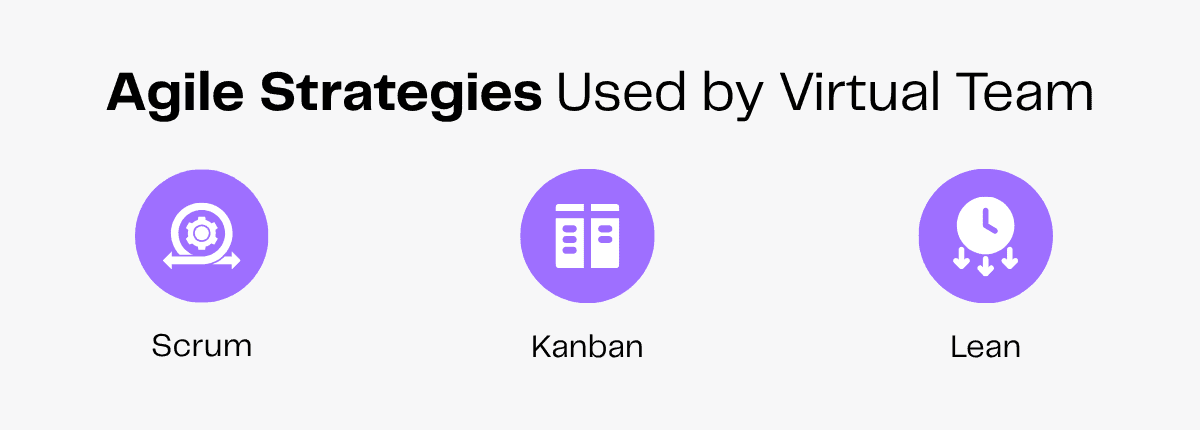
Here are some agile strategies your virtual agile team can follow to accelerate and refine operations.
Scrum
Imagine your team spending months working in silos—planning, executing and testing tasks without proper coordination. By the time they reach the end, they may face sudden market changes.
And they’ll have to work on the process all over again!
Instead of following this slow, tedious approach, your virtual team can apply the Scrum methodology. This is a repetitive, collaborative strategy that helps your virtual team deliver quick results.
Scrum teams will use sprint planning to plan, work on and test the results of a task in quick phases rather than long intervals.
Scrum allows teams to respond to changing plans effectively and measure productivity over time to anticipate future workload.
Chalmers Brown, CTO at Due
Customers are happy because they have a higher probability of getting what they want. Internal teams are happy since they can fix important bugs and push them out the door faster.
Once you’ve assigned a task, your team will use the Scrum strategy by:
- Breaking the task into smaller, manageable sprints.
- Using specific time boxes of 1-4 weeks to complete a task phase, review it and then move on to the next.
- Conducting regular meetings to stay aligned.
- Using real-time feedback loops to review and improve their workflow.
- Adapting to sudden changes in plans.
With achievable goals, your team members will stay focused and productive instead of confused.
If they face any issues with their workflow, they’ll learn from their experience and self-manage to polish it.
Kanban
When a team works in an in-person workspace, they usually craft plans and tasks using written lists, whiteboards or sticky notes.
Similarly, the Kanban approach allows your virtual team to collaborate using visual models. Many digital project management tools have Kanban boards that help your team visualize their workflow.
These boards will help your team view current and completed tasks.
For example, your virtual agile team can create separate backlog, to-do, in-progress and done lists to get a clear picture of their workflow. Based on such Kanban boards, your team can add new tasks according to its capacity for the week or the month.
When your team has a visual board to guide their work, they can keep a limited work-in-progress. They won’t end up multitasking and affecting the quality of work. Instead, they’ll pay dedicated attention to a specific number of tasks and deliver the best results.
The Kanban approach outlines all stages within your team’s workflow, giving them a transparent view to gain insights and make any required changes. They can also track how much work is completed within a week or a month and make better workflow decisions.
With this methodology, your virtual agile team can continuously evolve and perform better.
Lean
The Lean methodology is based on the principle of delivering value to the customer with fewer resources. In the context of virtual teams, this approach identifies and removes waste to create a high-value workflow.
Imagine wasting time on manually sorting files when they can easily set up cloud storage rules and automate the process.
So your team members will be responsible for detecting bottleneck tasks in the workflow that eat up time and eliminating what doesn’t add value. They will focus on quality and speed over non-essential tasks.
Your virtual agile team can apply the lean strategy to streamline working processes by:
- Reducing unnecessary meetings by using tools such as emails or chats for quick updates.
- Automating repetitive tasks using industry-standard tools.
- Creating templates for standardized processes.
- Using centralized communication and project management tools.
- Creating clear deadlines and response expectations to avoid time wastage.
With this strategy, your virtual team will prioritize what’s most important to your business and cut down distractions. Your team will have a smooth-flowing and uninterrupted workflow.
Features of Agile Virtual Teams
Your virtual agile team relies on key behaviors that help them work efficiently. Without these elements, your virtual team will be dysfunctional and counterproductive.
Here’s a list of characteristics that drive team effectiveness and enable your virtual team to deliver high performance to your business.
| Core Features of Virtual Agile Teams | Feature Insights |
|---|---|
| Teamwork | – Sharing responsibilities – Respecting points of view |
| Open communication | – Communicating regularly – Listening actively |
| Adaptability | – Accommodating different working styles – Adapting to a changing market |
Teamwork
It is no surprise that your virtual team must have strong teamworking qualities to coordinate effectively.
In a virtual team, when team members have a range of skills, smooth cross-functional collaboration is important to achieve maximum results.
Your agile virtual team will display teamwork by:
- Working towards a shared goal.
- Tackling complex problems together.
- Complementing each other’s skills.
- Dividing responsibilities and workload equally.
- Creating a safe space for diverse perspectives.
- Taking collective accountability for task completion.
- Sharing tools and resources for collective growth.
- Resolving conflicts professionally.
When a virtual team follows these principles, they create a positive work environment. Work stress doesn’t fall on a few members as the workload is balanced. Each team member feels motivated to work and gives their best effort for the team’s success.
Your virtual agile team will resolve problems together, bring more creative ideas to the table and contribute to the personal growth of each team member.
As a leader, you must lead by example. You can do this by creating a safe space for your team so they feel a sense of belonging at your workplace and perform to their maximum!
Open Communication
Suppose your virtual agile team is working on a complex task. Without constant communication to ensure all members are aligned, the task won’t have a clear direction. Everyone will remain confused, causing multiple errors.
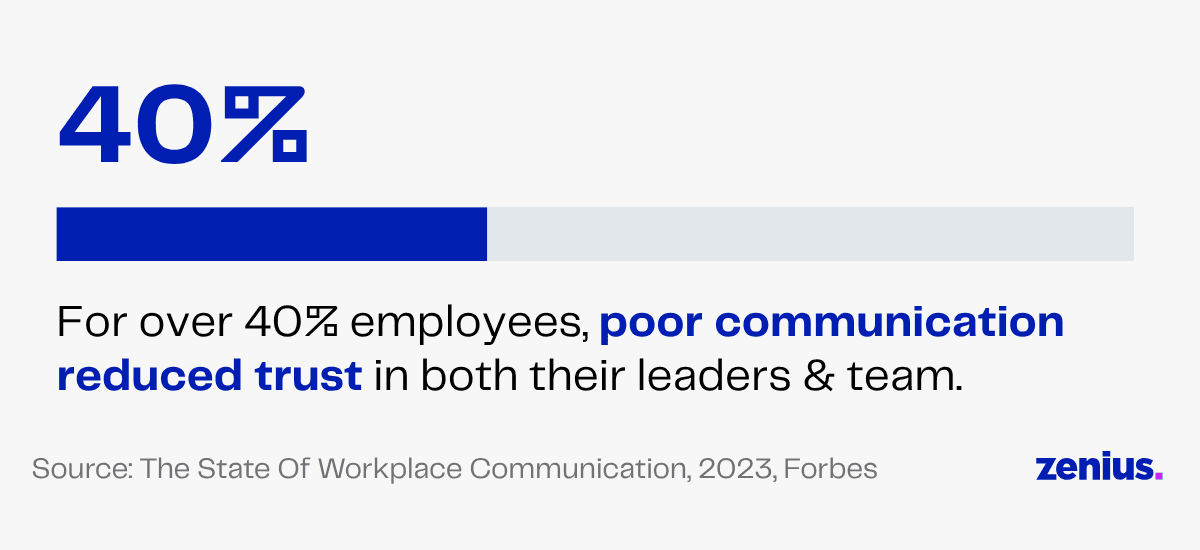
A Forbes survey on The State of Workplace Communication also found that, for over 40% of employees, poor communication reduced trust in both their leaders and team.
To avoid causing delays or reworking on the same task, your virtual agile team ensures that they maintain open communication. When your team communicates transparently, they identify gaps in their work and resolve them faster.
Since your team works virtually, they use both synchronous and asynchronous forms of communication. They’ll collaborate in real-time through virtual meetings to address immediate issues. And they’ll communicate asynchronously to reduce interruptions and maintain individual working pace.
Your virtual agile team will ensure regular and open communication by:
- Using common communication tools and channels.
- Scheduling regular meetings to share ideas, brainstorm, review their progress and give feedback.
- Using agile project management tools to work, edit and comment on projects simultaneously.
- Communicating over texts and emails.
- Listening actively to each other’s ideas and feedback.
- Addressing personal concerns and coming up with solutions.
With clear communication, your virtual agile team will reduce the chances of misunderstandings. This will help all team members to stay engaged and boost trust among them.
Some tips you can follow to facilitate communication among your team members include setting transparent expectations, dividing clear roles and arranging regular team meetings.
Adaptability
Your virtual agile team is dynamic in nature. Each team member will have different working styles, points of view and pace of work. They must learn to adapt to and accommodate each other’s working patterns.
Given the virtual nature of their collaboration, your team must also be ready to adapt to new remote working challenges. For example, they must be quick to learn and integrate new tools and software into their workflow for faster and more effective processes.
The world operations are constantly on the move. No one can predict sudden market changes or fluctuations, so your virtual agile team must be ready to adapt to changes in demand or roles. This will help them strengthen their team while managing crises.
If your virtual agile team has high adaptability skills, they will:
- Face challenges proactively and propose solutions easily.
- Stay productive even during crunch times.
- Bring fresh ideas to tackle different challenges.
- Keep elevating their skills through continuous learning.
- Help your business stay ahead of the competition.
How Agile Virtual Teams Help Your Business
Whether you own a small business or a large enterprise, virtual agile teams can help you work smarter and achieve goals faster.
Their agile nature enables them to adapt quickly to changing priorities while maintaining productivity and collaboration.
Here’s a list of benefits you can expect when working with virtual teams.
Access to Global Talent
When you build a virtual team, you are not restricted to geographical limitations as compared to traditional teams. You won’t have to settle for a limited range of skill sets.
You can hire a global virtual team that gives you access to a wide talent pool.
Especially when you hire through an outsourcing agency, they’ll make sure your virtual team is made up of top talent, has industry-standard skills and is dedicated to their work. They will tailor-make the team to suit your niche and unique demands.
A virtual team will offer fresh insights and innovative ideas so your business can outshine the competition!
Higher Productivity
You don’t want your team to simply log in and log off without contributing to quality work for the day.
Don’t worry—your virtual agile team is trained to make the most of their remote workspace and increase their productivity.
Your virtual team stays productive and provides maximum support to your business by:
- Saving hours and energy on office commuting.
- Ensuring that their workspace is designed for minimal distractions.
- Dividing roles responsibly so everyone’s workload is balanced.
- Using agile methodologies like Scrum, Kanban and Lean to save time and drive faster results.
- Using the best online collaboration tools to improve communication and project management.
- Tracking time and productivity to gain insights and improve.
Cost-Efficiency
When you work with a traditional, in-office team, you have to spend money on renting an office space, stationery, utilities, devices, internet connection and more.
But when you work with a virtual agile team, you save money on overhead costs as they have their own devices, office space and utilities.
Your virtual team needs collaboration tools to work online. Several digital tools offer free versions with basic features. If you are just starting with your business, you can hire a small virtual team and use these free plans to save more money.
Another way to save money is to hire a virtual team through an outsourcing agency like Zenius. When you outsource your team, you don’t spend extra money on recruiting as the agency takes care of the hiring process.
Your savings on overhead, tools and recruitment can be redirected to hiring more members, advanced training, paid software plans or other business investments!
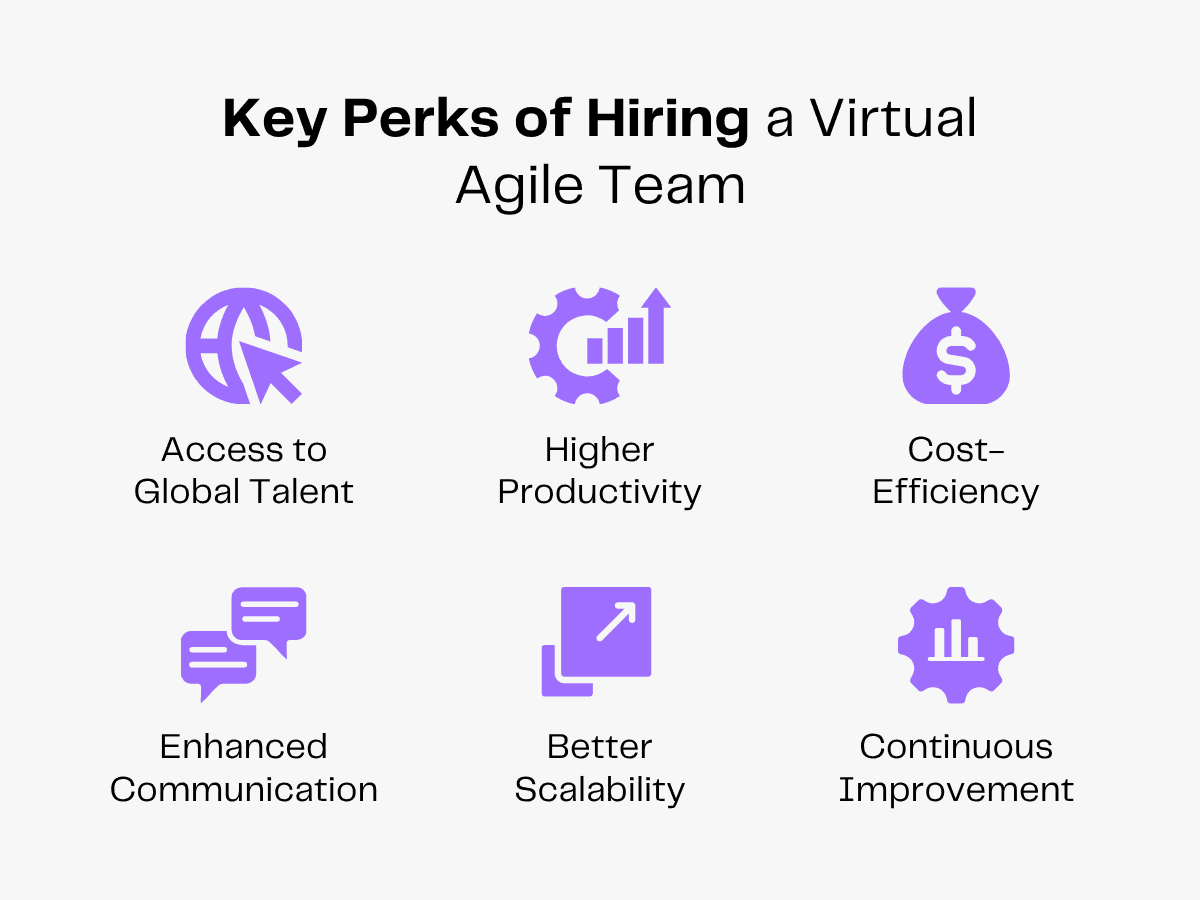
Enhanced Communication
Virtual teams use centralized communication and project management channels. This means all their conversations, brainstorming sessions, digital files and documents are easily accessible to all members.
There is no misalignment between team members. All communication is transparent, so sharing files, collaborating and building trust is easier.
Your virtual members use digital tools to streamline communication so the information flow is more efficient. For example, instead of creating long chains of emails, they’ll coordinate using instant messaging for faster communication.
With project management tools, they can break their team into smaller groups and easily work as cross-functional teams. There will be minimal confusion as such tools will help them view each other’s work and give feedback for seamless coordination.
Enhanced communication helps your team to make faster decisions and find better solutions to problems.
Continuous Improvement
Your virtual team does not stop at using agile methodologies and creating strong workflows. They review these strategies and their effectiveness to gain new insights.
Once they understand what patterns work best for their team, they try to leverage them more effectively. And if some strategies don’t fit into their workflow, they either try to improve or find new solutions. They will come up with creative ways to be more efficient.
Your team has to constantly adapt to new market situations, your business demands and each other’s working styles. This helps each team member to stay on their toes and continuously better themselves.
Working in a team and sharing knowledge and resources helps each member learn more and upskill. An agile virtual team environment promotes progress in team members, which helps to strengthen your overall business.
Better Scalability
Your virtual agile team offers high productivity, improves communication and saves you costs. With the same team, you enjoy several benefits that help you grow your business.
You can reinvest the saved costs and resources into your business and expand it. You’ll be able to hire more talent on your team or hire multiple virtual teams across departments. You’ll access quality work across different sections without spending huge amounts of money.
Your virtual team helps you scale your business to new heights and make profits!
Read More: 11 Top Advantages of Virtual Teams for Your Business
How To Manage Your Virtual Agile Team
You must learn how to manage a virtual team after you’ve formed one.
Here are some suggestions you can follow to easily deal with a virtual agile team.
Define Project Goals
Your virtual team must know your expectations so they are not confused about their roles.
To do this, you must:
- Establish company norms and values in the beginning.
- State task objectives that are easy to understand.
- Give clear, achievable deadlines.
- Set up communication channels, file-sharing tools and project management tools.
- Ensure each team member takes responsibility for their individual tasks.
Build Rapport With Team Members
Without regular face-to-face communication, building trust and meaningful connections with team members requires intentional efforts.
If you build a good rapport with them, it will improve collaboration and boost their morale.
You can do this by:
- Creating a positive space for open communication.
- Interacting through meetings or chats to build connections.
- Organizing virtual team building exercises.
- Appreciating the efforts of your team members.
- Being accessible for questions and inputs from your team.
- Managing conflicts in your virtual team with patience.
| Situation | Do This | Not This |
|---|---|---|
| Daily communication | Encourage regular updates | Withhold information |
| Missed deadline | Reprioritize tasks | Publicly blame members |
| Employee Morale | Recognize contributions | Criticize constantly |
| Task confusion | Clarify roles | Give vague instructions |
| Team conflicts | Mediate professionally | Show favoritism |
Give Regular Feedback
Sharing honest feedback will help your virtual team measure their growth and work on improvements. This includes:
- Setting up regular check-ins to track progress.
- Sharing prompt feedback to keep it relevant.
- Balancing positive and constructive comments to recognize good work and enhance team performance.
- Recognizing both individual and team impact.
- Using a polite tone instead of a harsh, overly critical tone.
- Offering advice and using examples to help your team.
- Encouraging your team to share feedback as well.
Your Agile Virtual Team’s Toolkit
Agile virtual teams thrive on collaboration tools that keep ideas, tasks and people connected in real time.
Here’s a list of top-tier digital tools they can use for seamless planning and task execution.
Communication Tools
- Zoom
- Google Meet
- Microsoft Teams
Project Management Tools
- Asana
- Trello
- ClickUp
File Sharing Tools
- Google Drive
- OneDrive
- Dropbox
Key Skills To Look For in Virtual Agile Teams
To build a competent virtual agile team, you should look for qualities that equip them to collaborate easily.
Here are some essential skills your virtual team can’t do without.
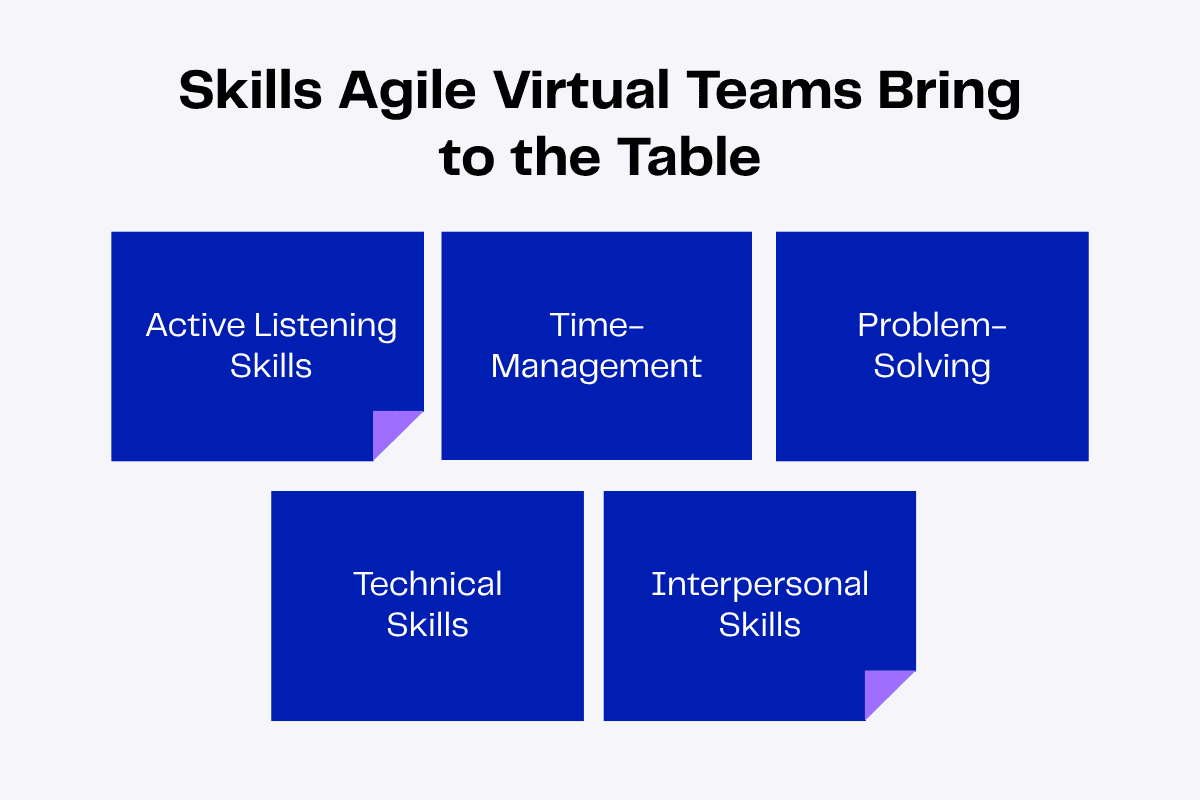
Active Listening Skills
Your team members work together to deliver the desired results. This means that every member will have different ideas and opinions. Speaking over each other will not help your team reach a consensus.
Team members must have listening skills to respect each other’s points of view. They should acknowledge each speaker and use nonverbal cues, such as nodding or sending emoji reactions, in meetings.
If each member actively pays attention, asks questions and gives feedback, the group will promote healthy discussions that lead to better decisions.
A virtual agile team that makes every teammate feel heard and valued will automatically enhance collaboration.
Time-Management
Your virtual team must be excellent at managing time to provide quality service in less time. They must plan and organize their workday to increase focus and productivity.
Your virtual team displays strong time-management skills by:
- Setting achievable goals for the week or month.
- Avoiding multitasking but planning their workday ahead of time.
- Implementing time-coordination tactics, such as sprint planning and asynchronous handoff, to make the most of time.
- Being punctual in meetings to value each other’s time and prevent time waste.
- Completing their share of work on time.
- Prioritizing critical tasks.
- Avoiding leaving urgent things to the last minute.
- Using time-tracking and productivity tools.
Problem-Solving Skills
You can’t expect every business task to run smoothly. But during challenging times, you must be able to depend on your virtual team for maximum assistance. They must have top-notch problem-solving skills so they find solid solutions effortlessly.
A virtual team displays problem-solving skills by:
- Showing resilience during setbacks.
- Identifying issues in tasks or working styles.
- Leveraging each member’s strengths during crunch times.
- Adapting to complex situations and changing priorities.
- Using time, resources and skills efficiently during complex situations.
- Finding long-term solutions together.
- Giving and being open to receiving constructive feedback.
- Resolving conflicts with patience and professionalism.
Technical Skills
All your virtual team’s work is digital. If they are inefficient with technology, they’ll slow down all tasks unnecessarily. So they must be tech-savvy and proficient in using online tools and software.
When assessing technical skills in your virtual team, you must ensure they:
- Collaborate through industry-standard tools like Zoom for faster and seamless communication.
- Use cloud-based platforms like Google Workspace to share and collaborate on digital files simultaneously.
- Navigate project management tools to assign and report on tasks.
- Use brainstorming tools like a virtual whiteboard for real-time collaboration.
- Have fast typing skills and digital communication etiquette.
- Learn and adapt to new technologies.
- Follow best cybersecurity practices to maintain privacy.
Interpersonal Skills
While tools enable collaboration, interpersonal skills make it effective!
Your team will be able to give their best only when they respect each other and work in collaboration.
When building a collaborative virtual team, don’t ignore key interpersonal skills, such as:
- Teamwork skills so that every member can rely on each other.
- Cooperation while working with a diverse team.
- Empathy towards each other during challenging situations.
- Professionalism, which includes respecting each other’s time and opinions.
- Approachable body language during meetings.
- Proactive approach to solving problems.
- Positive attitude during difficult situations.
- Flexibility to adapt to new situations and changes in working styles.
Final Thoughts
Agile virtual teams combine flexibility, collaboration and adaptability to help businesses achieve goals more efficiently.
With the right people, skills, processes and tools in place, such teams can respond quickly to market changes, maintain high productivity and deliver consistent results.
As remote work continues to evolve, agile teams are becoming a valuable asset for businesses seeking growth and innovation.
But building a virtual agile team from scratch may seem daunting. It can be time-consuming and expensive to take over all the recruitment hassle by yourself.
Why worry when Zenius can help you build ready-made teams with in-demand skills. With us, you’ll enjoy benefits like affordable pricing and no payroll, overhead or day-to-day HR management hassles.